Naxal-Affected Gadchiroli to Establish District Mining Authority
Source:Indian Express ↗
Why It Matters
This development provides an excellent case study for Mains GS-3 on how state governments are using economic development, resource monetization, and industrialization as tools to counter Left-Wing Extremism in affected districts. It is also highly relevant for Prelims GS-1 regarding the geographic distribution of minerals (iron ore, limestone, diamonds) and the regulatory framework for minor and major minerals.
Summary
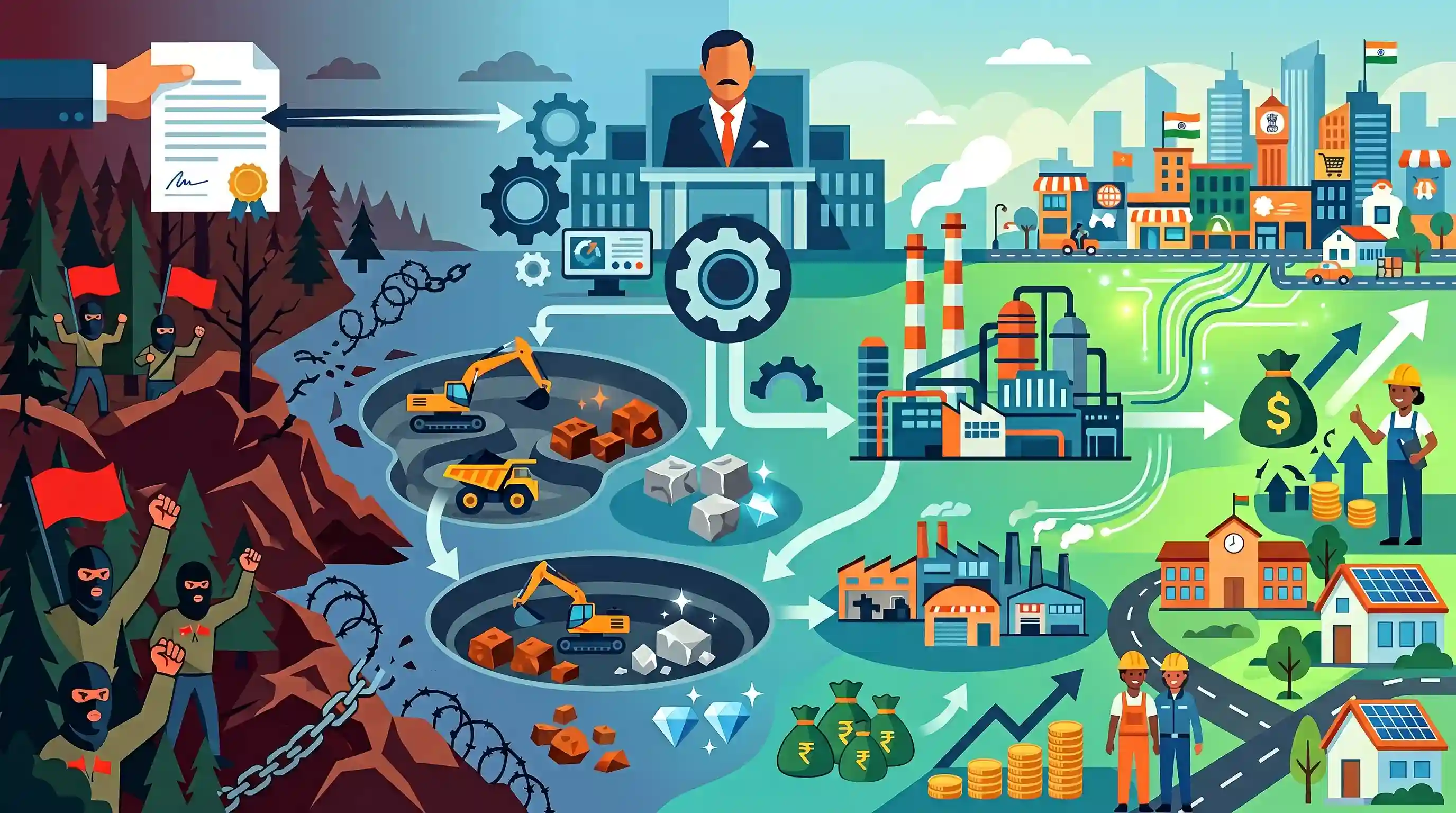
Maharashtra has announced the formation of the Gadchiroli District Mining Authority, headed by the Chief Minister, to oversee the extraction and management of major and minor minerals in the Naxal-affected region. By regulating resources like iron ore, limestone, and diamonds under the MMDR Act, the state aims to attract ultra-mega projects and MSMEs. This economic initiative is designed to drive local development, generate employment, and serve as a counter-insurgency tool to weaken Left-Wing Extremism (LWE) by integrating the region into the mainstream economy.
Key Points
- The Maharashtra cabinet approved the establishment of the Gadchiroli District Mining Authority, chaired by the Chief Minister, to manage the district's abundant mineral resources.
- Gadchiroli has significant reserves of iron ore (Surjagad, Bhamragad), limestone (Devalmali, Katepalli), and diamonds (Wairagad).
- The authority will operate under the MMDR Act and aims to foster an industrial environment for MSMEs and ultra-mega projects in the region.
- The initiative is framed as a strategic move to spur socio-economic development and counter Left-Wing Extremism (Naxalism) in the heavily affected district.
- A portion of the royalties and premiums generated will be dedicated to funding local infrastructure and development projects.
Important Terms
Mines and Minerals (Development and Regulation) Act, 1957

The primary central legislation governing the mining sector in India, regulating the grant of prospecting licenses and mining leases for all minerals except petroleum and natural gas.
UPSC context
GS Paper II & III: Governance and Resource Management; essential for understanding center-state relations in mineral administration.
Gadchiroli District Mining Authority
A unified 16-member body chaired by the Maharashtra Chief Minister, established to fast-track mining approvals and industrialize the Naxal-affected Gadchiroli district.
UPSC context
GS Paper III: Internal Security; a strategic administrative intervention to counter LWE through development and resource management.
Major and Minor Minerals
Broad classification under the MMDR Act; major minerals (e.g., iron ore, coal) are centrally regulated, while minor minerals (e.g., sand, gravel) fall under state jurisdiction.
UPSC context
GS Paper III: Economic Development/Geography; significant for federal structure and local revenue generation questions.
Maharashtra Minor Mineral Extraction (Development and Regulation) Rules, 2013
State-specific regulations framed under the MMDR Act that govern the granting of quarry leases, prospecting operations, and royalty collection for minor minerals in Maharashtra.
UPSC context
GS Paper II: State Governance; specifically tests knowledge of delegated legislation and state powers over natural resources.
Maharashtra State Mining Corporation (MSMC)
A state-owned entity responsible for the systematic exploration, excavation, and development of mineral resources to cater to Maharashtra's industrial needs.
UPSC context
GS Paper III: Infrastructure/Industrial Policy; relevant for Public Sector Undertakings (PSUs) role in regional economic integration.
Left-Wing Extremism (LWE)
A socio-political and security challenge (Maoism) targeting state authority, which the government aims to weaken in Gadchiroli through mineral-based economic development and employment.
UPSC context
GS Paper III: Internal Security; core topic regarding challenges to domestic peace and the "development-security" nexus.
Prelims Trap
"District Mineral Foundations (DMFs) are statutory bodies chaired by the state's Chief Minister."
DMFs are statutory trusts typically headed by the District Magistrate/Collector. The new Gadchiroli Mining Authority is a distinct state-specific executive body, not a replacement for the DMF.
Static Concepts Connected
How is the extraction of major and minor minerals regulated in India?
- Major Minerals: States grant concessions, but prior approval of the Central Government is required for specific minerals listed in the First Schedule of the MMDR Act.
- Minor Minerals: State Governments have exclusive rule-making powers for granting concessions and preventing illegal mining of minor minerals (e.g., building stones, sand, gravel).
- Offshore Minerals: Minerals extracted from the territorial waters, continental shelf, and the Exclusive Economic Zone (EEZ) belong exclusively to the Union Government.
What statutory frameworks support communities affected by mining operations?
- District Mineral Foundation (DMF): A non-profit statutory trust mandated in every mining district under the MMDR (Amendment) Act, 2015 to safeguard the interests of affected populations.
- PMKKKY Scheme: A central scheme implemented by DMFs, utilizing mining royalties to fund local infrastructure, healthcare, education, and environmental conservation.
- Mandatory Contributions: Statutory provisions require leaseholders to contribute a fixed percentage of their royalty to the DMF, ensuring direct local benefits from resource extraction.
Cross-Topic Patterns
LWE Economics & Resource Extortion
Historically, unregulated mining and forest produce trade in regions like Gadchiroli provided extortion revenue to Naxals. State-backed industrialization and formal authorities aim to disrupt this shadow economy.
PESA, FRA & Mining Clearances
Gadchiroli has a high density of Gram Sabhas holding Community Forest Rights. Mining mega-projects here frequently test the friction between economic development and tribal consent under PESA and FRA.

Expect a GS-3 Mains question linking mineral extraction in Schedule V areas to LWE mitigation, balancing industrialization with tribal rights.
Linked PYQs · 5
Linked PYQs · 5
- 2019PrelimsGS1
With reference to the management of minor minerals in India, consider the following statements: 1. Sand is a 'minor mineral' according to the prevailing law in the country. 2. State Governments have the power to grant mining leases of minor minerals, but the powers regarding the formation of rules related to the grant of minor minerals lie with the Central Government. 3. State Governments have the power to frame rules to prevent illegal mining of minor minerals. Which of the statements given above is/are correct?
- 2025PrelimsGS1
Consider the following statements : Statement I: In India, State Governments have no power for making rules for grant of concessions in respect of extraction of minor minerals even though such minerals are located in their territories. Statement II: In India, the Central Government has the power to notify minor minerals under the relevant law. Which one of the following is correct in respect of the above statements?
- 2022MainsGS3
Naxalism is a social, economic and developmental issue manifesting as a violent internal security threat. In this context, discuss the emerging issues and suggest a multilayered strategy to tackle the menace of Naxalism.
- 2018MainsGS3
Left Wing Extremism (LWE) is showing a downward trend, but still affects many parts of the country. Briefly explain the Government of India's approach to counter the challenges posed by LWE.
- 2025PrelimsGS1
Consider the following statements : Statement I: Studies indicate that carbon dioxide emissions from cement industry account for more than 5% of global carbon emissions. Statement II: Silica-bearing clay is mixed with limestone while manufacturing cement. Statement III : Limestone is converted into lime during clinker production for cement manufacturing. Which one of the following is correct in respect of the above statements?
