Maharashtra passes bill allowing dual role for municipal presidents
Source:Indian Express ↗
Why It Matters
Dual membership and direct election of municipal presidents impact the functioning of Urban Local Bodies (Part IXA) and the principle of democratic decentralization. This legislation touches upon constitutional questions regarding the concentration of power at the grassroots level, as well as the procedural aspects of replacing ordinances with legislative bills by state legislatures.
Summary
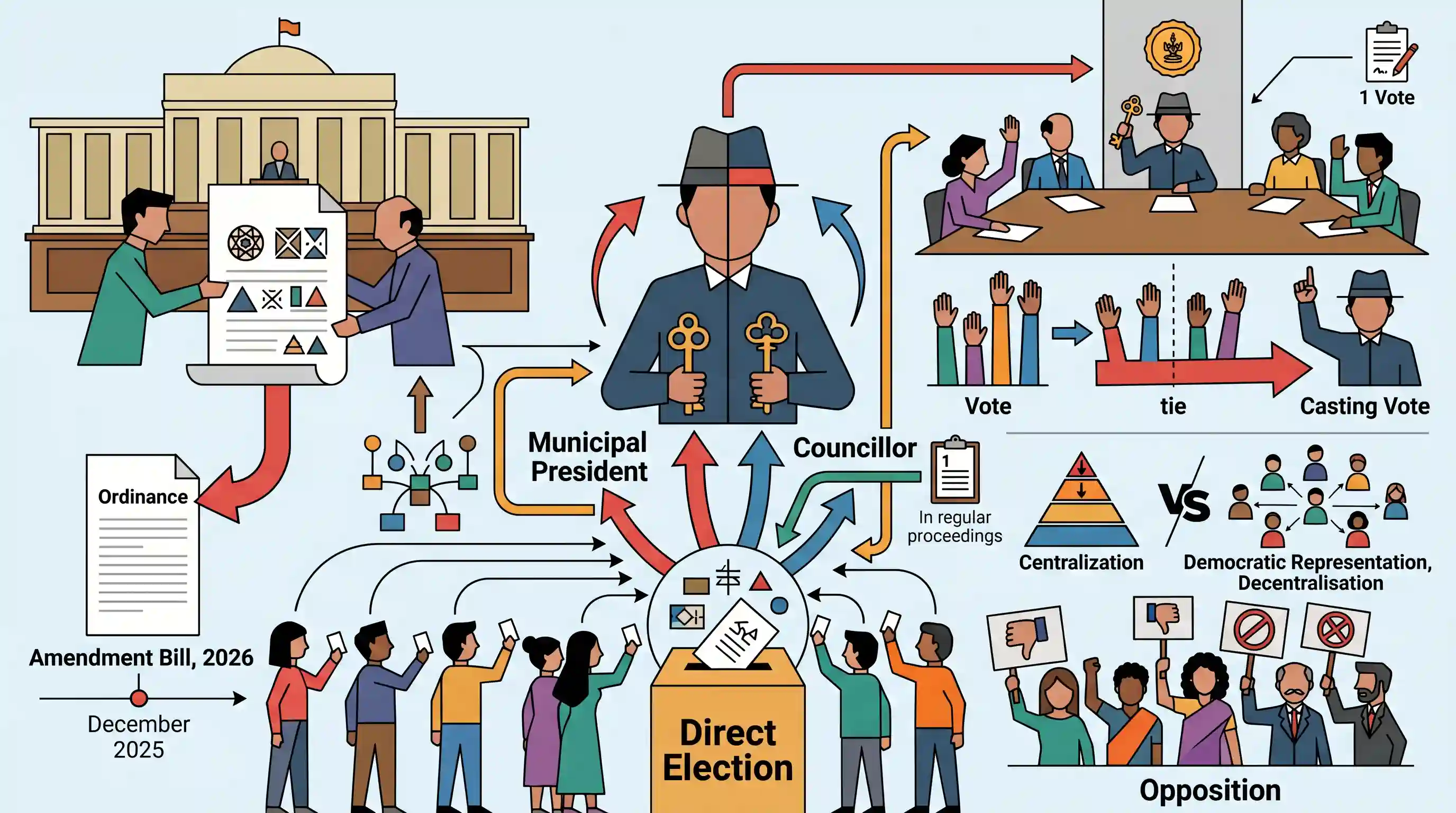
The Maharashtra Legislative Council passed the Maharashtra Municipal Councils, Nagar Panchayats and Industrial Townships Amendment Bill, 2026, allowing municipal presidents to concurrently hold the position of a councillor. Under the amendment, municipal presidents are directly elected by voters, and individuals can contest and hold both the president and councillor posts simultaneously. However, such individuals will have only one vote during council proceedings, with the president retaining a casting vote in case of a tie. The Bill replaces an ordinance issued in December 2025. Opposition members strongly opposed the legislation, alleging it centralizes power and stifles democratic representation at the local level.
Key Points
- The Maharashtra Legislative Council passed a bill allowing presidents of municipal councils, nagar panchayats, and industrial townships to also serve as councillors concurrently.
- The legislation enables presidents to be directly elected by voters and permits individuals to contest both posts simultaneously.
- A person holding both posts will possess only one regular vote in the council, but the president retains a casting vote in the event of a tie.
- The Bill formalizes an ordinance that was previously promulgated in December 2025.
- Opposition leaders criticized the bill as a tool for power concentration and a move that undermines democratic principles at the grassroots level.
Important Terms
Maharashtra Municipal Councils, Nagar Panchayats and Industrial Townships Amendment Bill, 2026

State legislation allowing directly elected municipal presidents to simultaneously serve as councillors, consolidating local leadership while centralizing certain powers within urban local bodies.
UPSC context
GS-II (Local Governance); relevant for analyzing urban governance models and the debate over centralization versus grassroots decentralization.
Maharashtra Legislative Council
The upper house of Maharashtra’s bicameral legislature (Vidhan Parishad), which provides a second layer of scrutiny for bills and represents interest groups like local bodies.
UPSC context
GS-II (State Legislature); tests knowledge of bicameralism, composition under Article 171, and the legislative process.
74th Constitutional Amendment Act
The 1992 Act that granted constitutional status to urban local bodies, introducing Part IXA and the 12th Schedule to ensure decentralized urban governance.
UPSC context
GS-II (Governance); foundational for understanding the constitutional framework and devolution of powers to urban municipalities.
Nagar Panchayats
A transitional urban local body for areas shifting from rural to urban, mandated under the 74th Amendment Act based on specific population and economic criteria.
UPSC context
GS-II (Local Self-Government); essential for understanding the tiered urban administrative structure and transitional governance classifications.
Ordinance-making Power
The power under Article 213 allowing the Governor to promulgate laws when the state legislature is not in session, having the same force as an Act.
UPSC context
GS-II (Executive); tests understanding of executive-legislative relations and the temporary nature of laws made by the Governor.
Casting Vote
A decisive, tie-breaking vote exercised by the presiding officer of a legislative or municipal body only when votes on a motion are equally divided.
UPSC context
GS-II (Legislative Procedure); tests knowledge of the procedural powers and the neutral role of presiding officers in democratic bodies.
Prelims Trap
The 74th Constitutional Amendment Act mandates direct elections for the President or Chairperson of a municipality.
The 74th Amendment leaves the manner of election of a Municipality Chairperson entirely to the state legislature. It does not mandate direct or indirect elections, unlike the strict rules for higher-tier Panchayats.
Static Concepts Connected
How does the election of a Municipality Chairperson differ from a Panchayat Chairperson?
- Panchayats: Intermediate and district level chairpersons must be elected indirectly. Village panchayat chairperson election methods are decided by the state.
- Municipalities: The 74th Amendment leaves the manner of election of the chairperson entirely to the discretion of the state legislature.
What constitutes an Industrial Township under Article 243Q of the Constitution?
- Governor's Discretion: The Governor can exempt an urban area from forming a regular municipality via public notification.
- Provision of Services: This exemption applies if municipal services are already being adequately provided by an industrial establishment in that area.
Cross-Topic Patterns
Asymmetry in Local Governance
Wide state discretion regarding ULB mayoral/presidential elections creates significant variations across India, contrasting with the structural uniformity intended by the 73rd and 74th Constitutional Amendment Acts.
Governor's Ordinance Making Power
This bill replacing a December ordinance highlights Article 213. UPSC frequently tests the constitutional timeline (six weeks from reassembly) and conditions for promulgating state ordinances.

Expect a comparative Prelims statement contrasting state discretion in electing ULB chairpersons vs mandated indirect Panchayat elections.
Linked PYQs · 5
Linked PYQs · 5
- 2024MainsGS2
Analyse the role of local bodies in providing good governance at local level and bring out the pros and cons merging the rural local bodies with the urban local bodies.
- 2023MainsGS2
“The states in India seem reluctant to empower urban local bodies both functionally as well as financially.” Comment.
- 2022MainsGS2
Discuss the essential conditions for exercise of the legislative powers by the Governor. Discuss the legality of re-promulgation of ordinances by the Governor without placing them before the Legislature.
- 2017PrelimsGS1
Local self-government can be best explained as an exercise in
- 2024PrelimsGS1
Which of the following statements are correct about the Constitution of India? 1. Powers of the Municipalities are given in Part IX A of the Constitution. 2. Emergency provisions are given in Part XVIII of the Constitution. 3. Provisions related to the amendment of the Constitution are given in Part XX of the Constitution. Select the answer using the code given below :
