Maharashtra adopts measures against El Nino monsoon disruptions
Source:pressroom-icrisat ↗
Why It Matters
Highlights proactive state-level adaptation planning and agricultural resilience against climate variability (El Nino) in dryland regions.
Summary
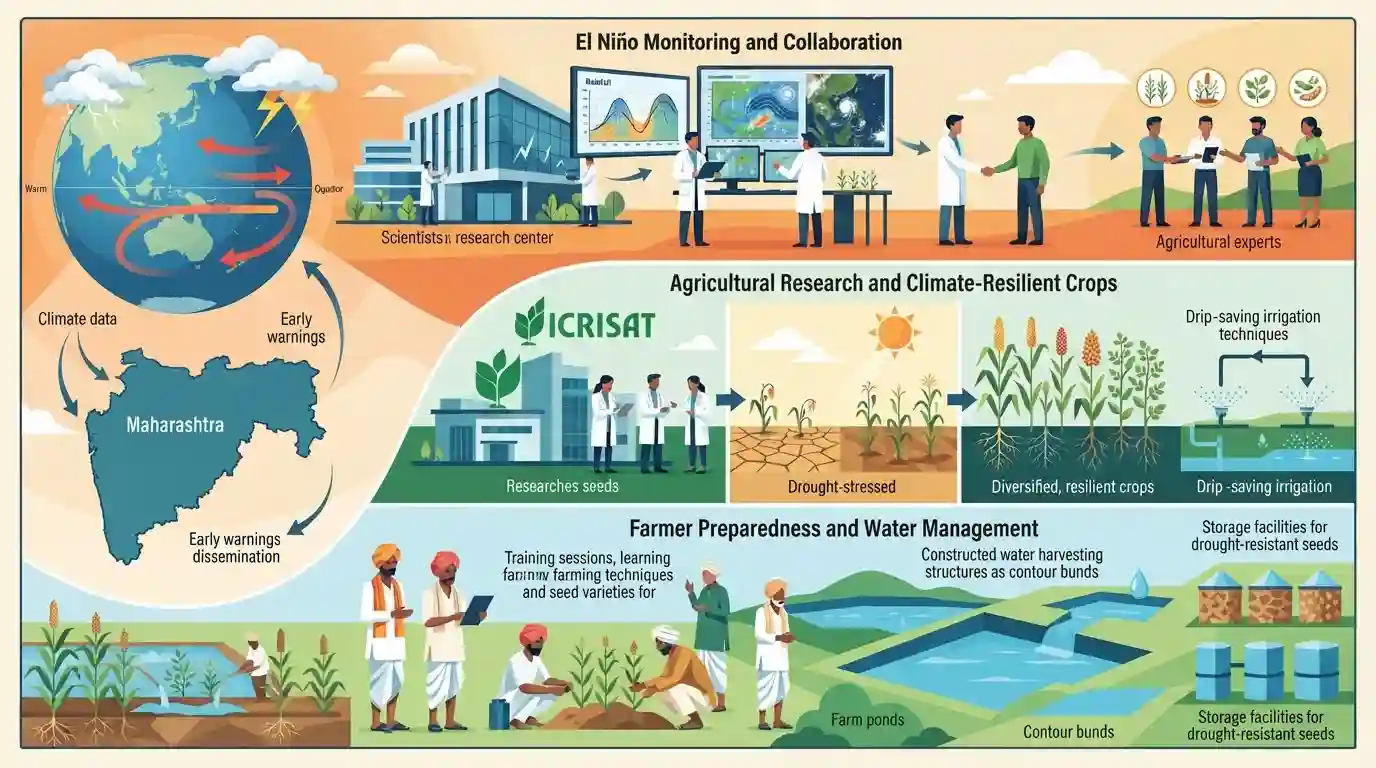
Maharashtra has initiated early proactive measures in collaboration with agricultural research organizations like ICRISAT to mitigate potential drought and monsoon disruptions driven by El Niño, focusing on climate-resilient crops and farmer preparedness.
Key Points
- Maharashtra has taken early preemptive measures to tackle potential monsoon disruptions caused by El Niño weather patterns.
- Collaboration with institutions like ICRISAT focuses on promoting climate-resilient agriculture, drought-tolerant crop varieties, and efficient water management strategies for dryland farming.
- The initiative emphasizes strengthening farmers' preparedness against climate shocks, delayed rainfall, and dry spells during the Kharif season.
Important Terms
ICRISAT

An international agricultural research organization focused on developing sustainable and climate-resilient crop varieties and farming practices for semi-arid tropical regions.
UPSC context
MPSC Geography & Agriculture: Tests knowledge of international research institutions partnering with Indian states for dryland agriculture and drought management.
El Nino
A climate phenomenon involving the warming of surface waters in the central and eastern Pacific Ocean, frequently causing deficient rainfall and drought conditions during the Indian monsoon.
UPSC context
MPSC Climatology & Geography: Tests understanding of ocean-atmosphere phenomena impacting Indian monsoon patterns and regional agriculture.
Prelims Trap
ICRISAT is a specialized research institute established directly under the Ministry of Agriculture, Government of India.
Aspirants often assume ICRISAT is a purely Indian governmental body, but it is an international agricultural research organization under the CGIAR consortium.
Static Concepts Connected
What is El Niño and what are its primary impacts on the Indian Summer Monsoon?
- Phenomenon:: Abnormal warming of surface waters in the central and eastern tropical Pacific Ocean, suppressing Indian monsoon rainfall.
- Monsoon Impact:: Leads to delayed onset, prolonged dry spells, or deficient rainfall during the Kharif season across peninsular India.
- Regional Effect:: Significantly impacts rain-fed agricultural regions, particularly in central and western India like Maharashtra's Vidarbha and Marathwada.
What is the role and headquarters of ICRISAT in agricultural research?
- Mandate:: International Crops Research Institute for the Semi-Arid Tropics, conducting agricultural research for development.
- Headquarters:: Headquartered in Patancheru, Hyderabad, Telangana, with regional centers across Asia and sub-Saharan Africa.
- Key Crops:: Focuses on resilient crops like sorghum, pearl millet, pigeonpea, chickpea, and groundnut for dryland farming.
Cross-Topic Patterns
El Niño impact on Kharif crop planning
El Niño agricultural preparedness directly links climate science (IMD/ENSO mechanisms) with state-level disaster management (drought mitigation codes) and agrarian welfare.
International agricultural research in state planning
ICRISAT partnerships highlight the integration of global agricultural research (CGIAR network) into regional drought-prone district planning in Maharashtra.

El Niño + ICRISAT collaboration likely to feature in multi-statement questions on Maharashtra's climate adaptation strategies.
Linked PYQs · 2
Linked PYQs · 2
- 2025MPSC_PRELIMSGS1
_______ Monsoon winds blow in Maharashtra from June to September.
- 2024MPSC_PRELIMSGS1
Identify the correct statements regarding the Chief Minister Solar Agricultural Channel Scheme. (a) This Scheme was started in June 2017, when Devendra Fadanvis was Chief Minister. (b) The main purpose of this Scheme is to provide supply of electricity to farmers through the agricultural feeder. (c) The government has decided to pay ₹ 50,000 per acre as rent to the farmers under this Scheme. (d) Solar panels are set up on government land up to ten kilometres from the 33 kV substation.
