Maharashtra Commercial Drivers Marathi Language Mandate
Source:indiatoday ↗
Why It Matters
State policies enforcing regional languages in licensing and public services are crucial topics in MPSC exams, linking regional administrative governance with Constitutional provisions regarding linguistic promotion and minority safeguards.
Summary
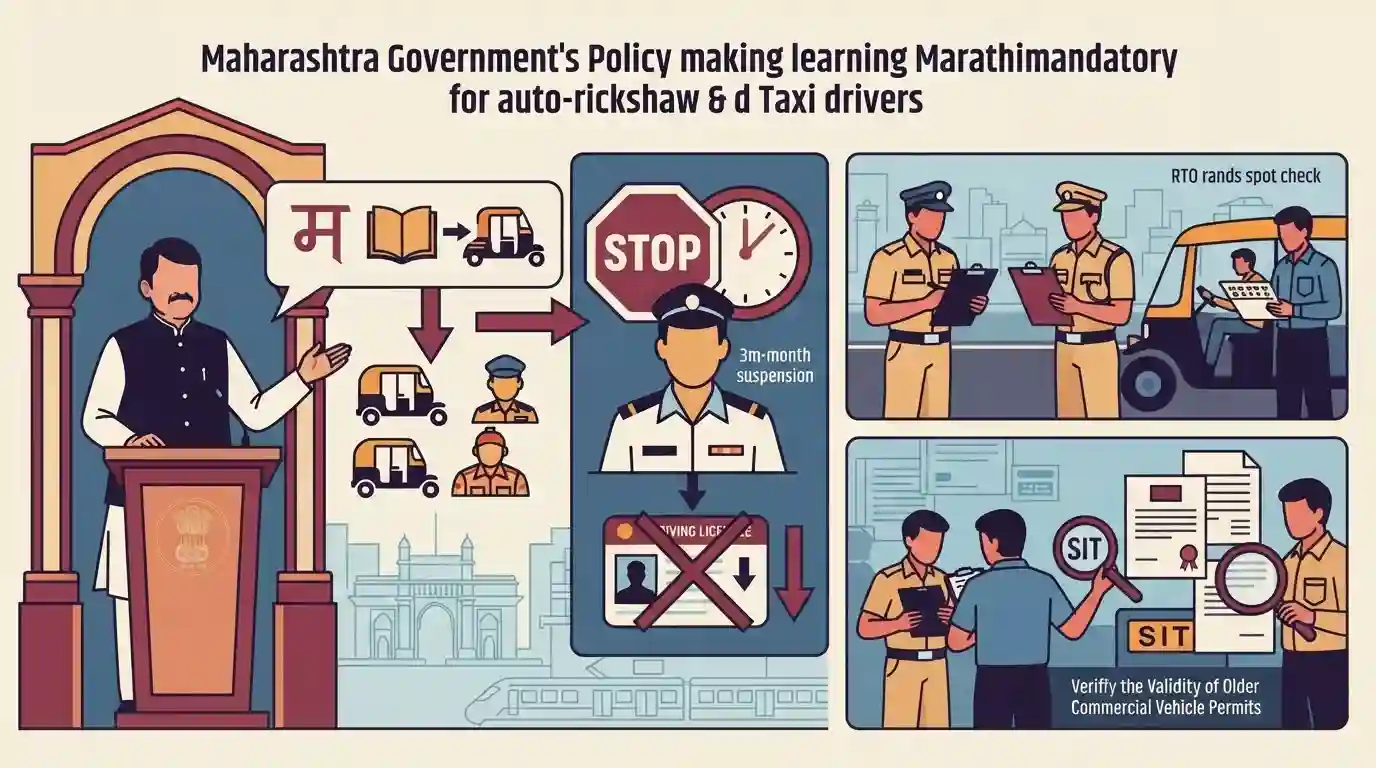
The Maharashtra government has made learning Marathi mandatory for auto-rickshaw and taxi drivers. Transport Minister Pratap Sarnaik warned that drivers refusing to learn the language will face a three-month suspension or permanent cancellation of their driving licences. RTO squads will conduct random spot checks, and a newly formed SIT will verify the validity of older commercial vehicle permits. This policy aligns with the state's broader push to promote the regional language in public and commercial services.
Key Points
- Maharashtra Transport Minister Pratap Sarnaik announced that auto-rickshaw and taxi drivers must learn Marathi, or face a three-month licence suspension or permanent cancellation.
- The announcement follows a 105-day campaign wherein 1.65 lakh commercial vehicle drivers were certified in basic Marathi.
- Passing a basic Marathi speaking test is mandatory for obtaining an auto-rickshaw or taxi badge in the state.
- RTO 'Vayuveg' squads will conduct random, video-recorded spot checks on drivers to enforce the Marathi requirement.
- A Special Investigation Team (SIT) has been constituted to investigate the validity of older auto and taxi permits.
Important Terms
Motor Vehicles Act, 1988

A central Indian legislation that comprehensively regulates road transport, covering driving licenses, motor vehicle registration, transport permits, and penalties for traffic violations.
UPSC context
MPSC GS-2 (Polity); tests knowledge of central-state legislative relations and state enforcement of federal transport laws.
Regional Transport Office (RTO)
A state-level administrative authority responsible for registering vehicles, issuing driving licenses, collecting road taxes, and enforcing road transport regulations on the ground.
UPSC context
MPSC GS-2 (State Administration); tests local executive machinery, public service delivery, and departmental functions.
Special Investigation Team (SIT)
A temporary, specialized investigative body constituted by the government to probe complex, sensitive, or high-profile cases requiring dedicated administrative focus.
UPSC context
MPSC GS-2 (Polity and Executive); tests administrative oversight, ad-hoc inquiry committees, and police reforms.
Maharashtra Motor Vehicles Rules, 1989
State-level delegated legislation framed under the central Motor Vehicles Act, 1988, regulating local transport licensing, permit allocations, and regional driver conduct.
UPSC context
MPSC GS-2 (State Administration); tests delegated legislation, regional executive powers, and state transport policies.
Maharashtra Official Languages Act, 1964
A state law mandating the adoption of Marathi in Devanagari script for official administrative, legislative, and public interaction purposes in Maharashtra.
UPSC context
MPSC GS-2 (Official Languages); tests constitutional Article 345 provisions and linguistic policies in state governance.
Prelims Trap
State-mandated local language proficiency for issuing commercial driving badges violates the fundamental right to practice any trade or profession.
Article 19(6) permits the State to prescribe professional qualifications; thus, language tests for commercial badges do not unconstitutionally violate Article 19(1)(g).
Static Concepts Connected
What are the constitutional provisions for Official Languages of States under Article 345?
- State Legislative Power: Empowers State Legislatures to adopt one or more languages used in the State, or Hindi, as official language.
- Default Language Status: Until a state law is passed, English continues to be used for the same official purposes it was used for earlier.
- Presidential Intervention: The President can direct state-wide official recognition of a language if a substantial proportion of the population desires it.
What governs the language requirement for commercial transport drivers in Maharashtra?
- Maharashtra MV Rules 1989: Rule 24 mandates working knowledge of Marathi and local topography to obtain authorization badges for driving public service vehicles.
- Vayuveg Pathak: Specialized flying squads of the State Transport Department authorized to inspect, check permits, and penalize violators on the spot.
Cross-Topic Patterns
Regional Language vs. Free Trade Right
Mandating local language tests highlights policy friction between Article 19(1)(g) (right to trade) and State actions preserving local language and employment under Article 345.
Delegated Legislation & Central Acts
The Motor Vehicles Act, 1988 allows States to frame rules (like Maharashtra's 1989 Rules) regulating public transport badges, illustrating functional delegated legislation.

Constitutional validity of state language mandates under Article 345 and Motor Vehicle Rules likely to feature in GS-2.
Linked PYQs · 3
Linked PYQs · 3
- 2026MPSC_PRELIMSGS1
Match the correct pairs of the following articles of the Constitution of India with the subject. Subject (a) Language to be used in the complaint for redressal of grievances (b) Facilities for education in mother tongue at primary level (c) Special officer for linguistic minority communities (d) Directive for development of Hindi Language Articles (i) 350 A (ii) 351 (iii) 350 (iv) 350 B Code: (a) (b) (c) (d)
- 2018MPSC_PRELIMSGS1
Which Article of the Constitution provides that it shall be the duty of the Union to promote the spread of the Hindi language, to develop it so that it may become the 'Lingua Franca' of the composite culture of India ?
- 2013MPSC_PRELIMSGS1
It is illegal to drink and drive in Maharashtra and one also needs a permit : (a) to buy liquor from an authorised shop. (b) to consume liquor in a hotel or a bar. (c) to possess it in your house. (d) to carry it from one place to another. Which of the above four statements is/are incorrect ?
