Maharashtra Transport Rules Marathi Proficiency Requirement
Source:outlook-india ↗
Why It Matters
Highlights the intersection of state-level motor vehicle regulations with regional language policies, reflecting how state executive powers are used to mandate linguistic integration in public services and local employment.
Summary
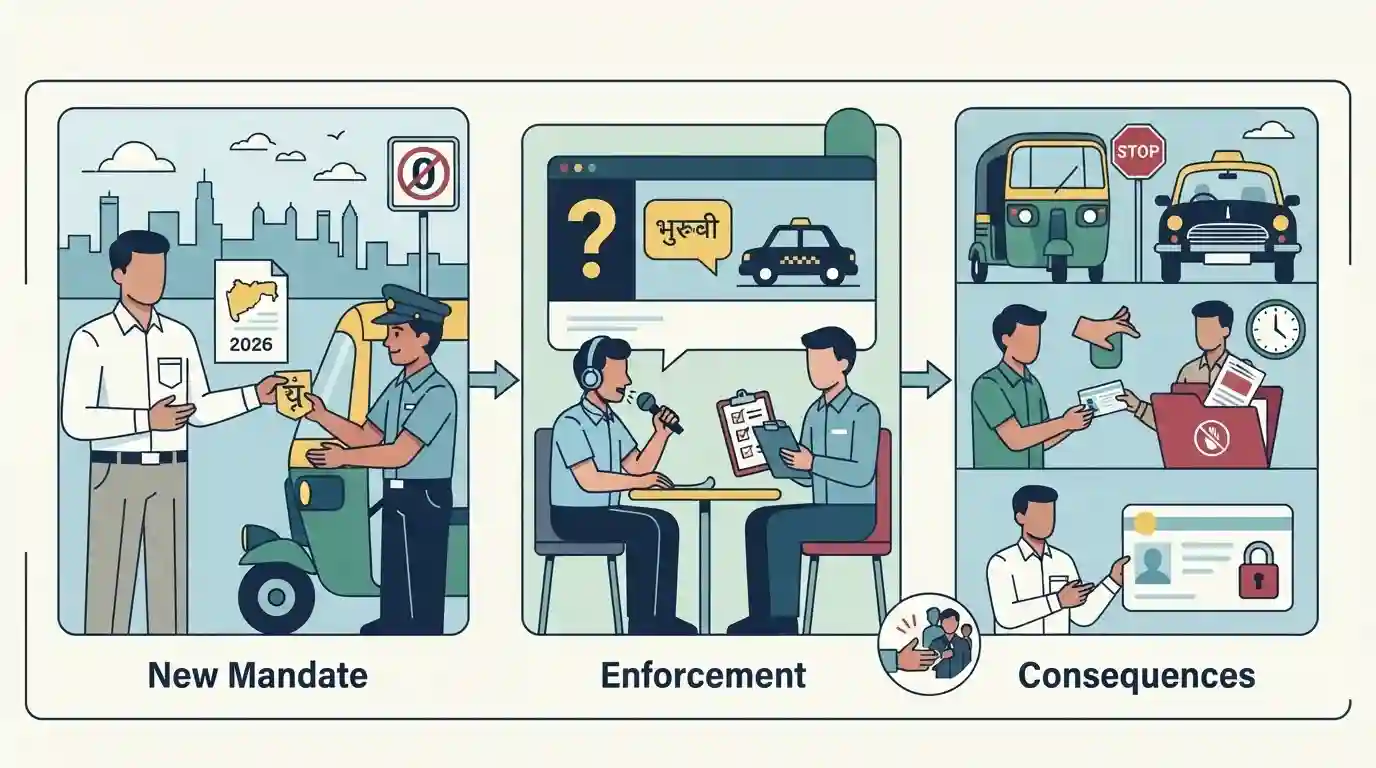
The Maharashtra state transport department has made it mandatory for autorickshaw, taxi, and cab drivers to possess a working knowledge of the Marathi language starting August 18, 2026. This enforcement is backed by an amendment to Rule 4(4) of the Maharashtra Motor Vehicles Rules, 1989. Drivers failing the oral-only test—which includes basic conversation and reading skills—face a minimum three-month licence suspension, with potential permanent cancellation for subsequent violations. Although political figures have sought extensions, the mandate remains effective immediately.
Key Points
- From August 18, 2026, working knowledge of Marathi is mandatory for all cab and auto drivers in Maharashtra.
- The mandate is enforced under the amended Rule 4(4) of the Maharashtra Motor Vehicles Rules, 1989.
- The assessment is strictly oral, involving conversational abilities based on 14 essential sentences and reading short passages from a designated booklet.
- Non-compliance triggers a minimum three-month licence suspension, with repeat offences leading to permanent cancellation.
- Despite political appeals for extensions, the rule is being enforced immediately as no major legal challenge was filed in the Bombay High Court.
Important Terms
Maharashtra Motor Vehicles Rules 1989

A set of state regulations framed under the federal Motor Vehicles Act, 1988, regulating driver licensing, commercial permits, and transport operations within Maharashtra.
UPSC context
MPSC GS Paper II & III. Tests knowledge of state delegated legislation, administrative rules, and transport governance.
Rule 4(4)
A specific administrative provision in the 1989 state rules, amended in 2026 to legally mandate "working knowledge of Marathi" as a driver qualification.
UPSC context
MPSC GS Paper II. Tests understanding of executive amendments, legal provisions, and state-level policy changes.
Maharashtra transport department
The state government department tasked with overseeing road safety, transport policy, vehicle registration, and enforcing licensing laws across Maharashtra.
UPSC context
MPSC GS Paper II. Tests structure and administrative functioning of state government departments and agencies.
Bombay High Court
The highest judicial authority in the state, which in 2017 struck down a non-statutory Marathi mandate circular, necessitating the 2026 statutory amendment.
UPSC context
MPSC GS Paper II (Judiciary). Tests judicial review of state policies, executive actions, and linguistic legislation.
Tardeo RTO
Mumbai’s oldest Regional Transport Office (MH-01), acting as a primary operational hub for testing and implementing the state’s Marathi-language driver directive.
UPSC context
MPSC GS Paper II. Tests knowledge of local public administration machinery and ground-level policy implementation.
Prelims Trap
mandated via a new Legislative Assembly Act requiring a written Marathi test
The rule is an administrative amendment to existing 1989 Rules, not a new Act, and the test is strictly oral, not written.
Static Concepts Connected
Under which Seventh Schedule list do motor vehicles fall, and how are state rules framed?
- Concurrent List: Mechanically propelled vehicles fall under Entry 35 of List III, allowing both Centre and States to legislate.
- State Rules: States frame specific rules (like Maharashtra Motor Vehicles Rules, 1989) under powers delegated by the central Motor Vehicles Act.
What constitutional provisions govern the official languages of Indian States?
- Article 345: Empowers state legislatures to adopt any language in use in the state, or Hindi, for official administrative purposes.
- Eighth Schedule: Marathi is officially recognized as one of the 22 languages under the Eighth Schedule of the Indian Constitution.
Cross-Topic Patterns
Linguistic federalism vs Freedom of Occupation
Examines how language mandates for commercial drivers balance the fundamental right to practice a profession (Article 19(1)(g)) against state-level regional language promotion.
Delegated legislation under Concurrent List
Connects central transport laws with state-level rule-making powers, showcasing how states use delegated authority to enforce regional administrative policies.

State language mandates for commercial licenses likely to be analyzed under Article 19(1)(g) reasonable restrictions and concurrent powers.
Linked PYQs · 2
Linked PYQs · 2
- 2022MPSC_PRELIMSGS1
Government of Maharashtra has adopted gender budgeting from the year ________.
- 2021MPSC_PRELIMSGS1
Maharashtra Legislative Council completed its 50 years of existence in ______.
