Maharashtra Energy Transition and Migrant Welfare Schemes
Source:Indian Express ↗
Why It Matters
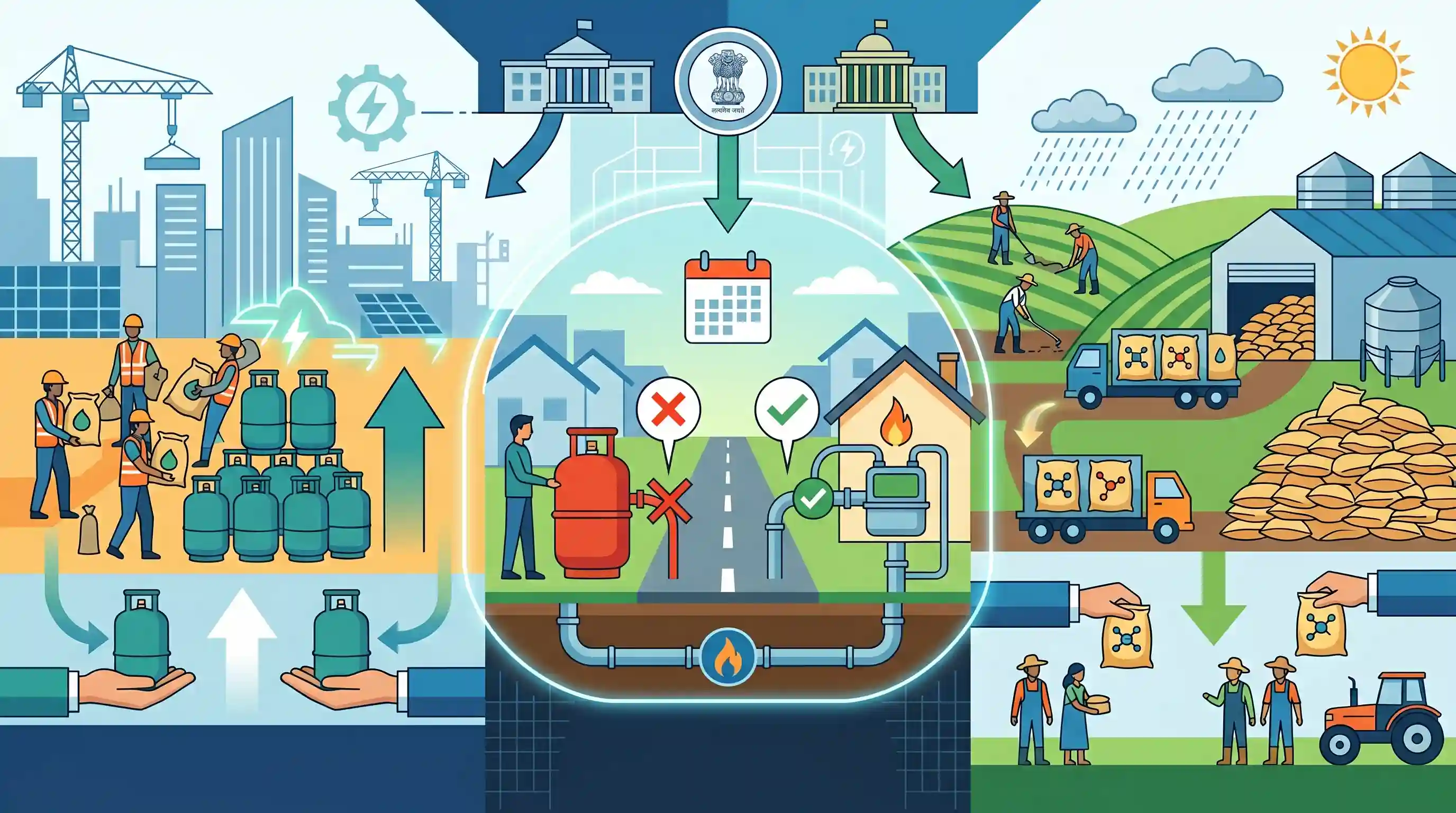
Highlights sub-national policy efforts on energy transitions (pushing PNG adoption over LPG) and showcases targeted welfare provisioning (smaller LPG cylinders for mobile migrant populations). Also reflects administrative foresight in agricultural planning through buffer stocking of critical inputs like Urea and DAP ahead of the Kharif season.
Summary
The Maharashtra government is taking multi-pronged steps addressing energy transition, migrant welfare, and agricultural inputs. It has asked Oil Marketing Companies to hike the supply of 5kg LPG cylinders by 25% to improve energy access for the state's migrant workers. Simultaneously, to accelerate the shift towards City Gas Distribution networks, the state food and civil supplies department has mandated that consumers in areas with Piped Natural Gas (PNG) connectivity switch to PNG by June 30, failing which their LPG supply will be disconnected. Furthermore, preparing for the upcoming Kharif season, the state is procuring a substantial 5.5 lakh MT buffer stock of chemical fertilizers (Urea and DAP) through state agencies MAIDC and MARKFED to ensure steady availability for farmers.
Key Points
- The Maharashtra government has requested Oil Marketing Companies (OMCs) to increase the supply of 5kg LPG cylinders by 25% specifically to meet the needs of migrant workers.
- LPG consumers living in regions with Piped Natural Gas (PNG) networks have been given a June 30 deadline to switch to PNG, after which their LPG supplies will be halted.
- To support the upcoming Kharif season, the state is proactively creating a 5.5 lakh metric tonnes buffer stock of fertilizers, including Urea and DAP.
- This buffer stock is being procured through state agricultural bodies like MAIDC and MARKFED to prevent shortages for farmers.
Important Terms
Oil Marketing Companies (OMCs)

Public and private entities engaged in refining, distribution, and retail marketing of petroleum products like petrol and LPG. Key public players include IOCL, BPCL, and HPCL.
UPSC context
GS-III: Energy and Infrastructure. Tests understanding of the downstream oil sector, fuel pricing, and energy security.
City Gas Distribution (CGD)
A network of pipelines delivering natural gas to domestic (PNG), transport (CNG), and industrial consumers within a specific geographical area to promote a gas-based economy.
UPSC context
GS-III: Infrastructure and Environment. Relevant for discussing clean energy transitions and reducing urban pollution.
Piped Natural Gas (PNG)
A clean-burning fuel, mainly methane, supplied directly to homes via pipelines. It is safer (lighter than air) and more convenient than traditional LPG cylinders.
UPSC context
GS-III: Energy Security. Pertains to clean cooking initiatives like PMUY and modernizing domestic energy infrastructure.
MAIDC
Maharashtra's nodal agency established in 1965 to modernize agriculture through mechanization and ensure the supply of quality fertilizers, pesticides, and agro-engineering equipment to farmers.
UPSC context
GS-III: Agriculture. Important for questions on state-led input delivery systems and agricultural mechanization.
MARKFED
An apex cooperative federation in Maharashtra responsible for marketing agricultural produce, procuring commodities under price support schemes, and distributing seeds and fertilizers.
UPSC context
GS-III: Agriculture and Cooperatives. Tests knowledge of cooperative roles in procurement and marketing.
Buffer Stock
A strategic reserve of essential commodities, such as fertilizers or grains, maintained to prevent scarcity during peak seasons and stabilize market prices.
UPSC context
GS-III: Food Security and Agriculture. Crucial for understanding market intervention and inflation control.
Prelims Trap
"Migrant workers must provide formal rent agreements or state domicile certificates to obtain an LPG connection under PM Ujjwala Yojana."
Ujjwala 2.0 specifically introduced a 'Self Declaration' provision for both identity and address proof to accommodate the transient lifestyle of migrant workers.
Static Concepts Connected
How do Piped Natural Gas (PNG) and Liquefied Petroleum Gas (LPG) differ?
- Composition: PNG is primarily composed of Methane, while LPG is a pressurized liquid mixture of Propane and Butane.
- Safety & Density: PNG is lighter than air and disperses rapidly if leaked. LPG is heavier than air, causing it to pool near the ground and increasing explosion risk.
- Delivery Mechanism: PNG relies on City Gas Distribution (CGD) pipeline networks for continuous supply, eliminating the logistical costs of bottling and transporting LPG cylinders.
How does India's fertilizer subsidy framework operate?
- Urea Pricing: The government exercises strict statutory control over Urea, fixing its Maximum Retail Price (MRP) at a flat rate to keep it affordable for farmers.
- Nutrient-Based Subsidy: Non-urea fertilizers like DAP are governed by the Nutrient-Based Subsidy (NBS) regime, which provides a fixed subsidy per kilogram based on specific nutrient (N, P, K, S) content.
Cross-Topic Patterns
Urban Energy Transition & Subsidy Optimization
Forcing urban PNG adoption reduces logistical subsidy costs and frees up bottled LPG supplies, allowing the state to redirect resources toward targeted migrant welfare and rural energy access schemes like Ujjwala.
Geopolitics, LNG, & Food Security
Natural gas is the primary feedstock for Urea. Creating proactive state buffer stocks of fertilizers insulates domestic Kharif agricultural output from sudden global LNG or geopolitical supply chain shocks.

Expect a Prelims question comparing PNG vs LPG composition alongside Ujjwala 2.0’s self-declaration address clause for migrant workers.
Linked PYQs · 5
Linked PYQs · 5
- 2024MainsGS1
Why do large cities tend to attract more migrants than smaller towns? Discuss in the light of conditions in developing countries.
- 2015MainsGS1
Discuss the changes in the trends of labour migration within and outside India in the last four decades.
- 2018MainsGS3
“Access to affordable, reliable, sustainable and modern energy is the sine qua non to achieve Sustainable Development Goals (SDGs).” Comment on the progress made in India in this regard.
- 2020PrelimsGS1
With reference to chemical fertilizers in India, consider the following statements : 1. At present, the retail price of chemical fertilizers is market-driven and not administered by the Government. 2. Ammonia, which is an input of urea, is produced from natural gas. 3. Sulphur, which is a raw material for phosphoric acid fertilizer, is a by-product of oil refineries. Which of the statements given above is/are correct?
- 2016PrelimsGS1
Why does the Government of India promote the use of 'Neem-coated Urea' in agriculture?
