Maharashtra assembly passes bill to repeal obsolete laws
Source:newsonair ↗
Why It Matters
Important for MPSC aspirants tracking state legislative procedures, legal updates, governance reforms, and the structure of the Maharashtra legislature.
Summary
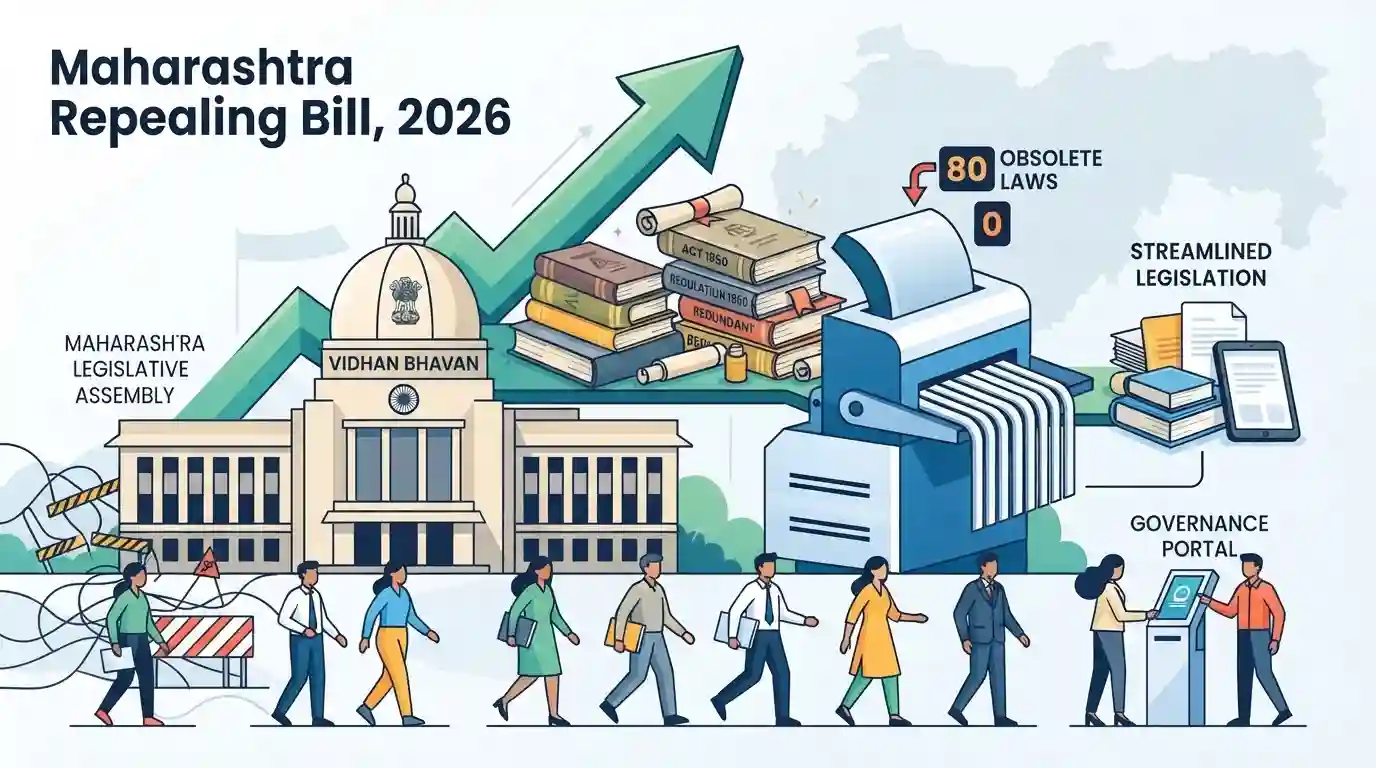
The Maharashtra Legislative Assembly passed the Maharashtra Repealing Bill, 2026, to scrap 80 obsolete and redundant laws, streamlining the legislative framework and improving governance efficiency within the state.
Key Points
- The Maharashtra Legislative Assembly passed the Maharashtra Repealing Bill, 2026, aimed at scrapping 80 obsolete and redundant laws.
- The initiative forms part of the government's continuous administrative reforms to declutter the statute books, enhance legislative clarity, and facilitate ease of governance.
- Scrapping obsolete legislation helps reduce ambiguity in legal interpretations and modernizes the state's legal framework.
Important Terms
Maharashtra Repealing Bill, 2026

A legislative measure introduced by the Maharashtra government in 2026 to scrap 80 obsolete, redundant, and colonial-era laws, streamlining the state's legal framework and promoting ease of governance.
UPSC context
Important for MPSC Polity and Governance (Paper II); tests knowledge of state legislative reforms, statutory simplification, and obsolete laws removal.
Maharashtra Legislative Assembly
The directly elected lower house of the bicameral Maharashtra State Legislature (Vidhan Sabha), comprising 288 members responsible for enacting state laws and holding the executive accountable.
UPSC context
Crucial for MPSC Indian Polity and State Administration; tests composition, powers, lawmaking procedures, and structural features of the Vidhan Sabha.
Maharashtra Legislature
The state legislature of Maharashtra consisting of the Governor and two houses—the Legislative Assembly (Vidhan Sabha) and the Legislative Council (Vidhan Parishad).
UPSC context
Core syllabus topic for MPSC State Polity; tests bicameralism in Maharashtra, legislative procedures, and parliamentary sovereignty at the state level.
Static Concepts Connected
What is the constitutional procedure for passing a state repealing or amending bill in Maharashtra?
- Legislative Nature: Money Bills vs Ordinary Bills: A repealing bill is generally introduced as an ordinary legislative bill requiring a simple majority in both houses of the Maharashtra Legislature.
- Governor Assent: Governor assent: Like any other bill passed by the State Legislature, a repealing bill requires assent from the Governor under Article 200 to become law.
- Saving Clauses: Sunset and Saving clauses: Repealing acts typically include saving clauses to protect rights, privileges, obligations, or liabilities already acquired or incurred under the repealed laws.
Cross-Topic Patterns
Repeal of Legacy Acts & Federal Jurisprudence
The repeal of regional acts like Hyderabad and CP & Berar acts touches upon Article 371 developments, historical integration, and post-reorganization legal continuity.

Expect a statement-based question on the committee (Suresh Kumar, 2022) and the breakup of repealed regional acts in Maharashtra.
Linked PYQs · 3
Linked PYQs · 3
- 2019MPSC_PRELIMSGS1
Which one of the following statements about the Governor of Maharashtra is true ?
- 2021MPSC_PRELIMSGS1
Maharashtra Legislative Council completed its 50 years of existence in ______.
- 2026MPSC_PRELIMSGS1
Consider the following statements regarding the Public Distribution System (PDS) in Maharashtra. (a) By December 2025, there were 270.48 lakh ration card holders in the state. (b) As of 31 October 2025, 51,636 Fair price shops were functioning in the state. (c) By October 2025, about 1.55 crore families received food grains through Aadhaar - based biometric authentication. Which of the statements given above is/are correct ?
