Maharashtra launches statewide menopause clinics and palliative care
Source:Indian Express ↗
Why It Matters
This article showcases state-led innovation in public healthcare targeting neglected areas—women's midlife health and palliative/geriatric care. It is highly relevant for GS2 (Social Development and Health Policies) as an example of expanding the reach and scope of grassroots public health systems beyond traditional maternal and communicable disease care.
Summary
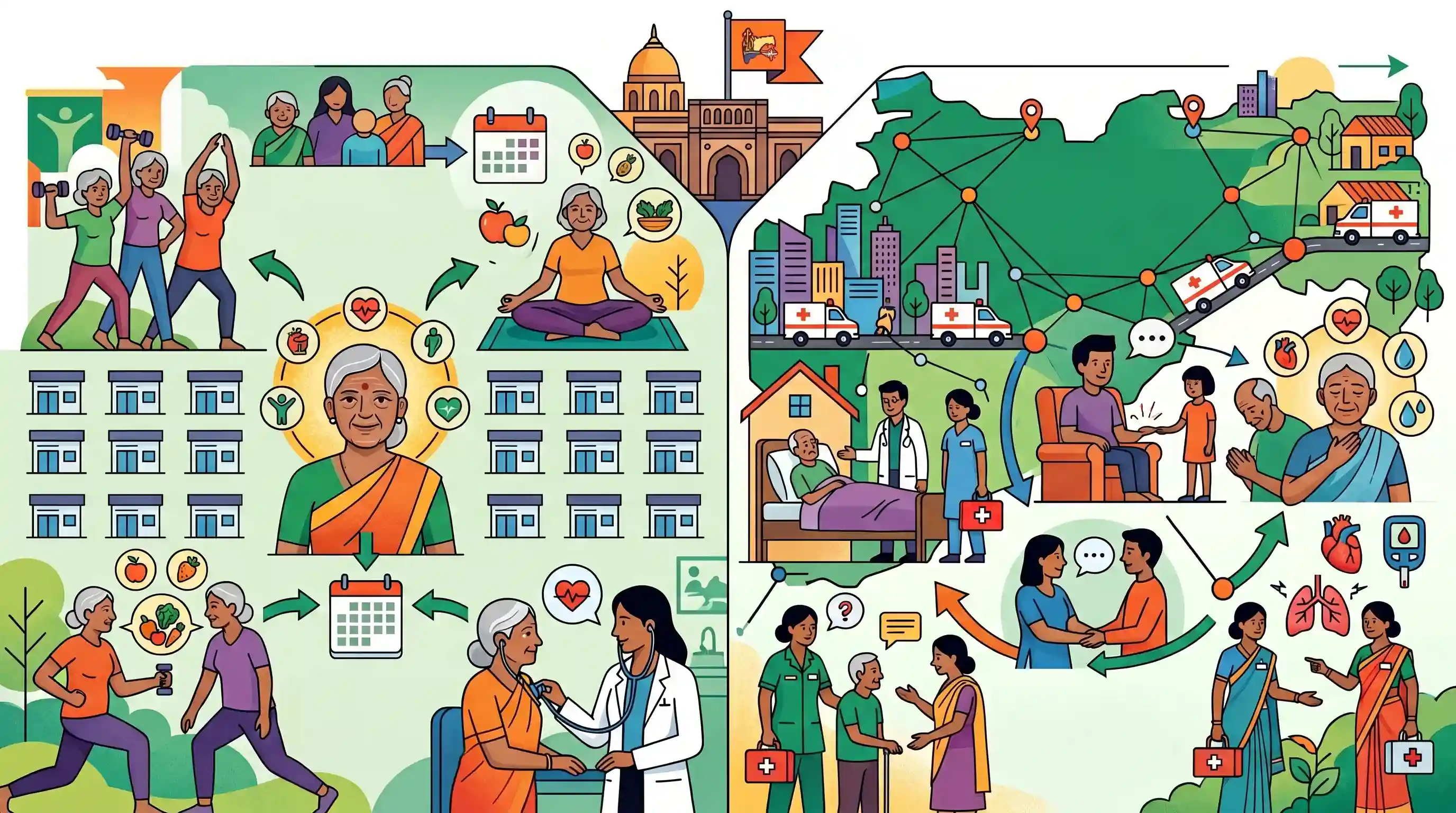
Maharashtra has launched a pioneering public health initiative featuring 580 state-run Menopause Clinics and a comprehensive Statewide Palliative Care Network. The menopause clinics will offer dedicated weekly OPDs providing free holistic care for women's post-reproductive health, addressing a long-standing gap in healthcare. Concurrently, the palliative care program aims to deliver pain management, psychological support, and home-based services for patients suffering from chronic and non-communicable diseases (NCDs), utilizing grassroots workers like ANMs for beneficiary identification.
Key Points
- Maharashtra has officially rolled out 580 state-run Menopause Clinics to provide free consultations, screening, counselling, and medicines for women navigating midlife health issues.
- The state simultaneously launched the Maharashtra Palliative Care Programme aimed at supporting patients with long-term, chronic illnesses such as cancer, heart disease, and diabetes.
- The palliative care initiative focuses on pain management, psycho-social support, family counselling, and home-based services, addressing a critical need in geriatric and chronic healthcare.
- Auxiliary Nurse Midwives (ANMs) and grassroots health workers will be actively involved in identifying beneficiaries for these specialized public health programs.
Important Terms
Palliative Care

Specialized medical care focusing on providing relief from symptoms and stress of serious, life-limiting illnesses to improve quality of life for patients and families.
UPSC context
GS-II (Social Justice/Health); tests understanding of healthcare for vulnerable populations and rights-based health approaches.
Menopause Clinics
Dedicated healthcare facilities providing holistic medical, psychological, and screening services for women transitioning beyond reproductive years, addressing a traditional gap in maternal-centric healthcare.
UPSC context
GS-II (Governance/Women); tests knowledge of gender-sensitive health interventions and life-cycle health models.
Auxiliary Nurse Midwife (ANM)
Grassroots-level health worker in India’s primary healthcare system, responsible for maternal health, immunizations, and community-level identification of patients for specialized care.
UPSC context
GS-II (Health Infrastructure); crucial for understanding India's decentralized health delivery and frontline workers.
Non-Communicable Diseases (NCDs)
Chronic, non-infectious conditions such as cancer, diabetes, and cardiovascular diseases that require long-term management and are leading causes of mortality in India.
UPSC context
GS-II (Public Health); tests awareness of shifting disease burdens and preventive policy needs.
Maharashtra Palliative Care Programme
A statewide initiative providing pain management, home-based services, and dedicated hospital beds for chronic patients, integrated into the three-tier public health system.
UPSC context
GS-II (Governance); a model for state-led health innovation and implementation of national health guidelines.
Prelims Trap
"The National Health Mission mandates all states to establish dedicated Menopause Clinics at Primary Health Centres."
Menopause clinics are currently a state-led initiative pioneered by Maharashtra, not a mandatory central mandate under NHM, which historically focuses on maternal/reproductive health.
Static Concepts Connected
What distinguishes Palliative Care from Curative and Hospice Care?
- Curative Care: Focuses strictly on curing the underlying disease or medical condition to restore health.
- Palliative Care: Provides symptom relief, pain management, and psychosocial support for chronic illnesses, functioning alongside ongoing curative treatments.
- Hospice Care: Specialized palliative care for terminally ill patients, typically activated when curative treatments have stopped entirely.
How do ASHAs and ANMs differ in India's primary healthcare structure?
- ASHA Workers: Honorary community volunteers serving as a bridge between the village and public health system, primarily focusing on awareness and community mobilization.
- ANMs: Auxiliary Nurse Midwives are frontline government health workers at sub-centres, providing primary clinical care, immunizations, and maternal services.
Cross-Topic Patterns
Shift from Maternal to Lifecycle Health
Historically, public health policies focused heavily on maternal mortality (JSY, PMMVY). Menopause clinics signal a vital policy shift toward a life-cycle approach, addressing post-reproductive women's health.
NCD Burden & Out-of-Pocket Expenditure
As India's demographic shifts toward an aging population, chronic NCDs increase. State-led palliative care models are critical interventions to mitigate catastrophic out-of-pocket health expenditure (OOPE) for vulnerable families.

The policy shift from maternal-focused schemes to a lifecycle approach in women's health is a prime candidate for a 2026 Mains GS-II question.
Linked PYQs · 3
Linked PYQs · 3
- 2020MainsGS2
In order to enhance the prospects of social development, sound and adequate health care policies are needed particularly in the fields of geriatric and maternal health care. Discuss.
- 2024MainsGS2
In a crucial domain like the public healthcare system the Indian State should play a vital role to contain the adverse impact of marketisation of the system. Suggest some measures through which the State can enhance the reach of public healthcare at the grassroots level.
- 2012PrelimsGS1
With reference to National Rural Health Mission, which of the following are the jobs of 'ASHA'; a trained community health worker? 1. Accompanying women to the health facility for antenatal care checkup 2. Using pregnancy test kits for early detection of pregnancy 3. Providing information on nutrition and immunization 4. Conducting the delivery of baby Select the correct answer using the codes given below:
