Maharashtra Artificial Intelligence Initiative in Skill Development
Source:educationworld ↗
Why It Matters
Important for MPSC aspirants tracking state-level policy innovations, technological advancements, and higher education milestones in Maharashtra.
Summary
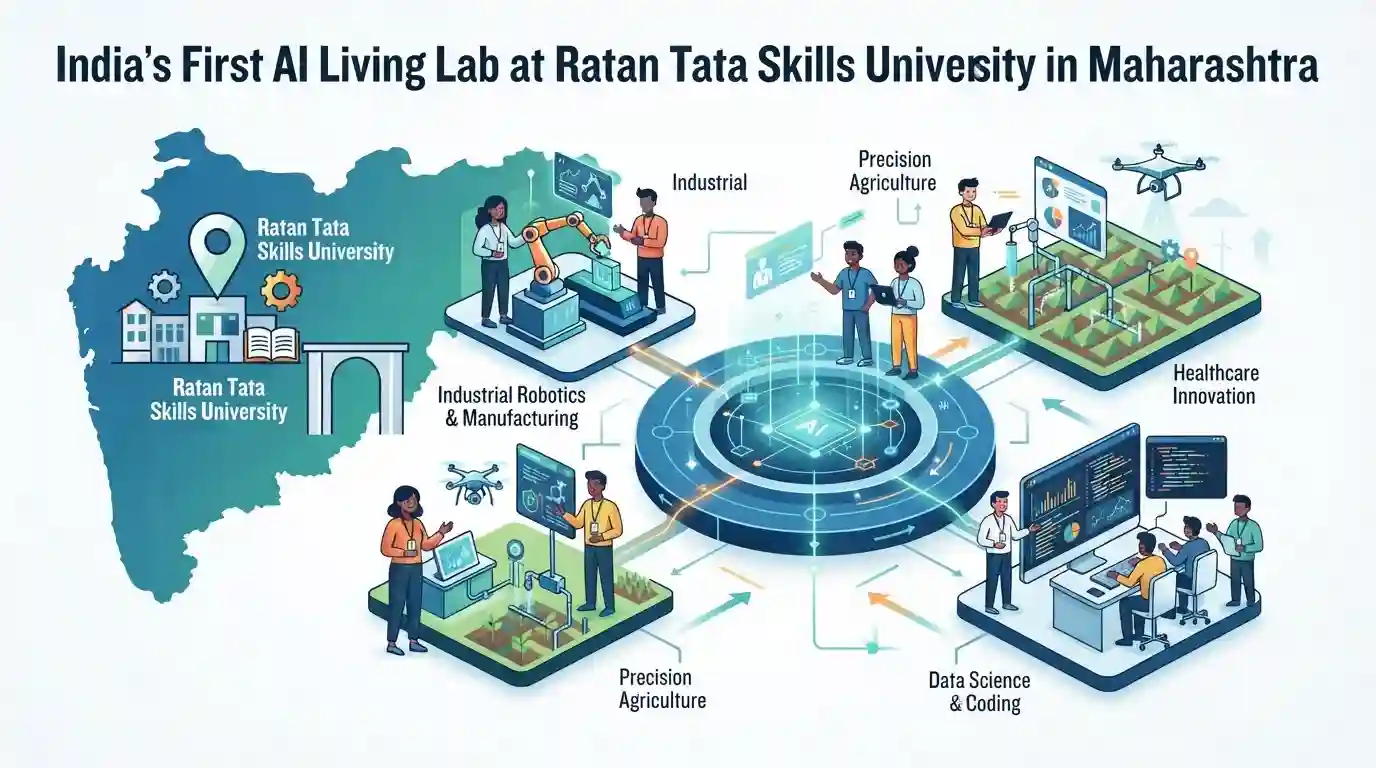
Maharashtra has launched India's first AI Living Lab at the Ratan Tata Skills University, marking a major milestone in integrating advanced artificial intelligence applications into skill development and higher education.
Key Points
- Maharashtra has launched India's first Artificial Intelligence (AI) Living Lab at the Ratan Tata Skills University.
- The initiative aims to integrate cutting-edge AI technologies into vocational training and higher education, providing real-world experiential learning environments.
- This development positions Maharashtra as a leader in bridging the gap between emerging deep-tech domains and skill development.
Important Terms
AI Living Lab

India's first dedicated artificial intelligence living lab launched at the Ratan Tata Maharashtra State Skills University in partnership with Germany to support MSMEs and practical industry training.
UPSC context
MPSC Paper III (Science & Tech / Skill Development): Tests knowledge of emerging technologies, innovation ecosystems, and state-level policy initiatives.
Ratan Tata Skills University
A state-established skills university in Maharashtra focused on integrating advanced technical education, vocational training, and industry collaboration.
UPSC context
MPSC / Maharashtra Governance & Education: Tests awareness of key state educational institutions and skill development schemes.
Prelims Trap
India's first AI Living Lab is a purely domestic state-funded academic project under UGC guidelines.
Aspirants often assume state university innovations are funded entirely by UGC or state budgets, missing international collaborative frameworks like GIZ and Leipzig University.
Static Concepts Connected
What are the core institutional frameworks and objectives of Public-Private Partnerships in Indian Skill Development?
- Skill Universities: Skill Universities focus on industry-aligned curricula, apprenticeship-embedded degree programs, and flexible exit-entry pathways under the National Credit Framework (NCF).
- Bilateral Tech Partnerships: GIZ and bilateral agencies partner with Indian states to bridge the gap between vocational training and Industry 4.0 manufacturing requirements.
Cross-Topic Patterns
Indo-German Skill Ventures & MSME Technology Upgradation
Indo-German technical collaborations in vocational training echo past initiatives like the Indo-German Industrial VET (IGVET) program under MSDE.
State Deep-Tech Policy & Industrial Competitiveness
State-level deep tech initiatives link directly to Maharashtra's District Innovation Hubs and the broader Magnetic Maharashtra policy framework.

Expect match-the-following or statement-based questions on India's first AI Living Lab at RT-MSSU and its Indo-German collaborative partners.
Linked PYQs · 3
Linked PYQs · 3
- 2024MPSC_PRELIMSGS1
Match the following pairs : | List-I | List-II | |---|---| | (a) Dr. Nitin Karmalkar Committee | (i) For implementation of National Education Policy - 2020 in Maharashtra | | (b) Nitin Karir Committee | (ii) To enquire the incident which happened during the distribution of Maharashtra Bhushan Award | | (c) Sunil Pawar Committee | (iii) To study why the rates of onion collapse. | | (d) Dr. K. Kasturirangan Committee | (iv) To make the syllabus for pre-primary to degree according to National Education Policy - 2020 | Code: (a) (b) (c) (d)
- 2020MPSC_PRELIMSGS1
Objectives of National Skill Development Agency of India are : (a) Support to government of India's five year plan for skills training. (b) Organize skills development across all factors. (c) Evaluate the effectiveness of existing skill development programs. (d) Empowerment of women through economic independence for betterment of society.
- 2026MPSC_PRELIMSGS1
Which of the following statement/s given is/are correct ? (a) The National Institutional Ranking Framework provides a methodology to rank educational institutions across the country. (b) The National Institutional Ranking Framework (NIRF) was launched in 2020. (c) The ranking is based on five parameters. (d) Indian Institute of Technology Madras tops in the Sustainable Development Goals (SDGs) category.
