Maratha Reservation: Manoj Jarange Starts Eleventh Hunger Strike
Source:deccan-chronicle ↗
Why It Matters
The Maratha quota agitation and the legal-administrative mechanisms of caste certificate validation (under the Maharashtra Caste Certificate Act, 2000) are major socio-political and administrative governance issues in Maharashtra, frequently asked about in MPSC examinations under polity and social justice.
Summary
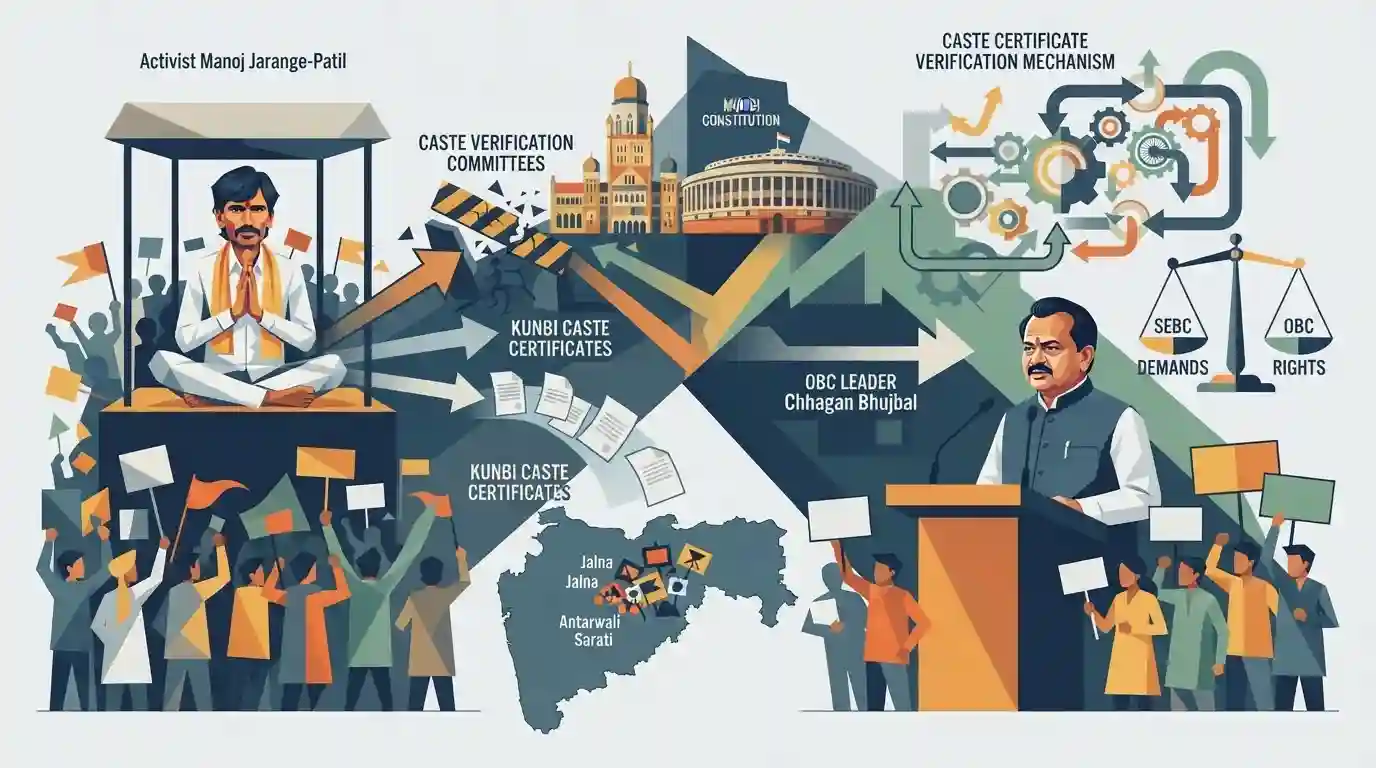
Maratha quota activist Manoj Jarange-Patil has launched his 11th indefinite hunger strike at Antarwali Sarati, Jalna. He is demanding the abolition of Maharashtra's caste verification committees and the swift clearance of Kunbi caste certificates for Marathas. While the state government claims to be addressing these issues on a war footing without compromising OBC rights, senior OBC leaders like Chhagan Bhujbal have vehemently opposed the demand to scrap caste verification committees, citing risks of fraudulent certificate distribution.
Key Points
- Maratha quota activist Manoj Jarange-Patil has launched his 11th indefinite hunger strike at Antarwali Sarati in Jalna district, calling it his 'final struggle'.
- His primary demands include the total abolition of caste verification committees in Maharashtra, alleging that they reject legitimate applications despite valid historical evidence.
- He also demanded the quick resolution of pending issues concerning the issuance of Kunbi caste certificates to members of the Maratha community (which grants them OBC benefits).
- Jarange threatened a major protest march to Mumbai—specifically targeting the Chief Minister's official residence 'Varsha' or Azad Maidan—if the demands are not met.
- Senior OBC leader and Maharashtra Cabinet Minister Chhagan Bhujbal strongly opposed the demand to abolish caste verification committees, warning that it would lead to fraudulent claims and illegal acquisition of SC, ST, and OBC certificates.
- Shiv Sena leader and Minister Uday Samant stated that the state government is working on a war footing to address Jarange's demands while ensuring that the existing rights of the OBC community are not compromised.
Important Terms
Maharashtra Scheduled Castes, Scheduled Tribes, De-notified Tribes (Vimukta Jatis), Nomadic Tribes, Other Backward Classes and Special Backward Category (Regulation of Issuance and Verification of) Caste Certificate Act, 2000

The primary state legislation regulating the issuance, verification, and cancellation of caste certificates to prevent fraudulent reservation claims in Maharashtra.
UPSC context
MPSC GS-2. Tests statutory reservation frameworks, administrative machinery, and state social justice laws.
Caste Scrutiny Committee
A statutory, quasi-judicial body constituted under Section 6 of the Maharashtra Caste Certificate Act, 2000, responsible for verifying caste claims and issuing validity certificates.
UPSC context
MPSC GS-2. Tests quasi-judicial bodies, administrative procedures, and judicial reviews under Article 226.
Kunbi
An agrarian peasant community traditionally classified as an Other Backward Class (OBC) in Maharashtra, central to recent demands for Maratha reservation.
UPSC context
MPSC GS-1 & GS-2. Tests social stratification, backward classes classification, and agrarian history.
Socially and Educationally Backward Classes (SEBC)
A constitutional category enabling targeted reservation for historically disadvantaged groups. In Maharashtra, the 2024 SEBC Act designates the Maratha community under this category.
UPSC context
MPSC GS-2. Tests constitutional articles (Articles 342A, 15, 16) and state legislative competence.
Vigilance Cell (Caste Verification)
An investigative wing of the Caste Scrutiny Committee, consisting of police officers tasked with verifying local lineage, history, and social backgrounds of applicants.
UPSC context
MPSC GS-2. Tests administrative checks, executive inquiry mechanisms, and verification rules under 2012 Rules.
Prelims Trap
Caste Verification Committees in Maharashtra were first conceptualized and established solely under the Maharashtra Act No. 23 of 2001.
While the 2001 Act formalized the statutory framework, the actual mandate and operational guidelines to establish Caste Scrutiny Committees came directly from the Supreme Court's 1994 Kumari Madhuri Patil judgment.
Static Concepts Connected
What are the implications of the 105th Constitutional Amendment Act, 2021?
- Power Restoration: Restored the power of State Governments and UTs to identify and maintain their own list of Socially and Educationally Backward Classes (SEBCs).
- Judicial Overrule: Overruled the Supreme Court's interpretation in the 2021 Maratha quota case which held that only the Union government had this power under the 102nd Amendment.
- Constitutional Changes: Directly amended Articles 338B (NCBC duties), 342A (President's list notification power), and 366(26C) (definition of SEBC).
What is the significance of the Kumari Madhuri Patil v. Addl. Commissioner (1994) case?
- Verification Guidelines: Laid down 15 mandatory guidelines to streamline the procedure for the issuance, social status verification, and scrutiny of caste certificates.
- Committee Mandate: Mandated every State Government to constitute a Scrutiny Committee to examine the genuineness of caste claims to prevent fraud.
- Consequences of Fraud: Directed that benefits obtained through fraudulent certificates (admission, employment) must be cancelled and withdrawn.
Cross-Topic Patterns
SEBC legislation vs Judicial review ceiling
The 10% Maratha quota under the 2024 Act directly tests the judicial sanctity of the 50% ceiling set in the Indra Sawhney case, highlighting the ongoing legislative-judicial friction over affirmative action.
Administrative history + Modern-day quotas
The Shinde Committee's trace of Nizam-era records connects modern-day caste claims to pre-independence administrative history and border state dynamics (Hyderabad State-Maharashtra linkages).

MPSC will likely combine the Shukre/Shinde commission mandates with the exact constitutional articles modified by the 105th Amendment.
Linked PYQs · 3
Linked PYQs · 3
- 2021MPSC_PRELIMSGS1
The Constitution 105th amendment act, 2021 related to the socially and educationally backward classes, amends ________ articles of Indian Constitution.
- 2023MPSC_PRELIMSGS1
Which of the following is/are a duties of National Commission for Backward Classes ?
- 2010MPSC_PRELIMSGS1
Article 15 (5) which was inserted with the 93rd Amendment, provides reservation for socially and educationally backward classes of citizens or for scheduled caste or Tribe, paved the way for ________ .
