Maharashtra Issues New Guidelines to Expedite Dues Recovery
Source:timesofindia ↗
Why It Matters
This administrative order directly impacts the execution of RERA awards, addressing a major bottleneck in real estate regulation where homebuyers struggle to recover money despite winning cases. It highlights the intersection of land revenue administration (Maharashtra Land Revenue Code, 1966), inter-departmental data integration (such as IGR, ROC, Income Tax), and district governance machinery, which are highly relevant for the MPSC Combined Prelims.
Summary
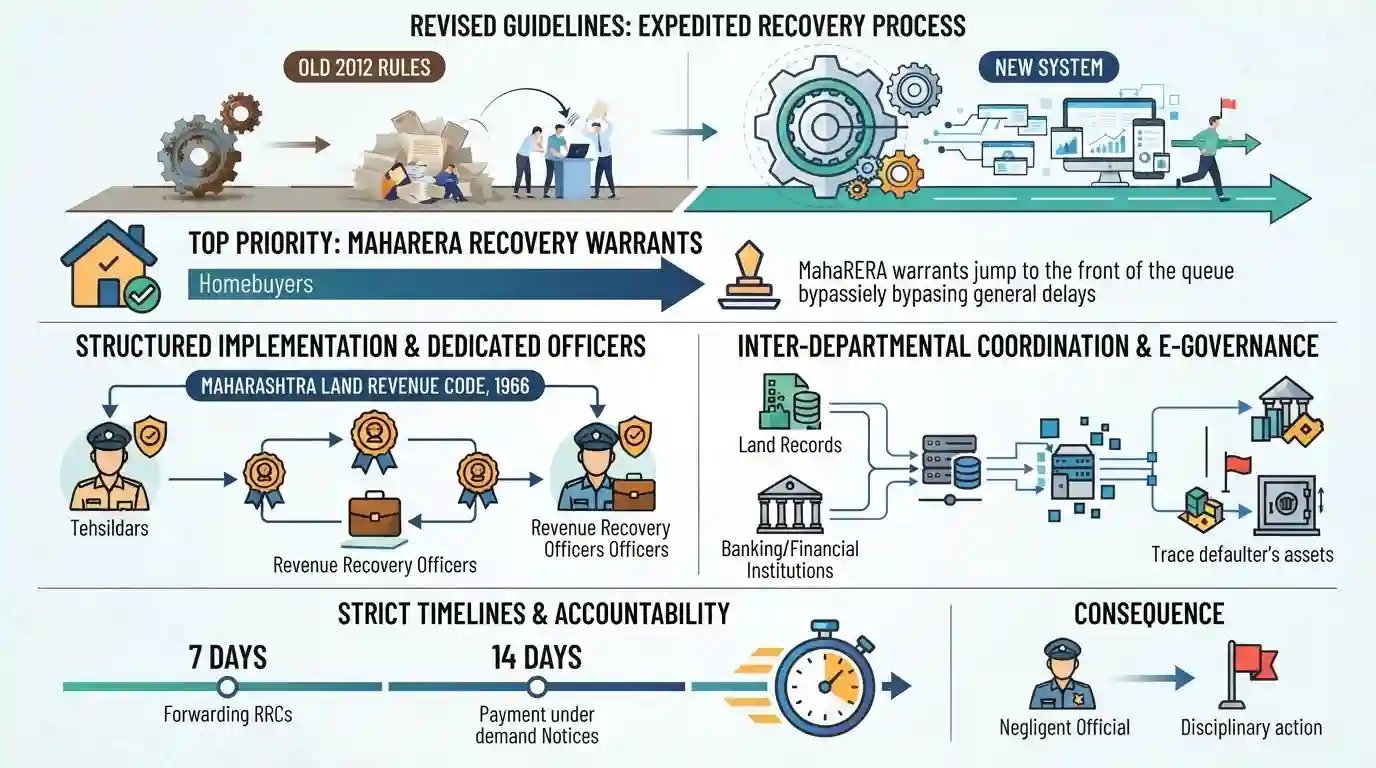
The Government of Maharashtra has introduced comprehensive and revised guidelines to expedite the recovery of dues under Revenue Recovery Certificates (RRCs) and warrants, replacing the old 2012 rules. To protect homebuyers, top priority is given to MahaRERA recovery warrants. The guidelines mandate a structured process under the Maharashtra Land Revenue Code, 1966, led by Tehsildars and dedicated Revenue Recovery Officers (additional/resident deputy collectors), and feature an expansive database-sharing network to trace defaulters' assets. Tight timelines of 7 days to forward RRCs and 14 days for payment under demand notices have been established, with strict disciplinary penalties for negligent officials.
Key Points
- The Government of Maharashtra has issued a comprehensive and revised set of guidelines to accelerate the recovery of outstanding dues under Revenue Recovery Certificates (RRCs) and recovery warrants.
- The new circular supersedes the previous guidelines issued in March 2012, establishing a stringent and structured mechanism for district administrations.
- MahaRERA recovery warrants are designated as priority cases to safeguard the financial interests of individual homebuyers who may have been deprived of their properties or money.
- Dedicated Revenue Recovery Officers (additional district collectors and resident deputy collectors) are already operational in Mumbai, Thane, and Pune, and will be appointed across all other districts shortly. They must submit monthly progress reports to the state by the 5th of every month.
- A strict timeline has been instituted: collectorates must verify and forward RRCs to the concerned Tehsildar within 7 days, and the Tehsildar must issue a demand notice giving the defaulter 14 days to settle the dues.
- Defaulters are mandated to submit an affidavit detailing all movable and immovable properties in their name or possession.
- If payment is not made within the stipulated period, seizure and public auction of the defaulter's assets are to be carried out under the provisions of the Maharashtra Land Revenue Code, 1966.
- An expanded asset-tracing mechanism allows officials to inspect land records, stamp duty and registration details (IGR), RTO records, urban/rural local body records, ROC corporate data, and Income Tax records to identify hidden assets across the state.
- Negligent or non-compliant officials will face disciplinary action.
Important Terms
Maharashtra Real Estate Regulatory Authority

The statutory body in Maharashtra established under RERA to regulate and promote the real estate sector, handle grievances, and protect homebuyers' interests.
UPSC context
MPSC GS-2 (Regulatory Bodies). Tests knowledge of real estate regulation, housing consumer rights, and state-level administrative authorities.
Maharashtra Land Revenue Code, 1966
A comprehensive state legislation that unifies and governs the administration of land, land titles, and the assessment, recovery, and collection of land revenue in Maharashtra.
UPSC context
MPSC GS-2 (State Administration) and GS-3 (Land Laws). Tests understanding of revenue recovery mechanisms and land administration codes.
Revenue Recovery Certificate
A legal document issued by a competent authority directing the district administration to recover unpaid government dues or decreed payments as arrears of land revenue.
UPSC context
MPSC GS-2 (Administration & Reforms). Tests concepts of public finance recovery, administrative execution powers, and land revenue mechanisms.
Real Estate (Regulation and Development) Act, 2016
A landmark central act enacted to establish the Real Estate Regulatory Authority, protect homebuyers, regulate transaction transparency, and resolve consumer grievances.
UPSC context
MPSC GS-2 (Acts and Laws). Tests understanding of housing sector reforms, consumer protection frameworks, and central-state administrative coordination.
Prelims Trap
MahaRERA has direct statutory powers to order the civil imprisonment of defaulting developers for up to 3 months.
MahaRERA itself does not possess the power to directly imprison developers. The execution must be escalated to a Principal Civil Court under the Code of Civil Procedure (CPC).
Static Concepts Connected
How does the Maharashtra Land Revenue Code (MLRC), 1966 prioritize and recover state dues?
- Priority of Claims: Under Section 169, the state's claim for land revenue takes precedence over all other private or institutional claims on the land.
- Arrears of Revenue: Unpaid statutory dues referred via RRCs are legally recovered using coercive mechanisms as if they were 'arrears of land revenue'.
- MLRC Enforcement: Recovery process includes issuing demand notices, attachment/sale of movable and immovable property, and executing arrest warrants.
What is the recovery enforcement mechanism under the Real Estate (Regulation and Development) Act, 2016?
- Section 40(1) Mandate: Section 40(1) directs that any compensatory or refund dues must be recovered in the manner prescribed for arrears of land revenue.
- Warrant Execution: The regulatory authority issues a recovery warrant, which is then executed by the district collectorate's revenue officials.
- Statutory Timelines: Maharashtra RERA Rules 2016 require a mandatory 60-day window for developers to pay compensation before a warrant is formally initiated.
Cross-Topic Patterns
MLRC 1966 + Consumer Welfare
Integrates traditional 1960s state revenue machinery (MLRC) with modern real estate consumer protection (RERA) to secure homebuyer refunds.
E-Gov + Revenue Administration
Illustrates the shift of land administration from localized manual records to integrated cross-departmental data-sharing (RTO, ROC, IGR) for tracing defaulters.

Timelines under the 2026 circular (7/14 days) and executive roles under MLRC 1966 are prime candidates for MPSC GS-II questions.
Linked PYQs · 2
Linked PYQs · 2
- 2021MPSC_PRELIMSGS1
Consider the following statements about Real Estate (Regulation and development) Act and select correct one. (a) was passed in 2016. (b) aims at protecting interest of home buyers. (c) was not applicable in the state of Jammu and Kashmir. Answer Options :
- 2009MPSC_PRELIMSGS1
Who is the Vice-President of 'District Planning and Development Council'?
