Manjara Dam Floating Solar and BESS Project Expression of Interest
Source:solarquarter ↗
Why It Matters
This project represents a significant shift towards innovative renewable energy solutions (floating solar + BESS) in Maharashtra. It is highly relevant for MPSC Prelims questions focusing on the state's geography (dams and river basins like Manjara/Godavari) and economic infrastructure development.
Summary
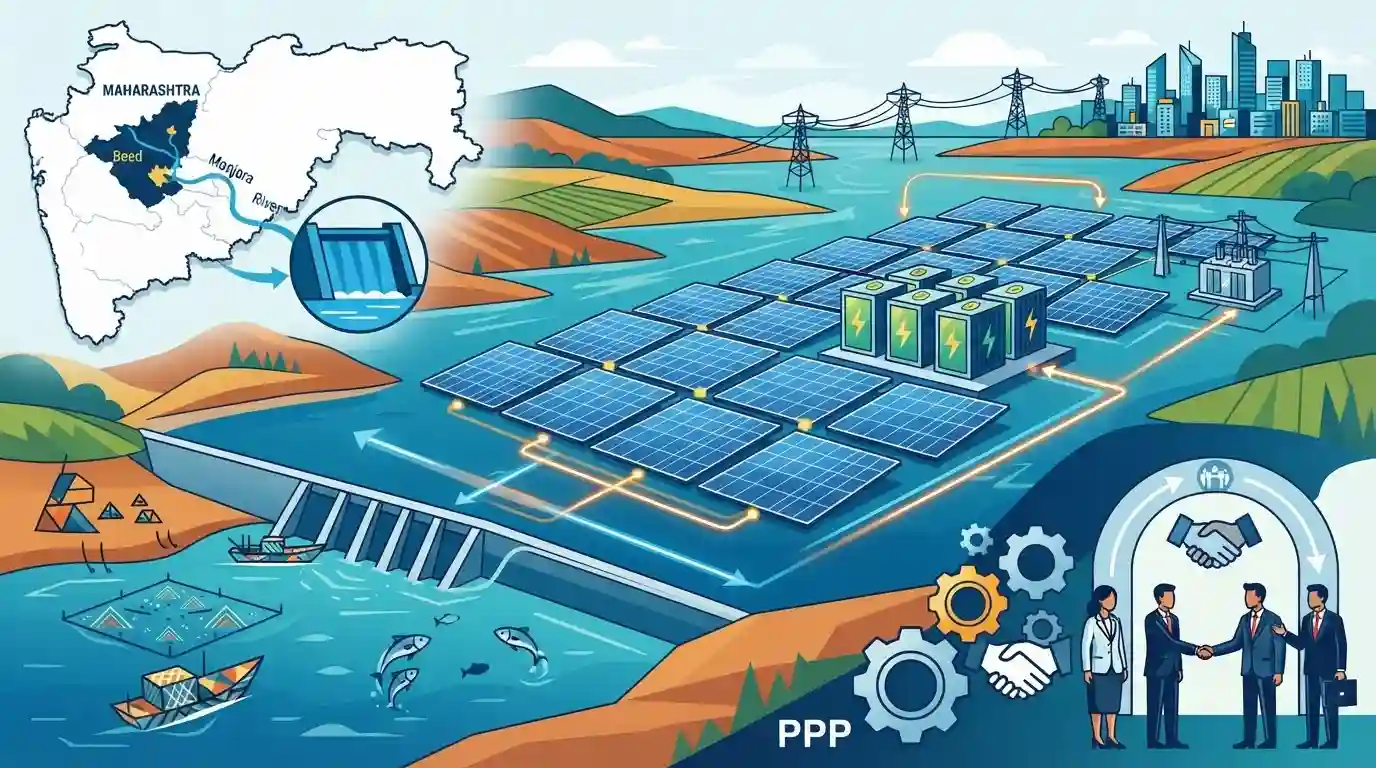
The Government of Maharashtra has invited Expressions of Interest (EOI) for the development of a 115 MW floating solar power project, integrated with a Battery Energy Storage System (BESS), at the Manjara Dam in the Beed district. Executed under a Public-Private Partnership (PPP) model on a DBFOT basis, the project seeks to utilize the reservoir's surface for clean energy generation while allowing parallel use for aquaculture by the Godavari Marathwada Irrigation Development Corporation (GMIDC).
Key Points
- The Water Resources Department of Maharashtra has issued an EOI for a 115 MW floating solar PV project integrated with a Battery Energy Storage System (BESS) at the Manjara Dam in Beed district.
- The project is planned to be executed under a Public-Private Partnership (PPP) framework on a Design, Build, Finance, Operate, and Transfer (DBFOT) basis.
- Developers will be responsible for conducting pre-feasibility studies, evaluating technical and financial viability, and determining the optimal BESS capacity.
- The generated electricity is primarily intended for sale to MSEDCL or through third-party open access.
- The Godavari Marathwada Irrigation Development Corporation (GMIDC) will concurrently lease parts of the reservoir for fisheries and aquaculture, ensuring multi-use of the water body.
Important Terms
Floating Solar Photovoltaic (FSPV)

Solar panels mounted on floating platforms over water bodies like dams or lakes, eliminating the need for vast land acquisition while utilizing the water's natural cooling effect to boost energy generation efficiency.
UPSC context
Tests GS-3 (Energy & Environment). Highlights land-neutral clean energy innovations and solutions to large-scale land acquisition conflicts.
Battery Energy Storage System (BESS)
A technological system that stores electrical energy generated from renewable sources in batteries for later use, mitigating the intermittency of solar or wind power and ensuring grid stability during peak demand.
UPSC context
Crucial for GS-3 (Infrastructure/Energy). Tests knowledge of grid stability and the transition of renewables into reliable, dispatchable power.
DBFOT Model
Design, Build, Finance, Operate, and Transfer is a Public-Private Partnership framework where a private developer handles the entire project lifecycle, managing funding and operations before returning the asset to the government.
UPSC context
Tests GS-3 (Investment Models). Important for understanding how governments leverage private capital and efficiency for large infrastructure projects.
Godavari Marathwada Irrigation Development Corporation (GMIDC)
A state-owned entity under Maharashtra's Water Resources Department tasked with executing, maintaining, and managing irrigation schemes and multipurpose dam projects across the drought-prone Marathwada region.
UPSC context
Relevant to GS-1 and GS-2 (Water Resources). Showcases regional administrative bodies handling water security in drought-prone areas.
Manjara Dam
An earthfill dam on the Manjara River in the Beed district of Maharashtra, serving as a critical reservoir for regional irrigation and recently repurposed for floating solar energy generation.
UPSC context
Tests GS-1 (Geography) mapping. Important for understanding Peninsular river systems and modern dual-use infrastructure.
Maharashtra State Electricity Distribution Company Limited (MSEDCL)
India's largest public sector electricity distribution utility, wholly owned by the Government of Maharashtra, responsible for supplying electricity to consumers across the state outside certain parts of Mumbai.
UPSC context
Tests GS-3 (Energy) and GS-2 (Governance), particularly regarding DISCOM reforms, smart meter rollouts, and power sector efficiencies.
Prelims Trap
"Manjara is a major left-bank tributary of the Godavari river, originating in the Western Ghats."
Manjara is a right-bank tributary of the Godavari, not left-bank. Furthermore, it originates in the Balaghat range in Maharashtra's Beed district, not the main crest of the Western Ghats.
Static Concepts Connected
What are the major tributaries of the Godavari river system?
- Right-bank tributaries: Include the Manjara, Pravara, and Maner rivers. Manjara is the most significant right-bank tributary, originating in the Balaghat hills.
- Left-bank tributaries: Include the Purna, Pranhita, Indravati, and Sabari. Pranhita is the largest tributary, formed by the confluence of the Wardha, Penganga, and Wainganga rivers.
How does the DBFOT model function in Public-Private Partnerships?
- Private Capital Risk: The private entity designs, builds, and finances the project entirely, bearing the primary financial and construction risks.
- Revenue and Transfer: The developer operates the asset for a concession period to recover investments (e.g., selling power) before transferring ownership back to the government.
Cross-Topic Patterns
Floatovoltaics in drought-prone regions
Deploying floating solar in water-scarce areas like Marathwada creates a dual-benefit: generating clean energy while significantly reducing reservoir evaporation and curbing harmful algal blooms.
Aquavoltaics and resource optimization
Integrating fisheries with floating solar (aquavoltaics) resolves land-use conflicts and offers dual economic revenues, aligning with India's broader goals for optimal resource utilization and augmenting rural incomes.

Prelims 2026 will likely test 'Aquavoltaics' efficiency gains and ecological benefits, or map Godavari right-bank tributaries to dams.
Linked PYQs · 2
Linked PYQs · 2
- 2023MPSC_PRELIMSGS1
Which of the following is/are correct statements ? In Maharashtra, in order from north, the major hill ranges on the plateau and the river basins to their south are as follows : a. Tapi Purna basin to the south of the Satpura mountain range. b. Godavari river valley to the south of Satmala Ajintha hills. c. Harishchandra Balaghat hill and Bhima river basin to its south. d. Shambhu Mahadeva hills and Krishna river basin to its south.
- 2019MPSC_PRELIMSGS1
Match the following and choose the correct option. | Column A | Column B | |---|---| | a. 1st Satellite communication centre in Maharashtra. | I. Wardha | | b. District having complete electrification in Maharashtra. | II. Gangapur (Nashik) | | c. 1st earthen dam in Maharashtra. | III. Arvi | | d. 1st hydroelectric project in Maharashtra. | IV. Khopoli (Raigad) | Code: a b c d
