Maharashtra Intercaste Marriage Incentive Scheme Implementation
Source:indianmasterminds ↗
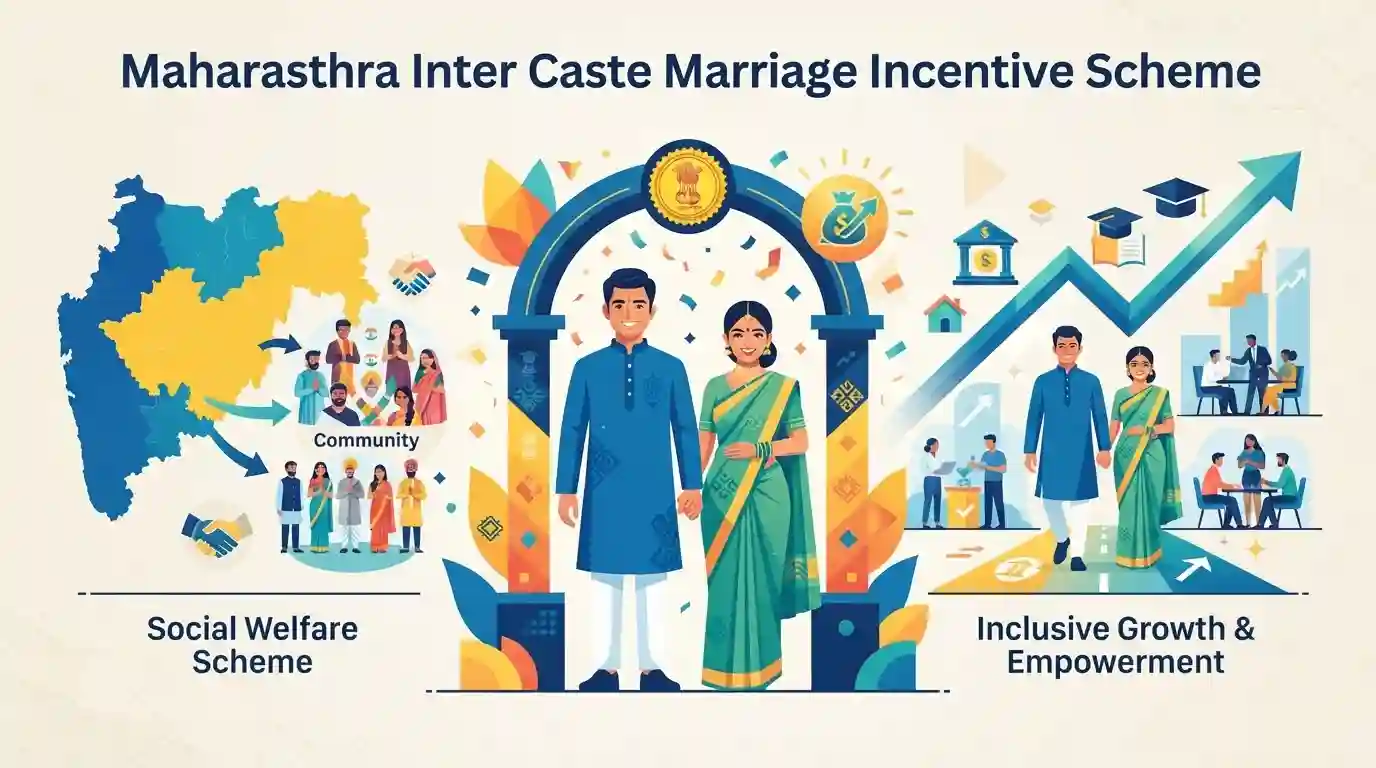
Why It Matters
Important for MPSC aspirants to understand key social welfare and empowerment schemes implemented by the Government of Maharashtra aimed at reducing caste barriers.
Summary
The article discusses the Maharashtra Inter Caste Marriage Incentive Scheme, a state government initiative designed to promote social equality, harmony, and national integration by encouraging marriages between different castes, particularly between scheduled castes/tribes and non-scheduled castes, offering financial incentives to eligible couples.
Key Points
- The Maharashtra government implements an inter-caste marriage incentive scheme to promote social integration, unity, and eradicate untouchability and caste discrimination.
- Financial incentives or rewards are provided to couples entering into inter-caste marriages, specifically where one spouse belongs to a Scheduled Caste (SC) or Scheduled Tribe (ST) or Vimukta Jatis and Nomadic Tribes (VJNT) and the other belongs to a non-scheduled/upper caste.
- The scheme aims to encourage progressive social reform and reduce caste-based barriers in society in line with national and state welfare mandates.
Important Terms
Maharashtra Inter Caste Marriage Incentive Scheme

A state-level welfare initiative providing financial incentives to couples entering inter-caste marriages to promote social equality, harmony, and national integration by dismantling caste boundaries.
UPSC context
MPSC Paper II/III: Tests knowledge of state social welfare schemes, inclusive growth, and administrative measures for caste eradication and social empowerment in Maharashtra.
Social Justice and Special Assistance Department Maharashtra
The state administrative body responsible for implementing welfare policies, social security programs, and financial assistance schemes for marginalized groups including Scheduled Castes and Vimukta Jatis.
UPSC context
MPSC Paper II: Important for understanding state-level administrative machinery and institutional frameworks dedicated to protecting vulnerable and backward classes.
Prelims Trap
The scheme is fully funded by the Maharashtra government and applies to any legally registered marriage.
Aspirants often assume such state-level incentive schemes are exclusively state-funded, ignoring the 50:50 central-state funding pattern or eligibility limits like first-marriage-only criteria.
Static Concepts Connected
What are the constitutional provisions and central schemes aimed at promoting inter-caste marriages in India?
- Central Scheme: Dr. Ambedkar Foundation operates a Central Scheme of Dr. Ambedkar Scheme for Social Integration through Inter-Caste Marriages providing monetary incentives.
- Constitutional Basis: Article 17 abolishes untouchability, and Article 46 directs the State to promote with special care the educational and economic interests of weaker sections.
- State Implementation: In Maharashtra, the Department of Social Justice and Special Assistance administers the incentive scheme to foster social harmony.
Cross-Topic Patterns
Social Welfare Schemes & Cooperative Federalism
Inter-caste marriage schemes are jointly funded by the Centre and States (50:50), reflecting cooperative federalism principles seen in various centrally sponsored welfare frameworks.
Constitutional Mandates & Social Schemes
Measures to eradicate untouchability and caste discrimination draw directly from the Directive Principles of State Policy (Article 46) and fundamental rights (Articles 14-17).

MPSC frequently tests specific funding patterns (50:50) and eligibility criteria (SC/ST/VJNT with upper caste) for state social welfare schemes.
Linked PYQs · 3
Linked PYQs · 3
- 2025MPSC_PRELIMSGS1
Identify the correct statements regarding Bhagwan Birsa Munda Road Linking Scheme. A. This scheme was started by Maharashtra Government. B. This scheme was only launched to connect the tribal villages. C. This scheme was made to connect tribal areas with primary health centres and Ashram schools through main roads. D. This scheme was discontinued by Govt. of Maharashtra in January 2025.
- 2026MPSC_PRELIMSGS1
Consider the following statements regarding the Public Distribution System (PDS) in Maharashtra. (a) By December 2025, there were 270.48 lakh ration card holders in the state. (b) As of 31 October 2025, 51,636 Fair price shops were functioning in the state. (c) By October 2025, about 1.55 crore families received food grains through Aadhaar - based biometric authentication. Which of the statements given above is/are correct ?
- 2018MPSC_PRELIMSGS1
Government of Maharashtra's Sumatibai Sukalikar Udyogini Mahila Sakshamikaran Yojana is related to
