Maharashtra Introduces Incentives to Tackle Malaria in Gadchiroli
Source:The Hindu ↗
हे का महत्त्वाचे आहे
This serves as an excellent case study for GS2 (Governance/Health) and GS3 (Internal Security/Development), illustrating how co-opting indigenous traditional structures and deploying smart financial incentives can bridge the 'last-mile' healthcare delivery gap in conflict-affected, tribal topographies.
सारांश
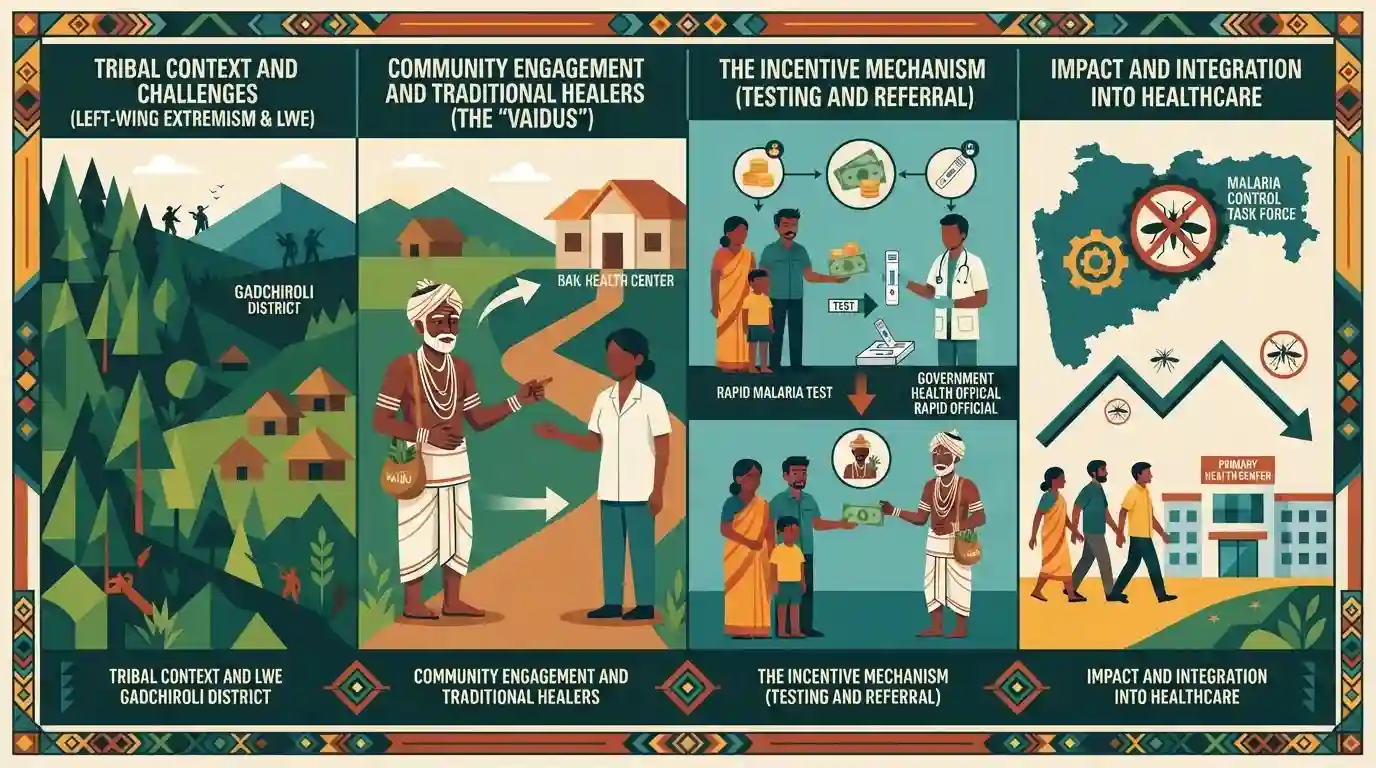
Maharashtra has introduced an innovative, incentive-based public health strategy to combat the severe malaria burden in the tribal-dominated district of Gadchiroli. To overcome deep-seated hesitancy toward modern medicine and structural deficits caused by historical Left-Wing Extremism (LWE), the government is providing cash incentives not only to tribal patients who get tested but also to traditional healers ('vaidus') who refer them to the formal healthcare system. Guided by the state's Malaria Control Task Force, this community-integrated approach mimics successful historical epidemiological campaigns like the smallpox eradication drive, turning grassroots socio-cultural leaders into active agents of public health.
मुख्य मुद्दे
- Gadchiroli, despite housing only 1% of Maharashtra's population, contributes 33% of the state's malaria cases, classifying it as a highly endemic national hotspot for 'forest malaria'.
- A new strategy offers a ₹500 cash incentive to tribal patients who seek medical help and test positive for malaria via a Rapid Diagnostic Test (RDT).
- Crucially, the policy incorporates traditional healers ('vaidus' or 'pujaris') by offering them ₹200 for successfully referring symptomatic patients to formal health channels like ASHA workers or PHCs.
- The initiative is modeled after the successful community-involvement and cash-reward strategies utilized during India's smallpox eradication campaign in the 1970s.
- Long-standing Left-Wing Extremism (LWE) and deep geographical isolation have historically crippled formal healthcare infrastructure in Gadchiroli, necessitating localized behavioral change strategies.
महत्त्वाच्या संज्ञा
Malaria Control Task Force

A specialized committee established by the Maharashtra government, led by Dr. Abhay Bang, to design and implement targeted strategies for eliminating malaria in high-endemic, tribal, and forested districts like Gadchiroli.
UPSC context
GS Paper 2 (Health). Highlights state-led, expert-driven decentralised policy interventions tackling regional public health crises.
Left-Wing Extremism (LWE)
An armed Maoist insurgency exploiting socio-economic grievances. In regions like Gadchiroli, prolonged LWE presence creates severe structural deficits, hindering administrative outreach, infrastructure, and healthcare delivery for marginalized tribal populations.
UPSC context
GS Paper 3 (Internal Security). Illustrates the direct correlation between internal security threats and the lack of development in remote areas.
Vaidus (Traditional Healers)
Indigenous tribal healers heavily trusted for local medical advice. Under Maharashtra's innovative health campaign, these informal socio-cultural leaders receive cash incentives for referring suspected malaria patients to the formal medical system.
UPSC context
GS Paper 2 (Health/Tribal Development). Demonstrates integrating indigenous socio-cultural practices with modern public health strategies to overcome healthcare hesitancy.
Primary Health Centre (PHC)
The foundational unit of India's rural public healthcare system. PHCs provide accessible, basic preventive, promotive, and curative medical services, typically acting as the first point of formal contact for populations of 20,000 to 30,000.
UPSC context
GS Paper 2 (Social Justice/Health). Crucial for evaluating grassroots healthcare delivery, rural infrastructure, and accessibility of state welfare programs.
पूर्वपरीक्षा सापळा
The National Framework for Malaria Elimination (NFME) targets complete nationwide elimination of malaria cases by 2027.
2027 is the interim milestone to interrupt transmission across all states/UTs; the final target year for complete national elimination is 2030.
संबंधित स्थिर संकल्पना
What is India's National Framework for Malaria Elimination (NFME) 2016-2030?
- Elimination Target: Aims to eliminate malaria nationwide (zero indigenous cases) by 2030.
- Interim Milestone: Seeks to interrupt transmission across all states and Union Territories by 2027.
- API Categorization: Classifies states/districts into categories based on Annual Parasite Incidence to customize elimination strategies.
How does the 'security-development nexus' function in LWE areas?
- Governance Vacuum: Lack of basic services like healthcare and connectivity allows extremist groups to exploit local tribal grievances.
- Soft-Power Interventions: Non-kinetic strategies like community health networks rebuild grassroots trust and validate the state's welfare credentials.
- Infrastructure Schemes: Central initiatives like Special Central Assistance (SCA) specifically fund critical development gaps in LWE-affected districts.
आंतर-विषय नमुने
Tribal Health + LWE Internal Security
Poor health access in LWE zones fuels alienation. Integrating traditional healers acts as soft-power governance, rebuilding state-citizen trust and countering insurgent narratives.
Behavioral Economics + Public Health
Using conditional micro-incentives for patients and indigenous healers leverages nudge theory, overcoming structural trust deficits and cultural barriers to modern medical diagnosis.

Multi-statement questions may link malaria elimination targets (NFME 2030) with health delivery challenges in PESA/LWE tribal regions.
संबंधित PYQ · 4
संबंधित PYQ · 4
- 2021MainsGS2
“Besides being a moral imperative of a Welfare State, primary health structure is a necessary precondition for sustainable development.” Analyze.
- 2022MainsGS3
Naxalism is a social, economic and developmental issue manifesting as a violent internal security threat. In this context, discuss the emerging issues and suggest a multilayered strategy to tackle the menace of Naxalism.
- 2018MainsGS3
Left Wing Extremism (LWE) is showing a downward trend, but still affects many parts of the country. Briefly explain the Government of India's approach to counter the challenges posed by LWE.
- 2023PrelimsGS1
Consider the following statements in the context of interventions being undertaken under Anaemia Mukt Bharat Strategy: 1. It provides prophylactic calcium supplementation for pre-school children, adolescents and pregnant women. 2. It runs a campaign for delayed cord clamping at the time of child-birth. 3. It provides for periodic deworming to children and adolescents. 4. It addresses non-nutritional causes of anaemia in endemic pockets with special focus on malaria, hemoglobinopathies and fluorosis. How many of the statements given above are correct?
