Maharashtra Earthquake Swarm and Seismic Zone Vulnerability
Source:the-week ↗
Why It Matters
The phenomenon highlights the unexpected vulnerability of the historically stable Deccan Plateau to monsoon-induced 'earthquake swarms' (hydro-seismicity). It serves as a practical case study for geography and disaster management, underscoring the critical need for earthquake-resistant infrastructure even in moderate-risk (Zone III) seismic areas.
Summary
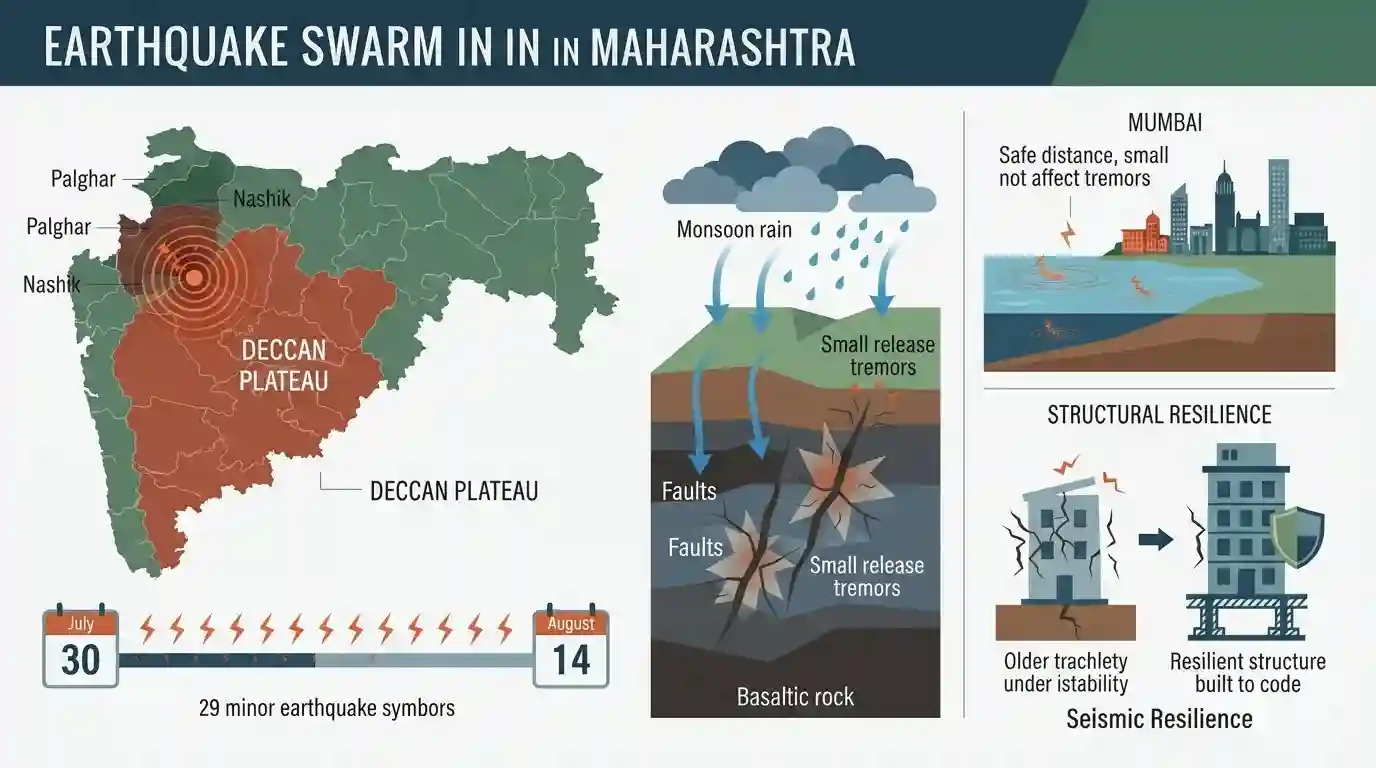
Maharashtra experienced an 'earthquake swarm' comprising 29 minor tremors between July 30 and August 14, 2026, primarily concentrated in Nashik and Palghar. These shallow earthquakes are attributed to monsoon water infiltrating the basaltic rocks of the Deccan Plateau, causing subsurface pressure to build and release as surface-level tremors. Because of their shallow depth, experts note they do not currently threaten Mumbai. However, since Nashik and Palghar fall under Seismic Zone III (moderate risk), authorities and experts strongly advocate for compliance with Indian Standard (IS) 1893 Part 1 to ensure structural resilience against potential future hazards.
Key Points
- An 'earthquake swarm' of 29 minor tremors (magnitudes 2.0 to 4.3) occurred in Maharashtra, primarily in Nashik and Palghar, between July 30 and August 14, 2026.
- The shallow depth of these tremors (5-8km) restricts their range, making them unlikely to pose a significant risk to Mumbai.
- The quakes are driven by hydro-seismicity: monsoon water seeps into cracks within the Deccan Plateau's basaltic rock, increasing pressure that releases as tremors.
- Nashik and Palghar fall under Seismic Zone III (moderate risk), prompting experts to urge strict adherence to earthquake-resistant construction guidelines under IS 1893 Part 1.
Important Terms
Earthquake Swarm

A sequence of numerous low-to-moderate magnitude earthquakes occurring closely in space and time within a localized area, without a singular, dominant mainshock.
UPSC context
GS Paper I (Geography-Geomorphology) and GS Paper III (Disaster Management); tests seismic hazards and disaster preparedness.
Indian Standard (IS) 1893 Part 1
The primary code formulated by the Bureau of Indian Standards (BIS) establishing criteria and provisions for the earthquake-resistant design of normal structures and buildings.
UPSC context
GS Paper III (Disaster Management); tests knowledge of structural building standards, earthquake-resistant design codes, and civil safety regulations.
Seismic Zone III
A classification on the national seismic zone map indicating moderate earthquake hazard risk, covering several peninsular Indian regions including Pune, Nashik, and Palghar.
UPSC context
GS Paper I (Geography of Maharashtra) and GS Paper III; tests understanding of regional seismic vulnerability and safety zoning.
Deccan Plateau
A large volcanic basalt plateau in peninsular India formed by Cretaceous flood basalt flows, generally considered stable but prone to localized reservoir-induced and shallow seismicity.
UPSC context
GS Paper I (Geography of India & Maharashtra); tests physical features, geomorphology, and structural geology of peninsular India.
Hydro-seismicity
A phenomenon where rainwater infiltrates underground fractures, increasing fluid pore pressure inside rock cavities, which subsequently triggers shallow, localized earthquake tremors or swarms.
UPSC context
GS Paper I (Geomorphology/Physical Geography); tests understanding of exogenic hydrologic triggers influencing localized crustal seismic activity.
IIT Bombay
A premier Indian engineering and research institution in Mumbai, whose experts actively study regional seismic hazards, advise on structural engineering, and assist disaster management authorities.
UPSC context
GS Paper III (Science & Technology/Disaster Management); tests institutional role in safety research, seismic monitoring, and regional risk assessment.
Prelims Trap
An earthquake swarm is characterized by a high-magnitude mainshock followed by a series of low-intensity aftershocks.
Swarms are sequences of many low-magnitude shocks over days/weeks without a single, clear, high-magnitude mainshock, unlike standard mainshock-aftershock sequences.
Static Concepts Connected
How is India classified into Seismic Zones, and where does Maharashtra stand?
- Zone classification: India is divided into four seismic zones (II to V); Zone I was merged with Zone II. No part of India is currently in Zone I.
- Maharashtra zonation: Mumbai, Nashik, and Palghar lie in Zone III (moderate risk), while the Koyna-Warna region in Satara district is classified under Zone IV (high risk).
- Plateau vulnerability: The Deccan Shield, once considered seismically stable, faces intraplate earthquakes due to historical fault lines and post-monsoon hydraulic pressure adjustments.
What is hydro-seismicity and how does it affect the Deccan Trap?
- Pore-pressure mechanism: Infiltrating water increases subsurface fluid pressure along pre-existing rock fractures, reducing friction and triggering slip on shallow, localized faults.
- Basaltic aquifer role: The Deccan Trap's fractured basalt allows rapid monsoon water percolation, making districts like Palghar hotspots for seasonal, rain-induced micro-earthquakes.
Cross-Topic Patterns
Monsoon intensity and structural safety
Extreme monsoon events accelerate groundwater infiltration and hydro-seismicity, forcing a re-evaluation of building code compliance (IS 1893) in expanding semi-urban Zone-III districts.
Hydro-seismicity vs Reservoir Seismicity
Both phenomena demonstrate how water triggers tremors in Maharashtra's basaltic shield, linking seasonal Nashik-Palghar swarms with historic reservoir-induced seismicity at Koyna.

MPSC may combine Deccan Plateau geomorphology with India's seismic zonation map to test regional earthquake vulnerability and mechanisms.
Linked PYQs · 2
Linked PYQs · 2
- 2019MPSC_PRELIMSGS1
Examine and identify the correct statements of the following : Statement 'A': Deccan Plateau is made up of Basalt Rock. Statement 'B': The origin of Basalt Rock on the Deccan Plateau is due to the deposition of lava erupted from volcano. Answer Options :
- 2022MPSC_PRELIMSGS1
Match the following : | Column I | Column II | |---|---| | (a) Dome-shaped Plateau | (i) Deccan Plateau | | (b) Volcanic Plateau | (ii) Vindhya Plateau | | (c) Step-like Plateau | (iii) Chota Nagpur Plateau | | (d) Piedmont Plateau | (iv) Shillong Plateau | Answer Options : (a) (b) (c) (d)
