Maharashtra AI Farming Pilot Project for Crop Yields
Source:theprint ↗
Why It Matters
Demonstrates the practical state-level execution of Fourth Industrial Revolution technologies (AI, IoT, Digital Twins, drones) to resolve structural agricultural constraints. Important for answering questions on e-technology applications for farmers, modern irrigation methods, and policy measures to improve agricultural productivity.
Summary
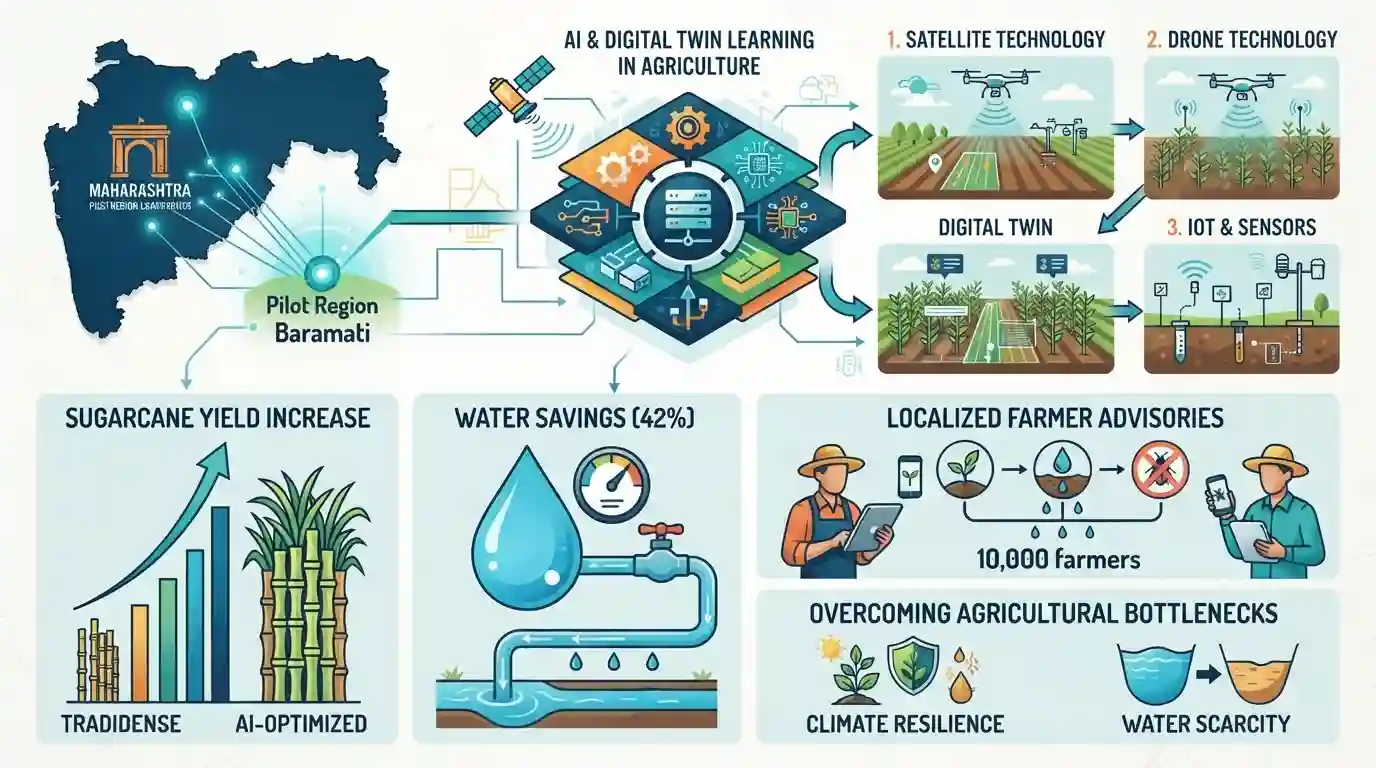
The Maharashtra government is set to roll out a pilot project titled 'Artificial Intelligence and Digital Twin Learning in Agriculture', integrating AI, drones, IoT, and satellite technology to enhance farm yields. Developed by the Agricultural Development Trust in Baramati, the initiative aims to provide 10,000 farmers with localized advisories on crop growth, soil moisture, and pest control. Preliminary trials have already demonstrated a significant increase in sugarcane yields and up to 42% water savings through AI-based irrigation management, underscoring the potential of e-technology to address severe agricultural bottlenecks like climate change and water scarcity.
Key Points
- The Maharashtra government is launching a pilot project targeting 10,000 farmers to boost farm productivity using AI, satellite tech, drones, IoT sensors, and data analytics.
- The project 'Artificial Intelligence and Digital Twin Learning in Agriculture' was developed by the Agricultural Development Trust, Baramati, to combat climate change, water scarcity, and pests.
- Early pilot results in sugarcane farming showed average yield increasing from 65.45 tonnes per acre to 73.12 tonnes per acre.
- AI-driven irrigation management led to a 42% improvement in water conservation, potentially saving around 90,000 litres of water per hectare per day.
- Drone imaging paired with machine learning is being employed for early detection of pests and crop diseases, allowing precise mobile advisories to cultivators.
Important Terms
Artificial Intelligence and Digital Twin Learning in Agriculture

A technological approach that creates virtual, real-time replicas of fields using AI, IoT, and satellite data to provide site-specific farming and irrigation advisories.
UPSC context
GS Paper I (Agri) & GS Paper IV (S&T); tests e-technology in farming, sustainable irrigation, and digital solutions for smallholders.
Digital Twin
A virtual model designed to accurately reflect a physical object or system, updated with real-time sensor data to simulate performance and predict outcomes.
UPSC context
GS Paper IV (Science and Technology); tests emerging digital technologies, simulation tools, and modern data-driven administration.
Agricultural Development Trust (ADT)
A Baramati-based trust that researches and deploys grassroots agricultural technologies in Maharashtra, collaborating with global institutions like Microsoft and Oxford University.
UPSC context
GS Paper I (Maharashtra Economy) & GS Paper IV (S&T); tests role of regional NGOs and institutions in rural extension.
Tiny AI
Compact, efficient machine learning models designed to run locally on low-spec devices or low-bandwidth SMS networks, overcoming infrastructure deficits in remote rural regions.
UPSC context
GS Paper IV (Science and Technology); tests technological solutions to the digital divide and IT applications for marginalized rural farmers.
MahaAgri-AI Policy
Maharashtra's strategic policy framework (2025–2029) focusing on integrating AI, blockchain, and digital infrastructure to modernize agriculture, secure crop yields, and boost rural incomes.
UPSC context
GS Paper I (Economy of Maharashtra) & GS Paper IV (S&T Policy); tests state policies on digital agriculture and sustainable farming.
Prelims Trap
The Digital Twin pilot was developed and implemented directly by the Indian Council of Agricultural Research (ICAR).
The pilot was designed and tested by a regional trust in Baramati, not by a central research body like ICAR or the Union Agriculture Ministry.
Static Concepts Connected
What is a Digital Twin in agricultural technology?
- Virtual representation: A real-time virtual replica of physical farm systems created using IoT sensors, drones, and satellite data.
- Predictive modeling: Allows simulation of pest outbreaks, soil moisture depletion, and crop yields before actual field interventions.
Why is water-use efficiency (WUE) critical for Maharashtra's agriculture?
- Sugarcane footprint: Sugarcane occupies under 5% of cultivated land in Maharashtra but consumes over 70% of its irrigation resources.
- Aquifer conservation: Precision tools reduce groundwater overdraft in rain-shadow regions like Marathwada and Western Maharashtra.
Cross-Topic Patterns
Precision Agtech + Drip Irrigation Mandates
Integrates digital-twin water savings with Maharashtra's policy to mandate micro-irrigation for heavy cash crops like sugarcane.
Extension services + e-governance
Leverages mobile-based AI advisories to modernize the state's Krishi Vigyan Kendra (KVK) delivery systems for climate-resilient farming.

MPSC GS-4/Agri likely to couple Baramati's Digital Twin pilot with state water conservation targets and drone-use policies.
Linked PYQs · 5
Linked PYQs · 5
- 2011MPSC_PRELIMSGS1
Modern technological development is increasingly becoming dependent on
- 2024MPSC_PRELIMSGS1
Identify the correct statements regarding the Chief Minister Solar Agricultural Channel Scheme. (a) This Scheme was started in June 2017, when Devendra Fadanvis was Chief Minister. (b) The main purpose of this Scheme is to provide supply of electricity to farmers through the agricultural feeder. (c) The government has decided to pay ₹ 50,000 per acre as rent to the farmers under this Scheme. (d) Solar panels are set up on government land up to ten kilometres from the 33 kV substation.
- 2006MPSC_PRELIMSGS1
______ helps in water conservation and increasing water use efficiency of a crop.
- 2010MPSC_PRELIMSGS1
By using sprinkler and drip irrigation systems there is ________ % increase in the crop yield.
- 2020MPSC_PRELIMSGS1
What happened in Maharashtra due to fragmentation of agricultural land ? (a) Farmer is not able to produce food grains, sufficient for his family. (b) There are obstacle to supply water to agricultural land. (c) The use of modern agricultural tools is uneconomical. (d) To pay individual attention on agriculture is uneconomical. Answer Options :
