Industrial policy and investment promotion initiatives in Maharashtra
Source:Indian Express ↗
Why It Matters
This provides a strong case study for GS3 on how state governments facilitate ease of doing business (e.g., Maitri Portal) and use policy levers (like reducing industrial electricity tariffs) to attract diversified manufacturing investments and generate employment.
Summary
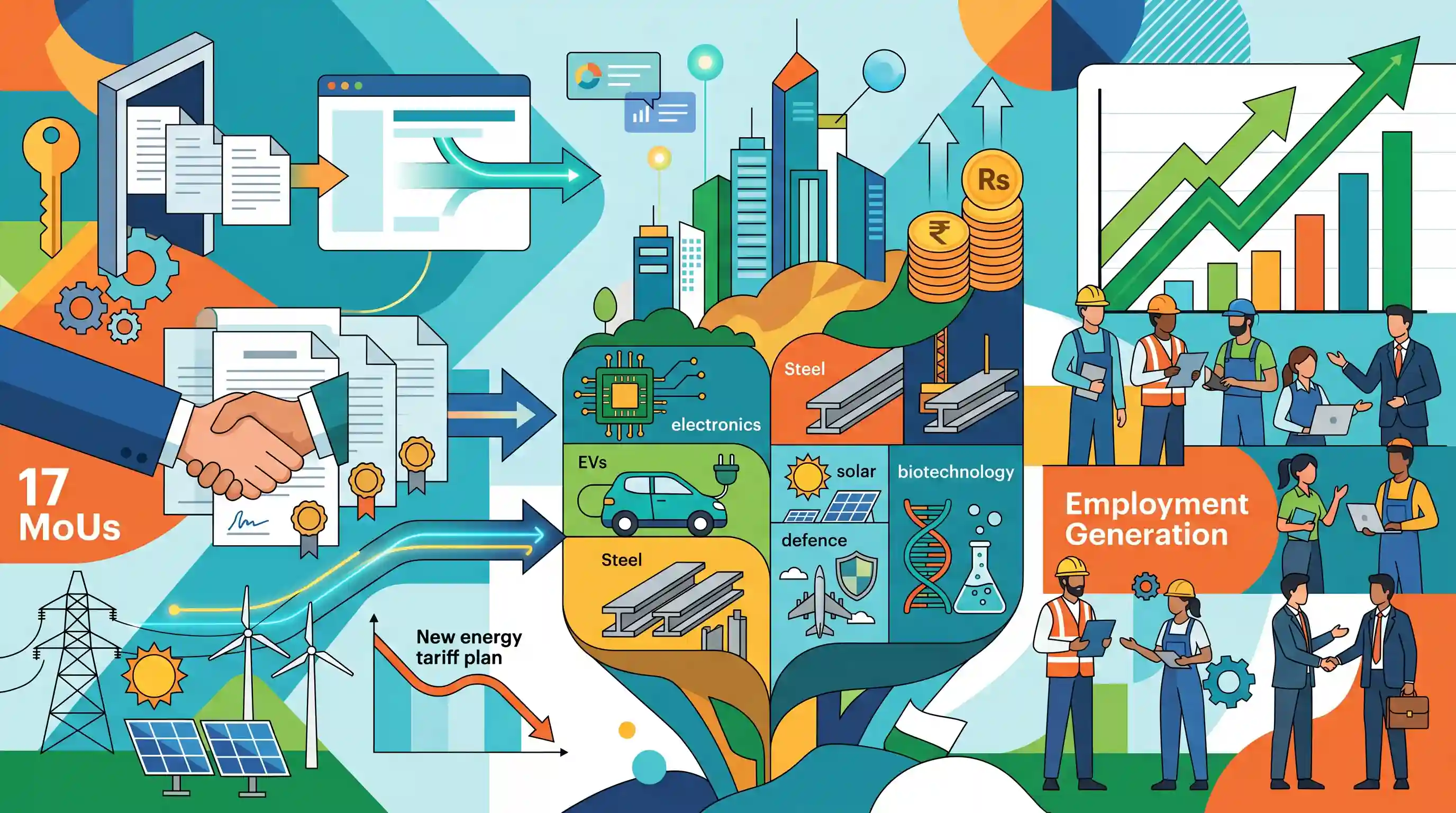
The Maharashtra government has signed 17 Memorandums of Understanding (MoUs) with leading companies to bring in Rs 33,768.89 crore in investments, expected to generate over 33,000 jobs. The investments reflect a focus on industrial diversification, spanning electronics, electric vehicles, steel, solar energy, defence, and biotechnology. Chief Minister Devendra Fadnavis emphasized the state's commitment to an investor-friendly ecosystem, highlighting the 'Maitri Portal' for single-window clearances and a new multi-year energy tariff plan designed to gradually reduce electricity rates for industries.
Key Points
- The Maharashtra government signed 17 MoUs to secure Rs 33,768.89 crore in investments, projecting the creation of 33,483 jobs.
- Investments are diversified across sunrise and traditional sectors, including EVs, electronics, biotechnology, defense, solar energy, and steel.
- The 'Maitri Portal' was highlighted as a one-stop, single-window clearance platform to fast-track land allocations and approvals for industries.
- A new five-year multi-year tariff plan under the state's energy policy aims to gradually reduce electricity rates, reducing operational costs for industrial units.
Important Terms
MAITRI Portal

A one-stop digital platform in Maharashtra facilitating integrated information and single-window clearances for investors. It streamlines permissions across departments to reduce bureaucratic delays and administrative hurdles.
UPSC context
GS Paper 3: Industrial Policy, Ease of Doing Business, and E-governance initiatives for state-led economic growth.
Multi-Year Tariff (MYT) Plan
A regulatory framework where electricity tariffs are determined for a multi-year control period (e.g., five years). It provides pricing predictability for industries and ensures financial stability for distribution companies.
UPSC context
GS Paper 3: Infrastructure (Energy) and Regulatory Frameworks; critical for industrial planning and cost-competitiveness.
Single-Window Clearance System
A facilitation mechanism allowing businesses to submit all regulatory applications through a single entry point. It eliminates the need to visit multiple government offices for different licenses.
UPSC context
GS Paper 3: Ease of Doing Business; important for understanding administrative reforms to attract investment.
Industrial Diversification
An economic strategy of expanding a region's industrial base across multiple sectors (e.g., EVs, solar, defence). It reduces dependency on any single industry and fosters resilient economic growth.
UPSC context
GS Paper 3: Changes in industrial policy and their effects on growth; tests understanding of structural economic shifts.
Ease of Doing Business (EoDB)
A measure of how conducive a regulatory environment is for starting and operating businesses. In India, it involves reforms like tax simplification, digital clearances, and contract enforcement.
UPSC context
GS Paper 3: Investment models and industrial growth; a core theme in Indian economic policy discussions.
Prelims Trap
"Industrial consumers in India enjoy lower electricity tariffs due to cross-subsidization by the agricultural sector."
It is the exact opposite. High industrial tariffs cross-subsidize cheaper agricultural and domestic power, which elevates operational costs and hurts manufacturing competitiveness.
Static Concepts Connected
What is cross-subsidization in India's electricity sector?
- Mechanism: Charging higher utility tariffs to one consumer group (like industries) to fund lower rates or free supply for another (like agriculture).
- Economic impact: Elevates operational costs for domestic manufacturing, making Indian exports less globally cost-competitive.
- Statutory mandate: The Electricity Act and National Tariff Policy advocate gradually reducing cross-subsidy surcharges to within +/- 20% of the average cost of supply.
What are the core components of a Single Window Clearance System (SWCS)?
- Unified interface: Provides a single digital platform for investors to submit data, replacing repetitive physical applications across multiple departments.
- Regulatory integration: Combines land allocation, labour registrations, environmental clearances, and municipal approvals into one synchronized workflow.
- Time-bound approvals: Often backed by state-level Right to Public Services Acts to mandate 'deemed approvals' if bureaucratic deadlines are missed.
Cross-Topic Patterns
Manufacturing push meets climate goals
State-level investments in solar and EV manufacturing align with India's PLI schemes, simultaneously addressing import substitution (cutting supply-chain dependence) and national decarbonization targets.
The employment elasticity paradox
Despite massive capital investment, projected job creation remains proportionately low. This illustrates the macroeconomic challenge of 'jobless growth' in capital-intensive sunrise sectors like electronics.

Expect a 2026 prelims statement interlinking state-level cross-subsidization of electricity with India's manufacturing competitiveness.
Linked PYQs · 5
Linked PYQs · 5
- 2023MainsGS3
Faster economic growth requires increased share of the manufacturing sector in GDP, particularly of MSMEs. Comment on the present policies of the Government in this regard.
- 2022MainsGS3
Economic growth in the recent past has been led by increase in labour productivity." Explain this statement. Suggest the growth pattern that will lead to creation of more jobs without compromising labour productivity.
- 2015MainsGS3
There is a clear acknowledgement that Special Economic Zones (SEZs) are a tool of industrial development, manufacturing and exports. Recognizing this potential, the whole instrumentality of SEZs requires augmentation. Discuss the issues plaguing the success of SEZs with respect to taxation, governing laws and administration.
- 2020MainsGS3
Describe the benefits of deriving electric energy from sunlight in contrast to the conventional energy generation. What are the initiatives offered by our Government for this purpose?
- 2017MainsGS3
Account for the failure of manufacturing sector in achieving the goal of labour-intensive exports. Suggest measures for more labour-intensive rather than capital-intensive exports.
