Maharashtra Electric Vehicle Charging Infrastructure Development
Source:theprint ↗
Why It Matters
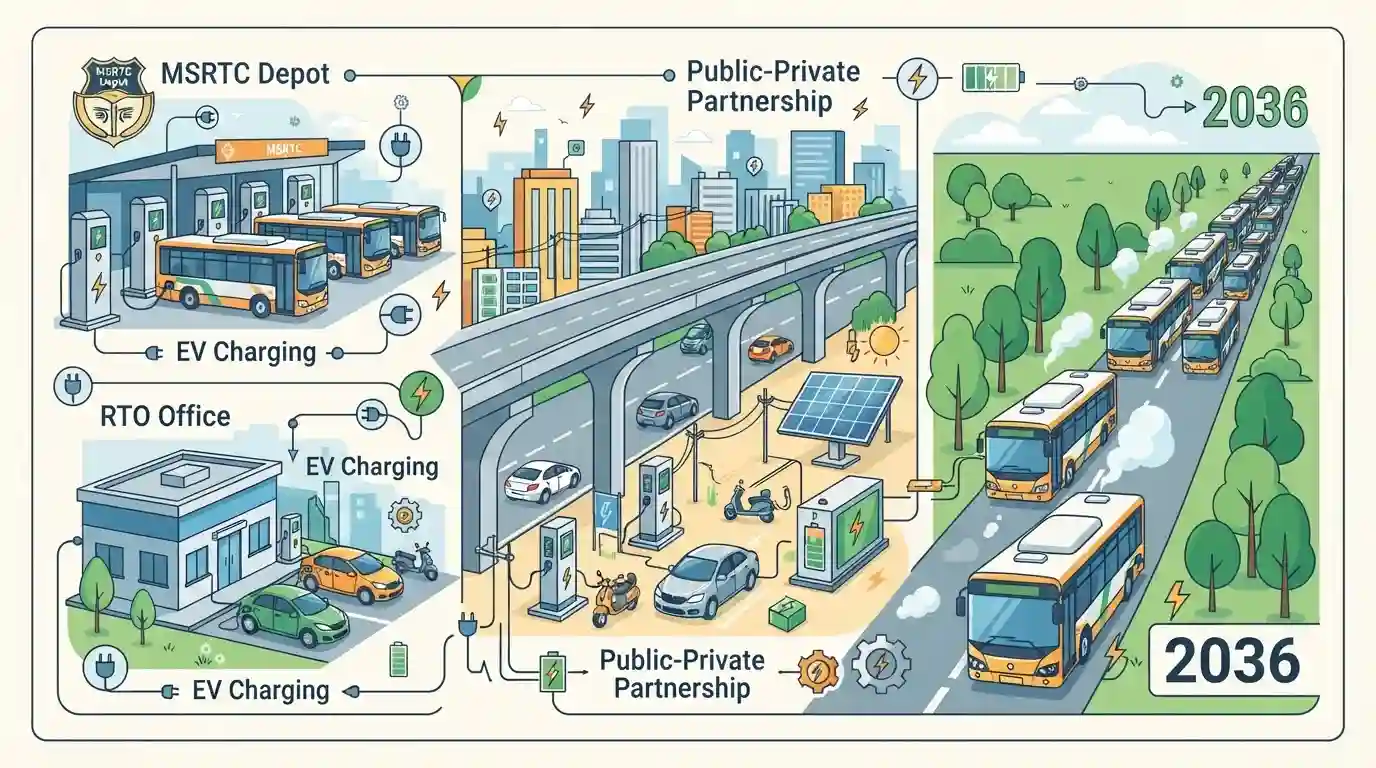
Transitioning to electric mobility is crucial for reducing urban pollution and carbon emissions. Addressing the charging infrastructure bottleneck at the state level through MSRTC depots and PPP models is a major step toward sustainable transport and energy independence in Maharashtra.
Summary
The Maharashtra government has announced a comprehensive plan to boost electric mobility by setting up EV charging infrastructure at all MSRTC depots and Regional Transport Offices (RTOs). To further expand the network, the state is considering a Public-Private Partnership (PPP) model to establish EV charging stations near flyovers. Furthermore, the state transport body, MSRTC, has set an ambitious target to transition its entire fleet to electric buses by 2036, supporting the national vision for sustainable, zero-emission transportation.
Key Points
- The Maharashtra government is planning to establish EV charging stations at all MSRTC depots and RTOs across the state.
- Authorities are considering a Public-Private Partnership (PPP) model to build charging stations under or near flyovers.
- MSRTC aims to convert its entire bus fleet to electric vehicles by the year 2036.
- These initiatives align with the broader vision of achieving 100% electric vehicles to curb pollution and rely on green energy.
Important Terms
Public-Private Partnership (PPP) model

A collaborative arrangement between a government agency and private sector entities to finance, construct, and operate public infrastructure or services, sharing risks, resources, and rewards.
UPSC context
GS Paper 3 (Investment Models) — tests cooperative development frameworks, risk allocation, and infrastructure resource mobilization.
Maharashtra EV Policy 2025
The sub-national policy framework designed to accelerate green transport adoption through fiscal incentives for electric vehicle manufacturing, consumer purchases, and charging grid expansion.
UPSC context
GS Paper 3 (Energy Transition, Environment) — tests state-level climate policies, green industrialization, and regional transportation frameworks.
Maharashtra State Road Transport Corporation (MSRTC)
A state-run public transport bus utility established under the Road Transport Corporations Act, 1950, managing one of India's largest passenger bus fleets.
UPSC context
GS Paper 2 (Statutory Bodies) & Paper 3 (Infrastructure) — tests sub-national administrative utilities and clean public transit transitions.
Regional Transport Offices (RTOs)
A government authority responsible for regulating road transport operations, registering vehicles, issuing licenses, and enforcing safety and emission standards under the Motor Vehicles Act, 1988.
UPSC context
GS Paper 2 (Governance & Administration) — tests transport regulation, federal safety law enforcement, and regional public service delivery.
EV Charging Infrastructure
The network of public and private charging facilities, hardware, and electrical grid systems essential for recharging batteries in plug-in electric vehicles.
UPSC context
GS Paper 3 (Infrastructure, Energy) — tests knowledge of public utility systems, decarbonization goals, and green economy bottlenecks.
Prelims Trap
PM E-DRIVE provides direct demand incentives for all categories of electric vehicles, including private passenger cars and hybrid vehicles.
PM E-DRIVE excludes private electric cars and hybrid vehicles from demand-side subsidies, focusing resources on public and mass transit.
Static Concepts Connected
What is the Gross Cost Contract (GCC) model in public transit PPPs?
- Operating Structure: Private operators procure, operate, and maintain buses, while the public transit authority manages fare collection and pays operators a fixed per-kilometer fee.
- Risk Allocation: Private concessionaires absorb capital, technology, and maintenance risks, whereas the public authority bears the commercial market and fare-box revenue risks.
- Policy Advantage: Enables resource-constrained State Transport Undertakings (STUs) to rapidly scale green fleets without incurring massive upfront capital expenditures.
How does the Payment Security Mechanism (PSM) support public e-buses?
- Core Problem: Addresses the default risk where financially strained state public transport authorities fail to pay private bus operators on time under GCC agreements.
- Mitigation Tool: A dedicated central fund steps in to guarantee timely payments to private concessionaires if a state transit utility defaults.
- Financial Impact: Reduces the cost of borrowing for private developers, boosting commercial lending confidence in green infrastructure projects.
Cross-Topic Patterns
Fiscal Federalism + Green Transport
Sub-national EV incentives spark competitive federalism, but their long-term viability remains tightly bound to Union-level financial backstops like the Payment Security Mechanism (PSM).
Urban Land Monetization + Green Infra
Converting under-flyover spaces and RTO depots for charging infrastructure represents innovative municipal land use, turning passive public land liabilities into active, revenue-generating green assets.

Mains 2026 will likely analyze the viability of GCC-PPP models in public transit decarbonization, focusing on payment security issues.
Linked PYQs · 2
Linked PYQs · 2
- 2024MPSC_PRELIMSGS1
______ development is prioritized over environment degradation in energy generation.
- 2019MPSC_PRELIMSGS1
The LPG model of development was introduced in 1991 by then Finance Minister
