Maharashtra Highway Encroachment Removal And Road Safety Drive
Source:theprint ↗
Why It Matters
Highlights the role of district administration and local self-government institutions (PRIs) in enforcing road safety regulations and preserving public infrastructure, which is a crucial aspect of state governance for MPSC aspirants.
Summary
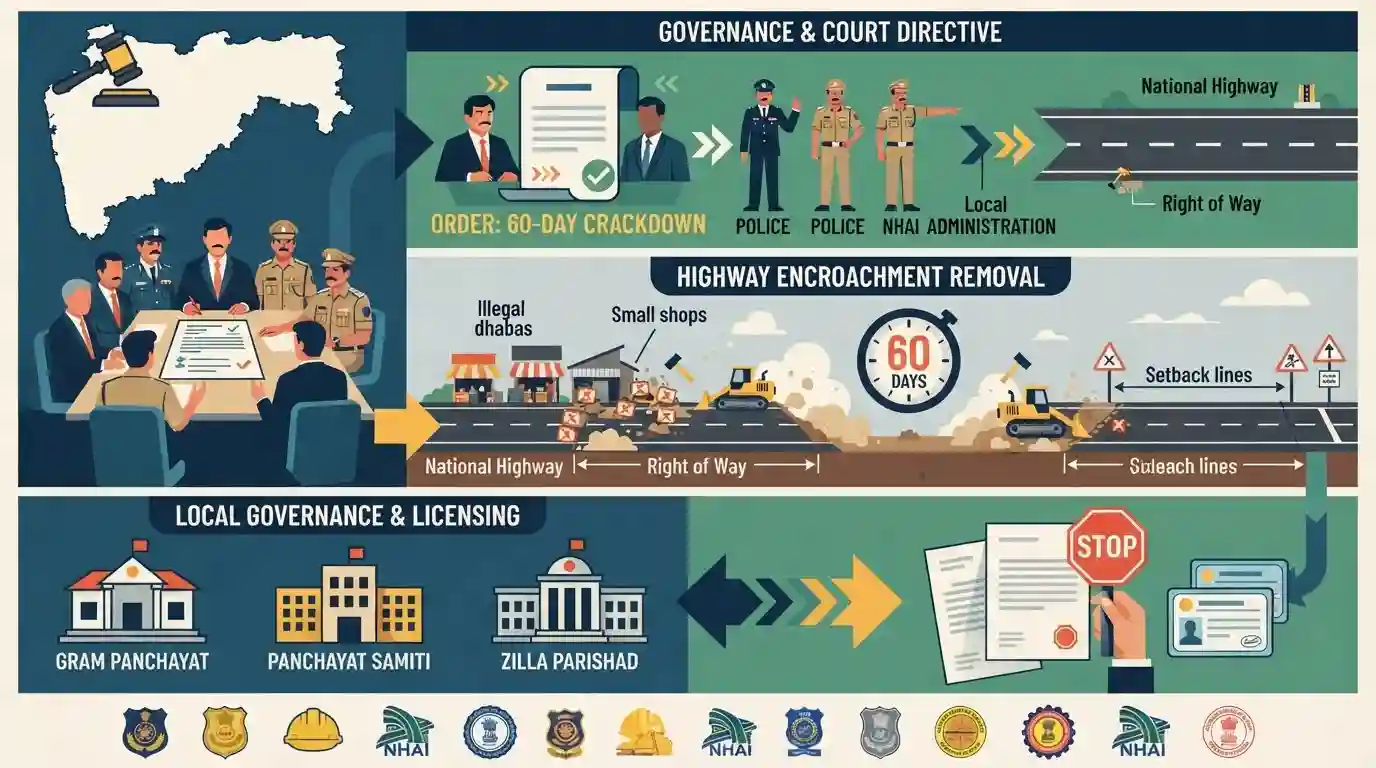
The Maharashtra government has initiated a strict crackdown on illegal dhabas, eateries, and other commercial structures situated within the Right of Way (ROW) along national highways to enhance road safety. Following a Supreme Court directive, the state has ordered district magistrates to demolish these structures within 60 days and form dedicated task forces comprising police, NHAI, PWD, and local administration. Local governance bodies like gram panchayats, panchayat samitis, and district councils have been explicitly instructed to stop granting or renewing licenses for businesses located in designated highway safety zones.
Key Points
- The Maharashtra government ordered the immediate demolition of illegal dhabas and eateries within the Right of Way (ROW) on national highways.
- District magistrates must form task forces with police, NHAI, and PWD to remove illegal structures within 60 days.
- The crackdown enforces a Supreme Court directive aimed at maintaining road safety and preventing obstructions.
- Local bodies, including gram panchayats and district councils, are barred from issuing or renewing licenses for commercial activities in highway safety zones.
Important Terms
Supreme Court

India's highest judicial authority. In this context, it utilized its constitutional powers to issue binding directives on highway right-of-way management, framing road safety as an extension of the Right to Life.
UPSC context
GS-2 (Polity). Highlights judicial activism, Article 142 powers, and the expansion of Article 21 (Right to Life) encompassing road safety.
National Highways Authority of India (NHAI)
A statutory body under the Ministry of Road Transport and Highways, tasked with the development, maintenance, and management of India's national highway network and associated safety infrastructure.
UPSC context
GS-3 (Infrastructure). Tests knowledge of statutory regulatory bodies, investment models, and national infrastructure management frameworks.
District Councils
Also known as Zila Parishads, these form the apex tier of the Panchayati Raj system at the district level, responsible for coordinating rural development, planning, and executing state directives.
UPSC context
GS-2 (Local Governance). Tests the multi-tiered structure of PRIs, rural administration, and district-level execution of policies.
Panchayat Samitis
The intermediate block or tehsil-level tier of the Panchayati Raj system, functioning as a vital administrative link connecting Gram Panchayats to the broader District Council framework.
UPSC context
GS-2 (Local Governance). Tests the structural functioning of the 73rd Amendment and coordination across rural governance tiers.
Gram Panchayats
The foundational village-level institution of local self-government in India. They manage civic facilities and are now restricted from granting commercial licenses in designated highway safety zones.
UPSC context
GS-2 (Governance). Examines grassroots democracy, devolution of powers under PRIs, and local bodies' roles in enforcing safety norms.
Prelims Trap
"Gram Panchayats have absolute jurisdiction to license commercial establishments within their territorial limits."
While PRIs issue licenses for local revenue, NHAI retains overriding statutory control over the ROW under the Control of National Highways Act, 2002.
Static Concepts Connected
How has the Supreme Court linked road safety to Fundamental Rights?
- Right to Life: The Supreme Court has interpreted safe travel on public roads as an integral part of the Right to Life under Article 21.
- State Obligation: This interpretation places a positive obligation on state authorities to remove encroachments, enforce traffic laws, and ensure accident-free corridors.
Who holds administrative control over India's National Highways?
- Union Subject: Highways declared by Parliament as National Highways fall under the Union List in the Seventh Schedule.
- NHAI Authority: NHAI exercises complete control over the Right of Way (ROW) via the Control of National Highways (Land and Traffic) Act, 2002.
- Local Restrictions: Local bodies (PRIs) are restricted from authorizing commercial activities within designated NH safety zones without explicit NHAI/PWD clearance.
Cross-Topic Patterns
Road fatalities as an economic drain
National Highways make up just 2% of India's road network but account for 30% of fatalities, costing 5-7% of GDP annually—highlighting the macroeconomic imperative of the ROW crackdown.
NHAI + ISRO Green Cover Index
Management of ROW extends beyond clearing encroachments; NHAI recently partnered with ISRO's NRSC to map the National Highways Green Cover Index (NH-GCI) using satellite imagery.

Expect a multi-statement question testing the intersection of NHAI's statutory powers over ROW vs PRIs' local licensing authority.
Linked PYQs · 3
Linked PYQs · 3
- 2009MPSC_PRELIMSGS1
________ National Highway has the maximum length in Maharashtra.
- 2007MPSC_PRELIMSGS1
The provision for the 'Panchayat Samiti' is made in which article of Maharashtra Zilla Parishad and Panchayat Samiti Act of 1961 ?
- 2011MPSC_PRELIMSGS1
Who is the Secretary of Zilla Parishad in Maharashtra ?
