Maharashtra Land Allotment Policy And Cooperative Housing Societies
Source:theprint ↗
Why It Matters
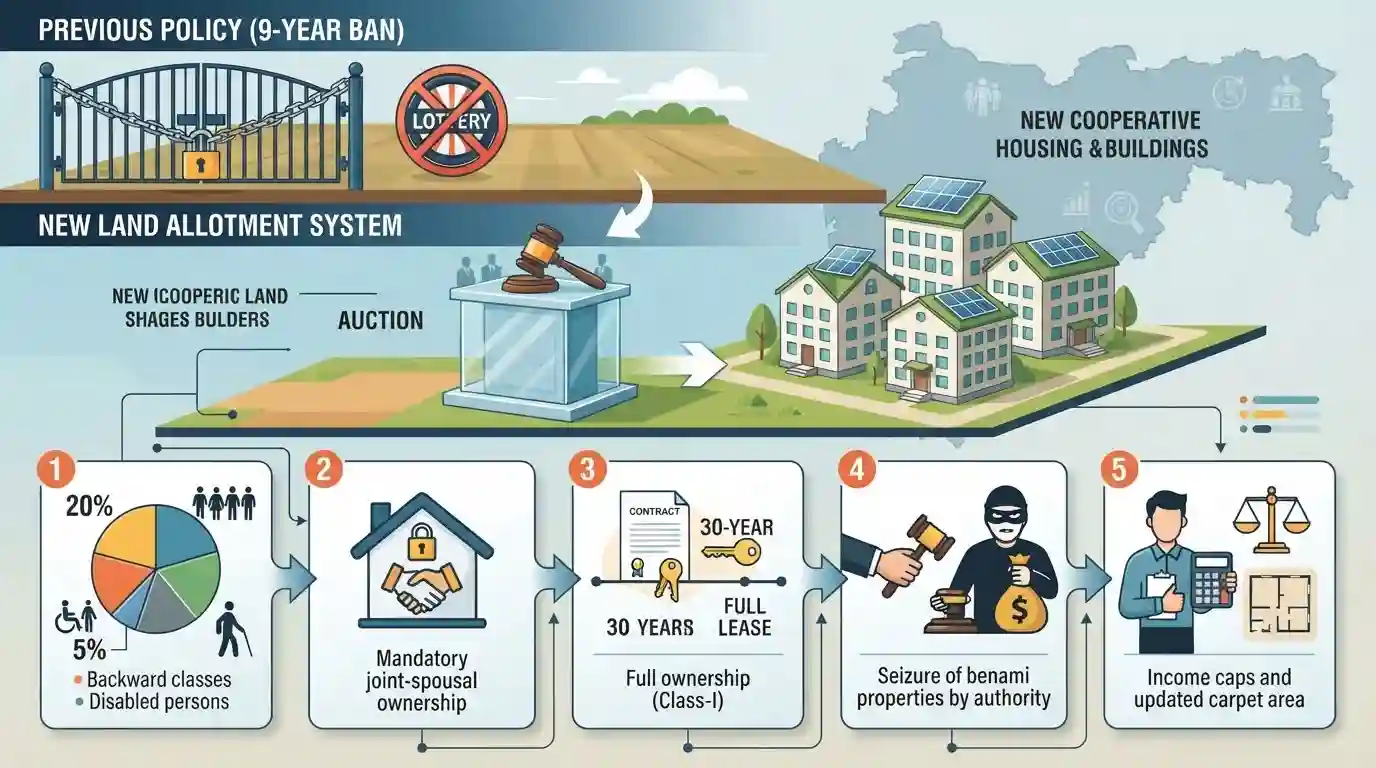
It illustrates crucial policy changes in urban governance and land administration at the state level, emphasizing transparency (auction over lottery), social equity (reservations in housing), and stricter regulatory enforcement against proxy ownership.
Summary
The Maharashtra government has revamped its land allotment policy by lifting a nine-year ban on allocating state-owned land to cooperative housing societies. Shifting from a lottery method to a transparent auction system, the new policy mandates 20% reservation for backward classes and 5% for disabled persons in these societies. It introduces modern regulatory safeguards, including mandatory joint-spousal ownership, 30-year lease periods before granting Class-I occupancy rights, and powers for district collectors to seize 'benami' properties. Income caps and carpet area entitlements have also been updated to align with the 7th Pay Commission recommendations.
Key Points
- The Maharashtra government lifted a freeze, active since 2010, on allotting state-owned land to cooperative housing societies.
- Allotment will now be done through a transparent auction process rather than a lottery, with a base price of 2.5% of market value in Mumbai and 5% elsewhere.
- The policy mandates social reservations within these societies, setting aside 20% flats for backward classes, 5% for persons with disabilities, and 5% for EWS.
- Stringent rules include mandatory joint membership for spouses and giving district collectors power to take over proxy or 'benami' flats without compensation.
- Carpet area norms and income limits for eligibility have been aligned with the 7th Pay Commission guidelines.
Important Terms
Cooperative Housing Society

A legally registered voluntary association under the Maharashtra Co-operative Societies Act, 1960, formed by individuals to collectively manage residential buildings, common amenities, and land-related rights.
UPSC context
MPSC GS Paper III (Cooperation) and GS Paper II (Governance). Tests governance, cooperative laws, and housing policies.
Occupant Class-I
A classification under the Maharashtra Land Revenue Code, 1966, designating holders who hold unalienated land in perpetuity with complete, unrestricted rights to transfer or convert the land without state permission.
UPSC context
MPSC GS Paper I (Geography/Land Revenue) and GS Paper II. Tests land administration, MLRC, and property classifications.
Occupant Class-II
A land tenure classification under the Maharashtra Land Revenue Code, 1966, where the holder has lawful possession but is subject to state-imposed restrictions on transferring or converting the land.
UPSC context
MPSC GS Paper II (State Administration) and GS Paper I. Tests land-use regulations and state revenue policies.
Leasehold Land
Land owned by the state or a landlord leased to an individual or society for a fixed term under specific conditions, requiring renewal or conversion to freehold status upon expiry.
UPSC context
MPSC GS Paper II (State Policies/Land Reform). Tests housing development, lease administration, and urban development policies.
Benami Property
An asset or property held by one person (the 'benamidar') but funded by and held for the benefit of another person, often to evade taxes or bypass legal ceilings.
UPSC context
MPSC GS Paper III (Economy) and GS Paper II (Laws). Tests anti-corruption regulations, financial governance, and property laws.
Prelims Trap
Land allotted under the new auction system is immediately registered as Class-I occupancy (freehold) land.
The land is initially given on a 30-year lease. Transition to Class-I occupancy (unrestricted ownership) is only allowed AFTER the completion of this lease period, not upon auction.
Static Concepts Connected
What is the difference between Class-I and Class-II occupancy under the Maharashtra Land Revenue Code (MLRC), 1966?
- Occupant Class-I: Holds land in perpetuity, free from any restrictions on transferability, partition, or succession.
- Occupant Class-II: Holds land in perpetuity but subject to restrictions on transfer/alienation, requiring prior permission of the Collector/Government and payment of premium.
- Government Lessees: Holders of land under temporary lease terms who do not enjoy occupancy rights unless specifically converted.
What are the constitutional provisions governing cooperative societies?
- Fundamental Right: Article 19(1)(c) guarantees the right to form cooperative societies as a fundamental right.
- DPSP: Article 43B directs the state to promote voluntary formation, autonomous functioning, and democratic control of cooperatives.
- Part IXB: Articles 243ZH to 243ZT govern the incorporation, terms, and election mandates of cooperative societies.
Cross-Topic Patterns
Cooperative Housing + Social Inclusion
Combines land auctioning with strict reservations to enforce mixed-income, diverse housing developments, countering urban segregation.
Asset Ownership + Gender Justice
Mandatory joint-spousal membership leverages state land allocation to structurally correct the historic deficit in female asset-ownership.

MPSC is highly likely to test the structural conditions of this policy, particularly the 30-year lease transition to Class-I occupancy.
Linked PYQs · 3
Linked PYQs · 3
- 2018MPSC_PRELIMSGS1
Government of Maharashtra's Sumatibai Sukalikar Udyogini Mahila Sakshamikaran Yojana is related to
- 2023MPSC_PRELIMSGS1
Which of the following is/are a duties of National Commission for Backward Classes ?
- 2010MPSC_PRELIMSGS1
Article 15 (5) which was inserted with the 93rd Amendment, provides reservation for socially and educationally backward classes of citizens or for scheduled caste or Tribe, paved the way for ________ .
