Public Order: Mumbai Protests Restricted To Azad Maidan Guidelines
Source:uniindia ↗
Why It Matters
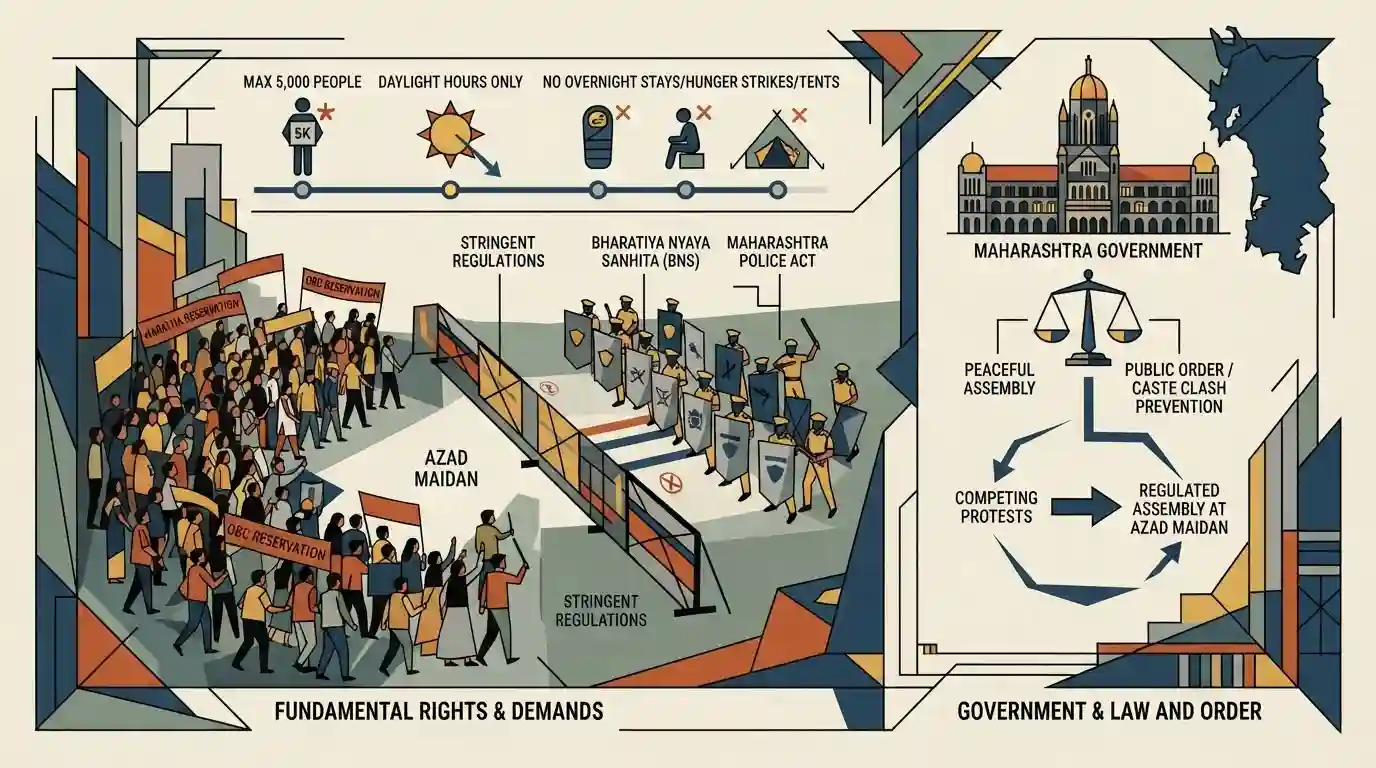
The issue illustrates the practical application of 'reasonable restrictions' on the Fundamental Right to assemble peacefully (Article 19) in the interest of public order. It also brings into focus the evolving administrative response to large-scale, competing socio-political agitations over caste-based reservations.
Summary
In anticipation of massive, competing protests over Maratha and OBC reservations, the Maharashtra Government has issued stringent regulations confining all demonstrations in Mumbai to Azad Maidan. The new guidelines impose strict limits on public assemblies, capping crowds at 5,000, restricting timings to daylight hours, and completely banning overnight stays, hunger strikes, or tent structures. Enforcement will be carried out under the Bharatiya Nyaya Sanhita (BNS) and the Maharashtra Police Act. This administrative action highlights the ongoing tension between safeguarding the fundamental right to peaceful assembly and the state's mandate to impose reasonable restrictions to maintain public order and prevent potential caste clashes.
Key Points
- The Maharashtra Government has restricted all protests in Mumbai strictly to Azad Maidan to prevent unrest ahead of competing agitations by Maratha quota activist Manoj Jarange Patil and OBC leader Laxman Hake.
- New guidelines limit protest crowd sizes to 5,000 people and restrict timings strictly between 8 AM and 10 PM.
- The regulations explicitly ban overnight stays, pitching of tents, hunger strikes, and sit-in dharnas at the protest venue.
- Violators of these public assembly norms will face strict legal action under the newly implemented Bharatiya Nyaya Sanhita (BNS) and the Maharashtra Police Act.
Important Terms
Bharatiya Nyaya Sanhita (BNS)

India's new criminal code that replaced the Indian Penal Code (IPC). It outlines offenses and punishments, emphasizing stricter penalties for various crimes including unlawful assemblies and disobedience of lawful orders.
UPSC context
Crucial for MPSC Polity and Law topics, testing knowledge of India's updated legal framework and its application in maintaining public order.
Maharashtra Police Act
A state legislation governing the police force in Maharashtra. It empowers authorities to issue prohibitory orders, regulate assemblies, and penalize contraventions to maintain public order and prevent disturbances.
UPSC context
Important for MPSC State Administration and Law exams, focusing on police powers and reasonable restrictions on fundamental rights.
Maratha Quota
The demand by the Maratha community for reservation in education and government jobs, often sought under the OBC category by identifying as Kunbis. Led prominently by activist Manoj Jarange Patil.
UPSC context
A major socio-political issue in Maharashtra; highly relevant for MPSC GS papers on Social Justice, Reservation Policies, and State Politics.
OBC Reservation
Affirmative action providing a quota (currently 29% in Maharashtra) for Other Backward Classes in education and jobs. OBC leaders like Laxman Hake protest against sharing this quota with Marathas.
UPSC context
Central to MPSC Social Justice and Polity topics, examining the complexities of affirmative action and inter-community conflicts over reservation distribution.
Prelims Trap
The State can restrict the right to peaceful assembly on grounds of public order, morality, and security of the State.
Article 19(3) limits restrictions on assembly to just two grounds: 'sovereignty and integrity of India' and 'public order'. Morality and security of the State apply only to freedom of speech (19(2)).
Static Concepts Connected
What are the constitutional and statutory provisions regulating public assemblies?
- Article 19(1)(b): Guarantees the fundamental right of citizens to assemble peaceably and without arms.
- Article 19(3): Permits the State to impose reasonable restrictions solely on the grounds of 'public order' and 'sovereignty and integrity of India'.
- Maharashtra Police Act: Section 37 empowers local authorities to prohibit assemblies for up to 15 days (extendable by State sanction) to prevent disorder.
Which key panels are associated with the Maratha reservation timeline?
- M.G. Gaikwad Commission: Basis for the 2018 SEBC Act (16% quota), which was struck down by the Supreme Court in 2021 for breaching the 50% ceiling without empirical justification.
- Sandeep Shinde Committee: Constituted in 2023 to draft an SOP for granting Kunbi (OBC) caste certificates to Marathas using Nizam-era historical records.
- Sunil B. Shukre Commission: Submitted the empirical data report that led to the 2024 SEBC Act granting a 10% standalone quota to Marathas in education and jobs.
Cross-Topic Patterns
Fundamental Rights vs New Criminal Laws
The use of the Bharatiya Nyaya Sanhita (BNS) alongside the Maharashtra Police Act to curb assemblies introduces new statutory dynamics in defining and penalising 'unlawful assembly' against Article 19 rights.
Quota Politics and Sub-categorisation
The tension between Jarange (demanding Maratha-Kunbi inclusion) and Hake (OBC quota protection) mirrors the broader national debate on sub-categorisation of reserved classes and the 50% Supreme Court ceiling.

Expect a multi-statement question testing the exact grounds for restricting freedom of assembly vs freedom of speech, paired with State Police Act powers.
Linked PYQs · 2
Linked PYQs · 2
- 2024MPSC_PRELIMSGS1
Which article empowers the High Courts to issue directions for the enforcement of Fundamental Rights ?
- 2024MPSC_PRELIMSGS1
Women Reservation Bill - 2023, consider the following statements : (a) Narishakti Vandan Adhiniyam officially the Constitutional (One hundred and twenty eight amendment) bill - 2023 is a bill introduced in the Parliament of India. (b) The Women reservation bill was introduced by Prime Minister Narendra Modi in Lok Sabha on 10th Sept. 2023. (c) This legislation seeks to allocate 30 percent of the seats in Lok Sabha and State legislative assemblies for women. (d) The bill was the first that was considered in the new Parliament building. Select the correct statements from the above.
