Tribal Student Protests: Maharashtra Government Accepts Key Demands
Source:theprint ↗
Why It Matters
The article deals with critical issues of governance, constitutional safeguards under the Fifth Schedule, and administrative reforms affecting Scheduled Tribes in Maharashtra. It highlights the challenges of implementing the PESA Act, managing public service rosters, auditing state-run tribal educational institutions, and enforcing judicial guidelines on caste validity certificates.
Summary
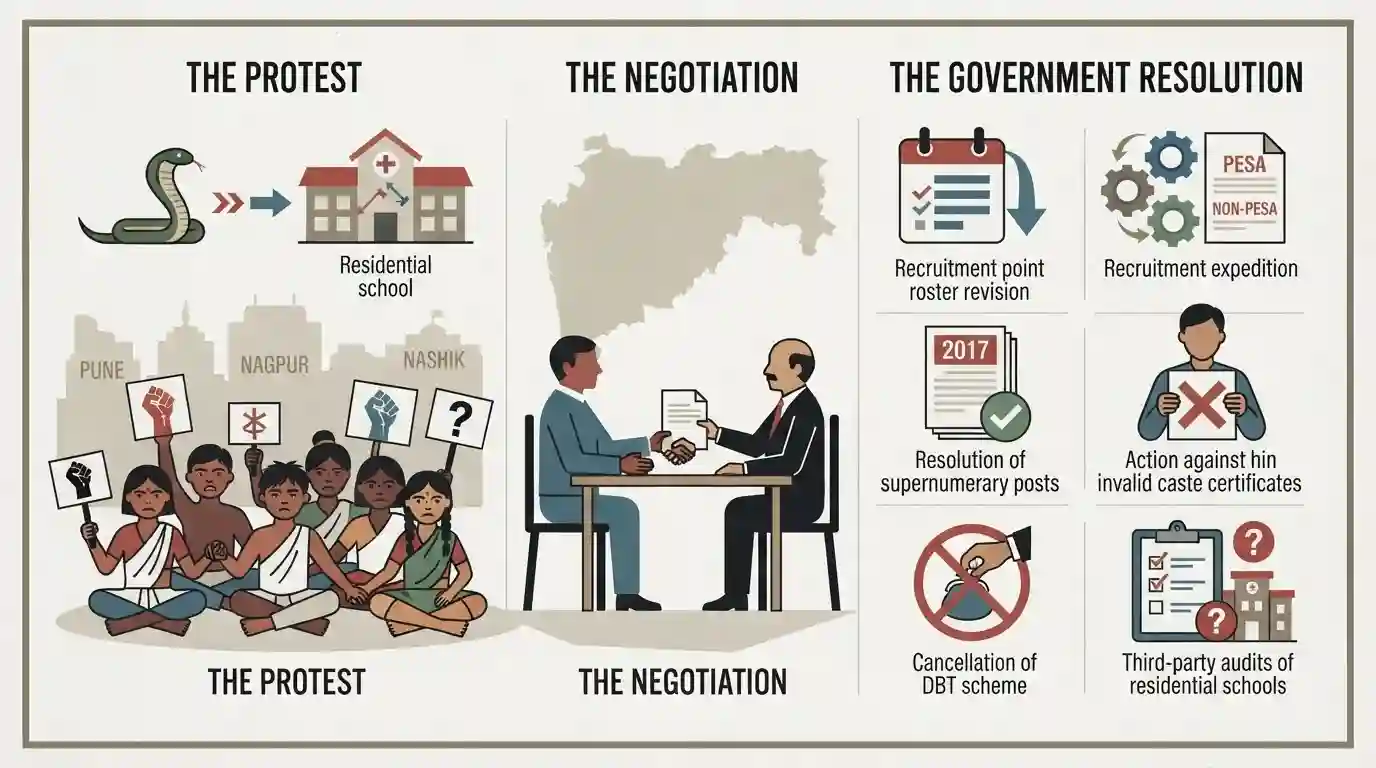
Following a hunger strike by tribal students in Pune, Nagpur, and Nashik, triggered by the snakebite deaths of three tribal girls in a Gadchiroli residential school, the Maharashtra government accepted all key demands of the protestors. Led by Chief Minister Devendra Fadnavis and Tribal Development Minister Ashok Uike, the government agreed to revise the recruitment point roster for Scheduled Tribes, expedite PESA and non-PESA recruitments, resolve supernumerary post issues in accordance with the 2017 Supreme Court ruling, initiate action against employees lacking valid caste certificates, cancel the Direct Benefit Transfer (DBT) scheme, and conduct third-party audits of tribal residential schools.
Key Points
- The protest, held across Pune, Nagpur, and Nashik, was triggered by the tragic death of three tribal girls from snakebites at a residential school in Gadchiroli district.
- The Maharashtra government agreed to place Scheduled Tribes (ST) in the second position of the state's employment point roster, subject to a committee's review within three months.
- Regarding recruitment under the Panchayats (Extension to Scheduled Areas) Act (PESA), recruitment has been completed for 9 out of 17 covered cadres; recruitment for the remaining 8 cadres will begin immediately.
- The government committed to establishing the number of supernumerary posts for ST candidates within three months and completing the process within six months, following the Supreme Court's landmark July 6, 2017 judgment on caste certificate validation.
- Prompt administrative action, including termination where applicable, will be initiated against candidates appointed in 2018, 2019, and 2020 who failed to submit their caste validity certificates within the mandatory six-month period.
- The state government decided to cancel the Direct Benefit Transfer (DBT) scheme for tribal students and set up a committee to review the central kitchen system for tribal schools within 15 to 30 days.
- The administration will initiate third-party audits of both government-run and government-aided tribal residential schools (Ashram Shalas) to identify and rectify infrastructural and safety deficiencies.
- The Bombay High Court (comprising Acting Chief Justice Ravindra Ghuge and Justice Gautam Ankhad) took suo motu notice of the strike, directing the state government to ensure the students' health and well-being.
Important Terms
Panchayats (Extension to Scheduled Areas) Act, 1996 (PESA)

A Central Act extending Part IX of the Constitution to Fifth Schedule areas, empowering local Gram Sabhas with self-governance, management of resources, and tribal welfare policies.
UPSC context
MPSC GS Paper II. Tests tribal administration, decentralization, and Scheduled Area governance under the Fifth Schedule.
Supreme Court Judgment of July 6, 2017 (Chairman & Managing Director, FCI v. Jagdish Balaram Bahira)
A landmark ruling establishing that obtaining public employment or education using invalid caste certificates is void ab initio, and the candidate must be dismissed regardless of their service tenure.
UPSC context
MPSC GS Paper II. Tests reservation laws, caste certificate scrutiny committees, and judicial checks on affirmative action fraud.
Direct Benefit Transfer (DBT) Scheme
A government mechanism transferring subsidies, scholarships, or cash benefits directly into the Aadhaar-linked bank accounts of beneficiaries to eliminate corruption, delays, and administrative leakages.
UPSC context
MPSC GS Paper III. Tests public service delivery, welfare schemes, and digital governance mechanisms in human resource development.
Bombay High Court
One of India’s oldest High Courts, holding original and appellate jurisdiction over Maharashtra, Goa, and the Union Territories of DNH and DD.
UPSC context
MPSC GS Paper II. Tests the state judiciary, writ jurisdiction under Article 226, and judicial oversight of state executive actions.
Prelims Trap
Employees who have completed decades of service before their caste certificate is invalidated are legally protected from termination.
The Supreme Court in the 2017 'Jagdish Balaram Bahira' case ruled that jobs secured on false caste claims are void ab initio, offering no equity-based protection regardless of service duration.
Static Concepts Connected
What are the core administrative provisions under the Fifth Schedule?
- Governor's Power: Can exclude or modify central or state laws applicable to Scheduled Areas within the state.
- Tribes Advisory Council: Consists of maximum 20 members, three-fourths of whom must be ST representatives in the State Legislative Assembly.
- Presidential Reports: Governor must submit annual or periodic reports to the President of India regarding the administration of Scheduled Areas.
What is the administrative role of Gram Sabhas under PESA 1996?
- Resource Control: Owns minor forest produce and approves all socio-economic development plans and programs before implementation.
- Mineral Rights: Prior recommendation of Gram Sabha is mandatory for granting prospecting licenses or mining leases for minor minerals.
- Social Control: Empowered to enforce prohibition, control money lending, manage village markets, and prevent alienation of tribal land.
Cross-Topic Patterns
Ashram Shalas + Governance Audits
Infrastructure failures in residential schools highlight gaps in tribal schemes, shifting policy focus from direct benefit transfers (DBT) back to physical state-managed safety audits.
Caste Validation + Public Employment
The strict implementation of SC's 2017 ruling on invalid caste certificates illustrates the intersection of affirmative action, constitutional morality, and administrative reforms in state recruitment.

PESA local cadre recruitment rules and SC's ruling on caste validation likely to feature in GS-2 legislative/policy questions.
Linked PYQs · 4
Linked PYQs · 4
- 2018MPSC_PRELIMSGS1
Consider the following statements : a. The provisions of Part IX of the Constitution relating to the Panchayats are not applicable to the Fifth Schedule Areas. b. At present seven states have Fifth Schedule Areas. c. The Parliament has enacted the PESA Act in 1996 for such areas. Which of the above statements is/are correct ?
- 2023MPSC_PRELIMSGS1
Provisions of the Constitution relating to the administration of Scheduled Areas and Scheduled Tribes in Schedule - V
- 2018MPSC_PRELIMSGS1
In Maharashtra, Dr. Abdul Kalam Amrut Ahar Yojana is related with
- 2026MPSC_PRELIMSGS1
Match the following forest circles with their share in percentage to total forest area of Maharashtra. | (Forest circles of Maharashtra) | (Percentage to total forest area Economic survey of Maharashtra (2024)) | |---|---| | (a) Gadchiroli | (1) 12.5 | | (b) Nagpur | (2) 20.8 | | (c) Dhule | (3) 9.5 | | (d) Thane | (4) 10.4 | Code: (a) (b) (c) (d)
