Maharashtra Kunbi Caste Certificates And Reservation Policy
Source:The Hindu ↗
Why It Matters
Understanding the constitutional and legal frameworks governing SEBCs, OBC categorization, and EWS quotas is crucial for MPSC aspirants. The ongoing Maratha reservation agitation highlights state-level policies, constitutional amendments (like the 105th Amendment restoring states' power to identify SEBCs), and welfare administration in Maharashtra.
Summary
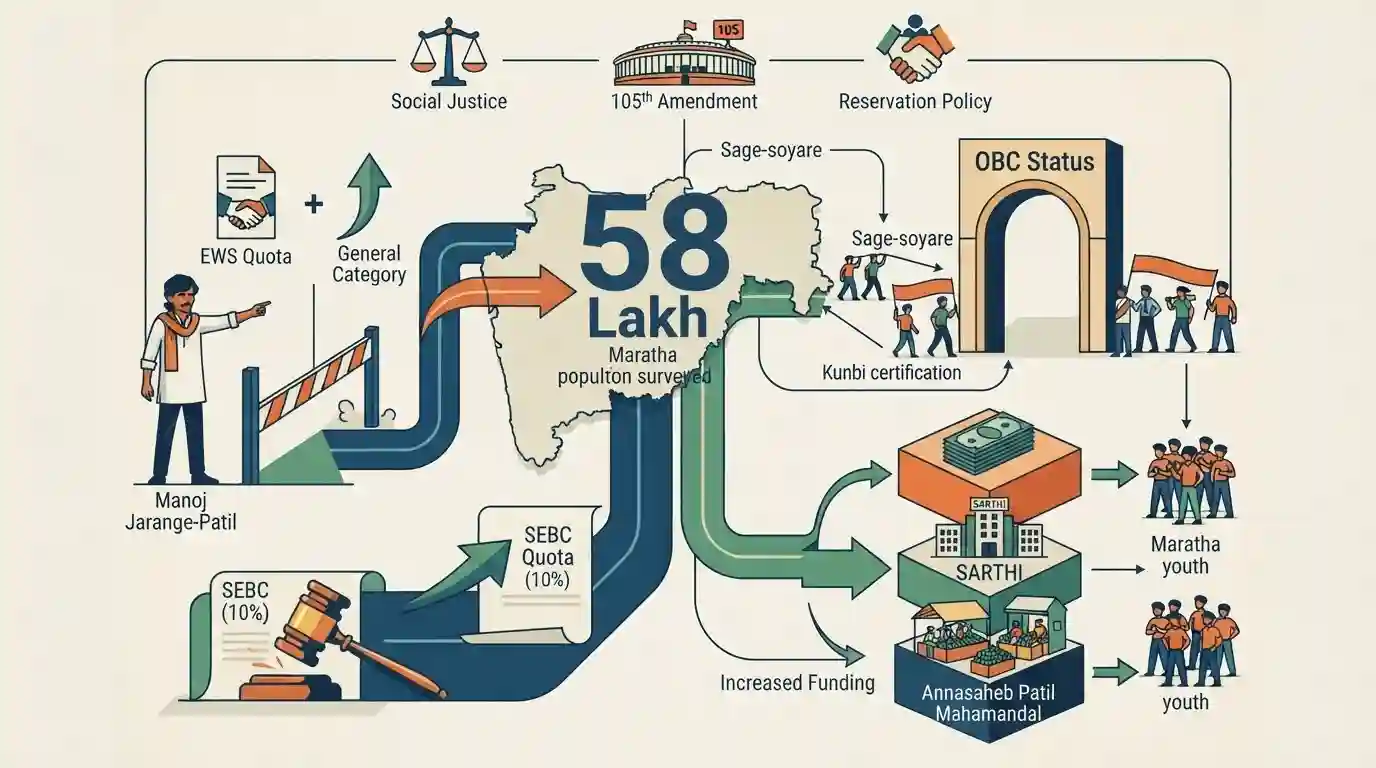
The Maharashtra government intends to issue Kunbi caste certificates to around 58 lakh Marathas based on recent surveys. However, Maratha quota activist Manoj Jarange-Patil has opposed the state's approach, claiming it is a deliberate tactic to strip these youth of their eligibility for the Economically Weaker Section (EWS) quota and general category opportunities by forcing them into the new 10% Socially and Educationally Backward Classes (SEBC) quota, which is currently facing legal hurdles. He continues to demand Kunbi certificates for all blood relatives (Sage-soyare) to secure OBC status, while also pressing the government to boost funding for community welfare entities like SARTHI and the Annasaheb Patil Mahamandal.
Key Points
- The Maharashtra government plans to issue Kunbi caste certificates to approximately 57.5 lakh members of the Maratha community found to have Kunbi antecedents.
- Activist Manoj Jarange-Patil alleges this move is a conspiracy to confine the Maratha youth to the legally challenged 10% SEBC quota, denying them benefits under the EWS and general categories.
- Jarange-Patil is advocating for Kunbi certificates to be issued not just to applicants but also to their 'Sage-soyare' (blood relatives), enabling them to access the broader OBC reservation.
- Demands include better implementation and funding for welfare programs tied to SARTHI and the Annasaheb Patil Mahamandal, which provide scholarships and business loans to Maratha youth.
Important Terms
Socially and Educationally Backward Classes (SEBC) Act

A Maharashtra law granting reservation in education and public employment to communities recognized as socially and educationally backward. Designed primarily for the Maratha community, it has faced continuous judicial scrutiny over the 50% reservation ceiling.
UPSC context
Vital for GS-2 (Polity and Social Justice), testing knowledge of state affirmative action policies, constitutional limits, and Supreme Court judgments.
Economically Weaker Section (EWS) Quota
A 10% reservation in public jobs and education for General Category candidates. Enabled by the 103rd Constitutional Amendment, eligibility in Maharashtra requires an annual family income below ₹8 lakh alongside specific asset limitations.
UPSC context
Relevant for GS-2 (Social Justice), assessing understanding of reservation criteria, poverty alleviation policies, and key constitutional amendments.
Chhatrapati Shahu Maharaj Research, Training and Human Development Institute (SARTHI)
An autonomous government institute in Pune established to study the socio-economic issues of the Maratha and Kunbi communities. It provides skill training, fellowships, and competitive exam guidance to foster educational upliftment.
UPSC context
Key for GS-3 (Human Resource Development) and GS-2, highlighting state-sponsored institutional mechanisms for targeted social welfare and educational empowerment.
Annasaheb Patil Arthik Magas Vikas Mahamandal
A Maharashtra state government corporation that provides financial assistance, interest-free loans, and entrepreneurship support to economically backward youth, specifically targeting the Maratha community to encourage self-employment and economic growth.
UPSC context
Crucial for GS-3 (Economy and Employment), testing awareness of state-level schemes promoting youth entrepreneurship, financial inclusion, and inclusive economic growth.
Prelims Trap
Communities recognized as SEBCs by a state can simultaneously avail EWS quota if they meet the income criteria.
The 103rd Amendment explicitly restricts the 10% EWS quota to those *not* covered under existing SC, ST, or OBC/SEBC reservations. SEBC inclusion automatically voids EWS eligibility.
Static Concepts Connected
How did the 105th Constitutional Amendment alter the identification of SEBCs?
- Restored State Power: Reaffirmed the authority of State governments to independently identify and maintain their own state lists of Socially and Educationally Backward Classes (SEBCs).
- Amended Articles: Modified Articles 338B, 342A, and 366(26C) to exempt states from having to consult the NCBC for state-level backward class lists.
What are the mandates of SARTHI and Annasaheb Patil Mahamandal in Maharashtra?
- SARTHI's Focus: A non-profit providing fully sponsored coaching for competitive exams (UPSC/MPSC) and fellowships primarily for Maratha, Kunbi, and allied communities.
- Annasaheb Patil Mahamandal: Established in 1998, it targets unemployed youth from the Maratha community by offering skill development, self-employment support, and interest-free business loans.
Cross-Topic Patterns
EWS exclusion vs. State SEBC classification
The quota friction highlights a key constitutional mechanism: inclusion in a state-level backward class (SEBC) legally disqualifies candidates from the broader EWS pool under Article 15(6) and 16(6).
Dual OBC lists and the 105th CAA
The demand for blood-relative 'Kunbi' certificates connects to the dual-list system post-105th Amendment, where communities prefer established OBC inclusion over newly created, legally vulnerable SEBC categories.

Expect multi-statement MPSC questions combining the 103rd (EWS) and 105th (SEBC) Amendments, specifically testing the criteria overlaps.
Linked PYQs · 2
Linked PYQs · 2
- 2021MPSC_PRELIMSGS1
The Constitution 105th amendment act, 2021 related to the socially and educationally backward classes, amends ________ articles of Indian Constitution.
- 2010MPSC_PRELIMSGS1
Article 15 (5) which was inserted with the 93rd Amendment, provides reservation for socially and educationally backward classes of citizens or for scheduled caste or Tribe, paved the way for ________ .
