Tribal Welfare: Age Limit Scrapped For Government Hostel Admissions
Source:The Hindu ↗
Why It Matters
This highlights ongoing administrative and welfare issues concerning Scheduled Tribes (ST) in Maharashtra, particularly regarding educational infrastructure like Ashram Schools and government hostels. It is highly relevant for MPSC questions on state-specific tribal welfare policies and social justice.
Summary
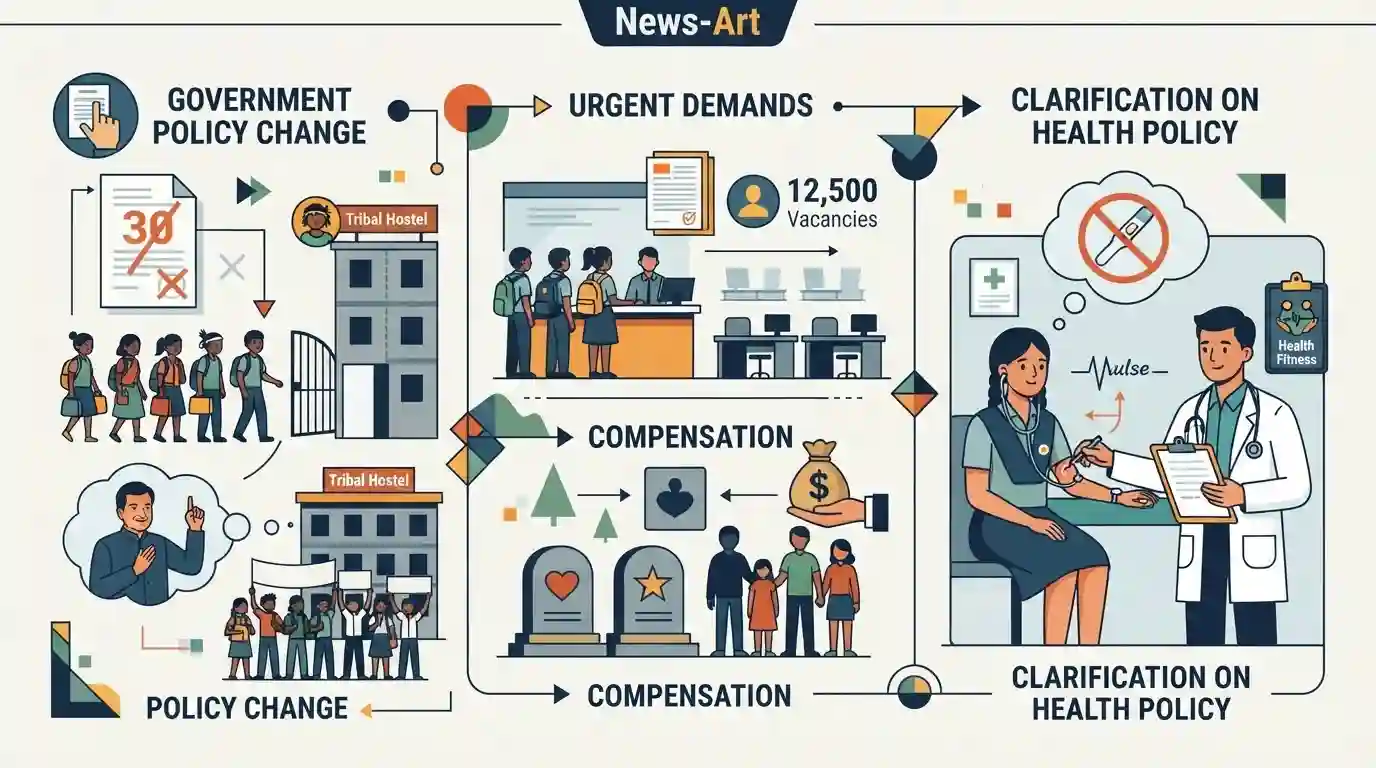
The Maharashtra government has scrapped the 30-year age limit for admission to tribal hostels following political intervention and ongoing student protests. Tribal students in Pune have been agitating over several demands, including the urgent filling of 12,500 vacancies in the tribal department and compensation for the deaths of two girls at a Gadchiroli Ashram school. The state's Tribal Affairs Minister also denied allegations that female students were subjected to pregnancy tests, clarifying that only routine health fitness certificates were required.
Key Points
- The Maharashtra government revoked a policy that imposed a 30-year age limit for admission to government-run tribal hostels.
- The decision followed a letter by Rahul Gandhi to Chief Minister Devendra Fadnavis highlighting the grievances of protesting tribal students.
- Tribal students are also demanding the filling of 12,500 vacancies in the Tribal Development Department and ₹1 crore compensation for the families of two girls who died from snake bites in a Gadchiroli Ashram school.
- Allegations regarding mandatory pregnancy tests for female tribal students returning from holidays were firmly denied by Tribal Affairs Minister Ashok Uike, who clarified they were routine fitness tests.
Important Terms
Tribal Hostels Scheme

A Maharashtra government initiative providing free boarding, lodging, and maintenance allowances to tribal students pursuing higher education in cities. It aims to prevent dropouts caused by financial constraints or lack of accommodation.
UPSC context
Relevant for MPSC GS-3 (Human Resource Development) and GS-2 (Social Justice), testing knowledge of state interventions for tribal education and welfare.
Ashram Schools
Government-run residential schools (Ashram Shalas) established specifically for children from Scheduled Tribe communities in remote or hilly areas of Maharashtra, providing integrated free schooling, lodging, and boarding.
UPSC context
Important for MPSC GS-3 (Education) and GS-2 (Vulnerable Sections). Tests state mechanisms for bridging educational gaps in remote tribal habitats.
Tribal Development Department
An independent Maharashtra government department established in 1983, responsible for formulating and implementing welfare schemes, the Tribal Sub-Plan, and managing educational infrastructure like Ashram Schools and hostels for ST communities.
UPSC context
Crucial for MPSC GS-2 (State Administration). Tests understanding of institutional mechanisms and state administrative structures dedicated to tribal empowerment.
Prelims Trap
"Pandit Deendayal Upadhyay Swayam Yojana is a central scheme for tribal youth skill development."
It is a Maharashtra state scheme providing direct financial assistance (DBT) to ST students for accommodation and meals when denied government hostel admission, not a skill scheme.
Static Concepts Connected
How does the Fifth Schedule govern Scheduled Areas in Maharashtra?
- Presidential Declaration: The President of India is empowered to declare an area as a Scheduled Area and can alter its boundaries in consultation with the Governor.
- Governor's Authority: The Governor can direct that specific parliamentary or state laws do not apply, or apply with exceptions and modifications, to Scheduled Areas.
- Tribes Advisory Council: States with Scheduled Areas must establish a TAC (up to 20 members), where three-fourths are ST representatives from the State Legislative Assembly.
Which tribes are officially recognized as PVTGs in Maharashtra?
- Madia Gonds: A forest-dwelling community residing predominantly in the remote and dense forest regions of Gadchiroli district (e.g., Bhamragad).
- Katkaris: Found primarily in the western coastal and foothill districts of Maharashtra, such as Raigad, Thane, and Palghar.
- Kolams: An agrarian and forest-dependent tribal group concentrated mostly in Yavatmal district and adjacent areas of the Vidarbha region.
Cross-Topic Patterns
Ashram Schools & Health Deficits
The Gadchiroli snakebite deaths highlight the critical intersection of tribal educational schemes (Ashram schools) and severe rural health infrastructure deficits, a common theme in MPSC Human Development questions.
DBT vs Institutional Support
Links institutional capacity constraints (Tribal hostels) to DBT alternatives (Pandit Deendayal Upadhyay Swayam Yojana), showcasing the shift toward direct cash transfers in Maharashtra's Social Welfare policies.

Expect match-the-following questions linking Maharashtra's PVTGs to their districts, or multi-statement queries on the Swayam Yojana.
Linked PYQs · 3
Linked PYQs · 3
- 2018MPSC_PRELIMSGS1
In Maharashtra, Dr. Abdul Kalam Amrut Ahar Yojana is related with
- 2025MPSC_PRELIMSGS1
Identify the correct statements regarding Bhagwan Birsa Munda Road Linking Scheme. A. This scheme was started by Maharashtra Government. B. This scheme was only launched to connect the tribal villages. C. This scheme was made to connect tribal areas with primary health centres and Ashram schools through main roads. D. This scheme was discontinued by Govt. of Maharashtra in January 2025.
- 2023MPSC_PRELIMSGS1
Provisions of the Constitution relating to the administration of Scheduled Areas and Scheduled Tribes in Schedule - V
