Ladki Bahin Yojana inclusion errors and civil service accountability
Source:Indian Express ↗
Why It Matters
The incident highlights systemic challenges in Direct Benefit Transfer (DBT) schemes, specifically inclusion errors where non-target groups siphon off welfare funds. It serves as an excellent case study for GS4 regarding the lack of probity and ethical conduct among civil servants, as well as for GS2 concerning welfare scheme leakages and the importance of e-governance mechanisms like e-KYC.
Summary
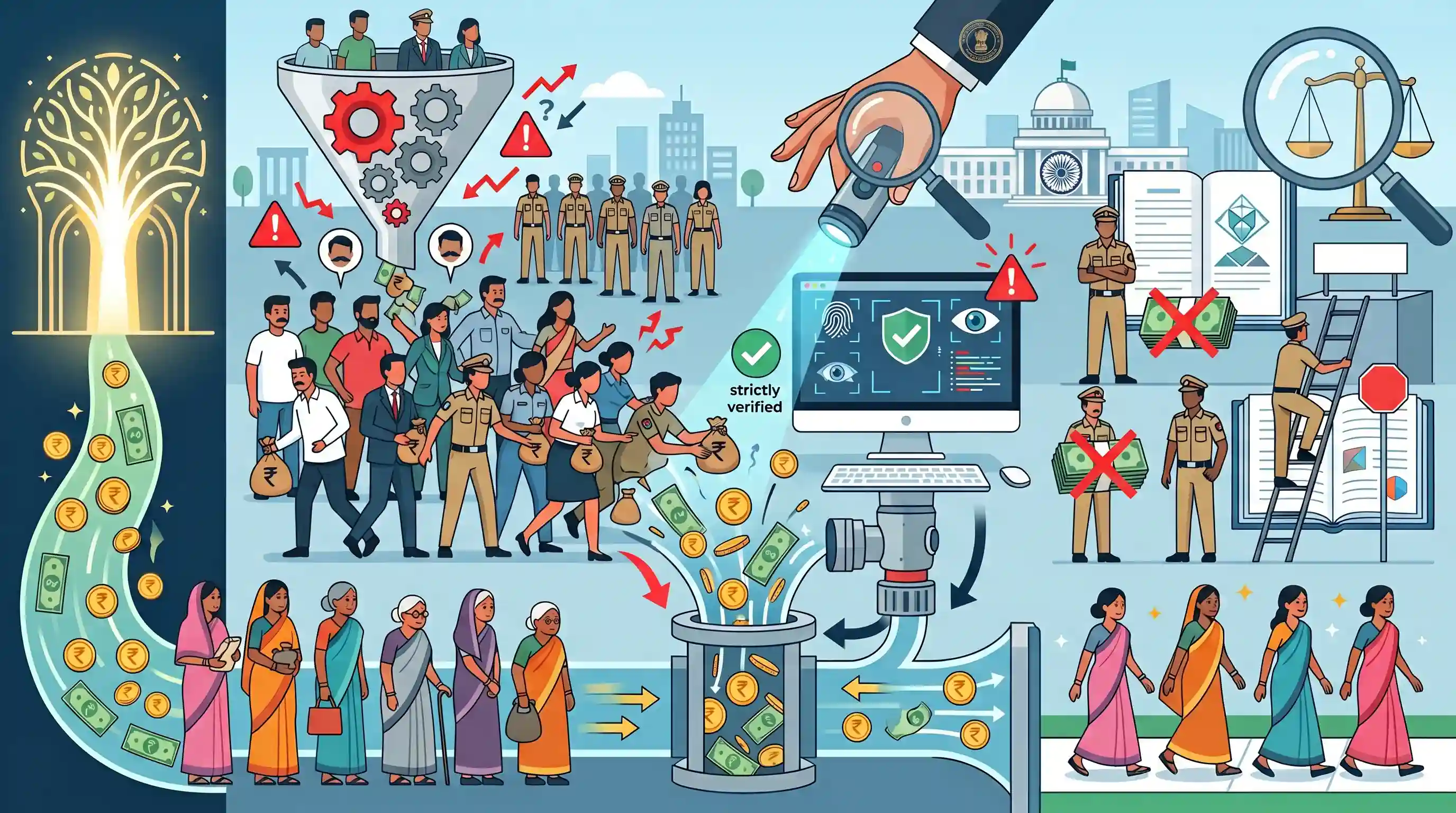
The Maharashtra government has initiated a recovery drive and halted salaries and promotions of government employees who wrongfully availed of the ₹1,500 monthly assistance under the Ladki Bahin Yojana. Despite being explicitly barred, over 12,000 state employees, alongside thousands of men and other ineligible women, exploited the welfare scheme, exposing massive inclusion errors. The government is now enforcing strict e-KYC verification and invoking Maharashtra Civil Services rules to bring accountability and recover the ₹11 crore disbursed to these ineligible beneficiaries.
Key Points
- The Maharashtra government has recovered around ₹11 crore from ineligible beneficiaries of the Ladki Bahin Yojana, primarily targeting government employees who exploited the scheme.
- Punitive actions, including stalling salaries and blocking promotions, have been initiated under the Maharashtra Civil Services rules against the erring staff.
- The scheme, providing ₹1,500 monthly to vulnerable women, suffered massive inclusion errors, with over 12,915 government employees and 12,431 men wrongfully receiving funds.
- The state has extended the e-KYC verification deadline to April 30, 2026, to regularize the beneficiary list and plug further leakages.
Important Terms
Mukhyamantri Majhi Ladki Bahin Yojana

Maharashtra's flagship welfare scheme providing ₹1,500 monthly to women (21–65 years) from low-income families to promote economic independence and improve nutritional status.
UPSC context
GS Paper 2: Welfare schemes for vulnerable sections; tests implementation challenges and gender-centric social security.
Inclusion Error
A targeting failure in social security programs where ineligible individuals receive benefits meant for the vulnerable, leading to fiscal leakages and reduced effectiveness.
UPSC context
GS Paper 2/3: Governance and Economy; tests understanding of subsidy targeting, leakages, and fiscal management.
e-KYC (electronic Know Your Customer)
A paperless identity verification process using Aadhaar-based authentication to confirm a beneficiary's credentials before disbursing welfare funds, ensuring transparency and accountability.
UPSC context
GS Paper 2: E-governance; tests the role of technology in improving service delivery and preventing ghost beneficiaries.
Maharashtra Civil Services (Discipline and Appeal) Rules, 1979
Statutory rules regulating the conduct and disciplinary actions for Maharashtra state employees, allowing for penalties like salary halts for misconduct or fraudulent acts.
UPSC context
GS Paper 4: Ethics and Integrity; tests knowledge of administrative accountability and disciplinary frameworks for civil servants.
Direct Benefit Transfer (DBT)
A mechanism to transfer subsidies and welfare benefits directly into Aadhaar-linked bank accounts, reducing intermediaries and ensuring funds reach intended recipients without leakages.
UPSC context
GS Paper 3: Indian Economy; tests efficiency in public expenditure and reforms in the subsidy delivery system.
Probity in Governance
The standard of integrity and honesty required in public administration, ensuring that officials act with transparency and accountability in managing government resources.
UPSC context
GS Paper 4: Ethics; central to questions on public service values and the prevention of administrative corruption.
Prelims Trap
"Inclusion errors in welfare schemes refer to eligible beneficiaries being left out due to biometric failures or digital illiteracy."
This defines an exclusion error. An inclusion error occurs when ineligible people (like government employees or men in this scheme) wrongfully receive benefits.
Static Concepts Connected
What is the difference between inclusion and exclusion errors in welfare targeting?
- Inclusion Error: Occurs when ineligible persons (e.g., government employees) wrongfully receive welfare benefits, draining fiscal resources.
- Exclusion Error: Occurs when genuinely eligible beneficiaries are denied benefits due to missing documents, biometric failures, or digital exclusion.
- Role of e-KYC: DBT and e-KYC aim to minimize inclusion errors by verifying identity, though they sometimes inadvertently increase exclusion errors.
How do Civil Service Conduct Rules enforce financial probity?
- Absolute Integrity: Rules (like Rule 3 of CCS Conduct Rules) mandate that a civil servant maintain absolute integrity at all times.
- Disciplinary Action: Exploiting public welfare schemes violates core ethical norms, inviting disciplinary proceedings such as stalling of increments or demotion.
- Breach of Trust: Public servants wrongfully appropriating funds designed for vulnerable sections directly undermines democratic governance and institutional trust.
Cross-Topic Patterns
DBT leakages & Administrative Ethics
Links GS2 (DBT efficacy) with GS4 (Probity). The exploitation of a vulnerable women's scheme by public servants serves as a primary case study for lack of foundational integrity in administration.
JAM Trinity limits vs Inclusion Errors
Despite Jan-Dhan, Aadhaar, and Mobile (JAM) architecture, pure DBT schemes without dynamic, state-level e-KYC filters still suffer from massive inclusion errors, highlighting the limits of basic digital infrastructure.

Expect a GS4 case study or GS2 question in 2026 linking DBT inclusion errors with civil servant integrity and mandatory e-KYC.
Linked PYQs · 4
Linked PYQs · 4
- 2019MainsGS2
Performance of welfare schemes that are implemented for vulnerable sections is not so effective due to absence of their awareness and active involvement at all stages of policy process. Discuss.
- 2019MainsGS4
What do you understand by probity in governance ? Based on your understanding of the term, suggest measures for ensuring probity in government.
- 2024MainsGS2
The Doctrine of Democratic Governance makes it necessary that the public perception of the integrity and commitment of civil servants becomes absolutely positive. Discuss.
- 2024MainsGS4
“The 'Code of Conduct' and 'Code of Ethics' are the sources of guidance in public administration. There is code of conduct already in operation, whereas code of ethics is not yet put in place. Suggest a suitable model for code of ethics to maintain integrity, probity and transparency in governance.”
