Maharashtra New Conservation Reserves and Biodiversity
Source:hindustantimes ↗
Why It Matters
Important for MPSC aspirants tracking environmental updates, geographic distributions of protected areas, and wildlife conservation frameworks in Maharashtra.
Summary
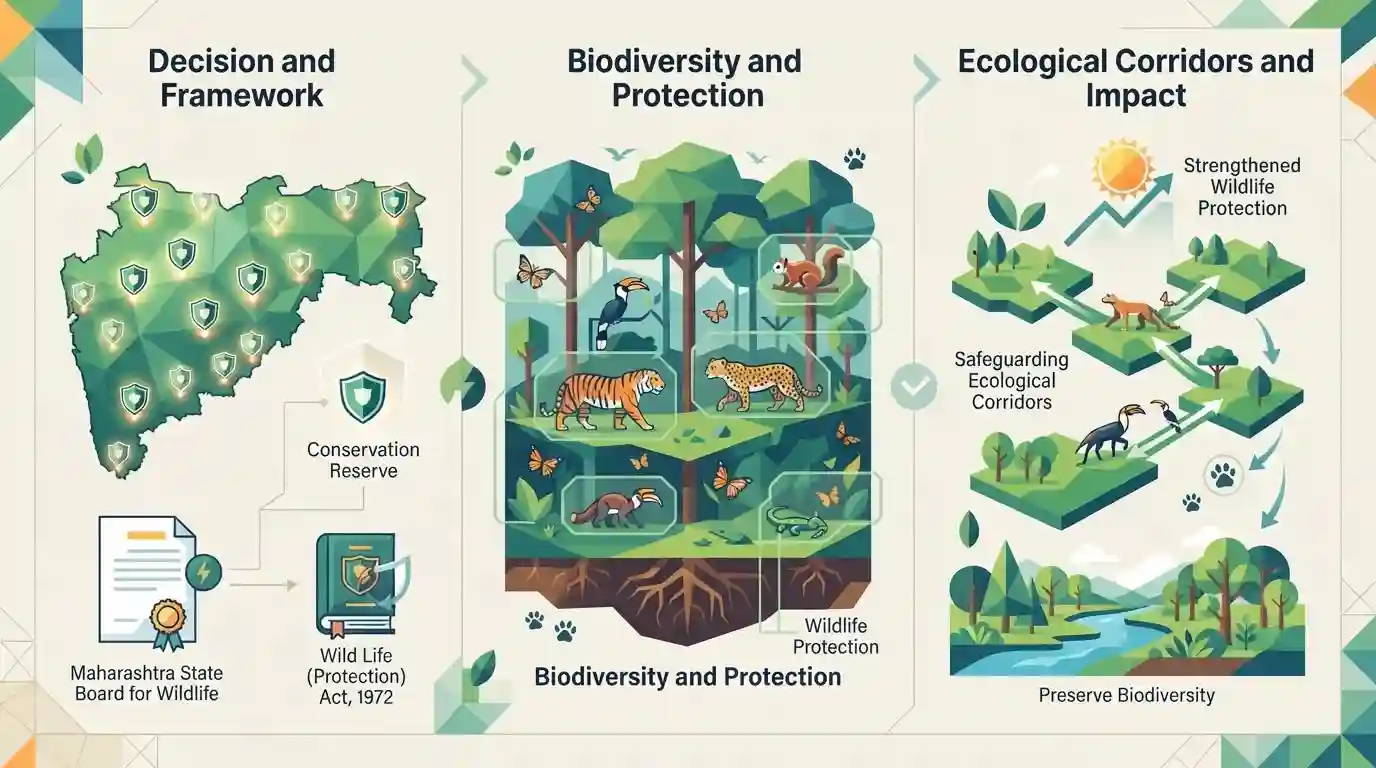
The Maharashtra government has approved the establishment of 18 new conservation reserves across the state, aiming to strengthen wildlife protection, preserve biodiversity, and safeguard ecological corridors. The decision, taken by the Maharashtra State Board for Wildlife, adds crucial buffer areas under the legal framework of the Wild Life (Protection) Act, 1972.
Key Points
- Maharashtra government approved the creation of 18 new conservation reserves, significantly expanding the protected area network in the state.
- The decision was taken during a meeting of the Maharashtra State Board for Wildlife (MSBWL).
- Conservation reserves act as buffer zones or migration corridors between established national parks, wildlife sanctuaries, and reserved forests.
- Under the Wild Life (Protection) Act, 1972, conservation reserves are declared by the state government in consultation with local communities.
Important Terms
Wild Life (Protection) Act, 1972

A key legislation enacted by the Parliament of India that provides a legal framework for the protection of wild animals, birds, and plants, and establishes various categories of protected areas like sanctuaries and conservation reserves.
UPSC context
Crucial for MPSC Paper 1 (Geography) and Paper 3 (Environment, Biodiversity, and Climate Change). Tested for statutory provisions and wildlife protection laws.
Maharashtra State Board for Wildlife
A statutory body headed by the Chief Minister of Maharashtra, tasked with advising the state government on wildlife conservation policies, protected area boundaries, and project clearances.
UPSC context
Important for MPSC governance and environment sections, testing knowledge of state-level wildlife administrative bodies and advisory mechanisms.
State Government of Maharashtra
The executive branch of the government of Maharashtra, which holds the administrative and legal authority to notify conservation reserves and implement state-level environmental policies.
UPSC context
Relevant for MPSC administration, policy implementation, and Maharashtra-specific geography and governance questions.
Prelims Trap
Conservation reserves are declared directly by the Ministry of Environment, Forest and Climate Change without consulting local communities.
Aspirants often confuse who declares conservation reserves with national parks. Conservation reserves are declared by state governments in consultation with local communities, whereas National Parks can be notified by state or central governments under specific provisions.
Static Concepts Connected
What are the four categories of protected areas established under the Wild Life (Protection) Act, 1972?
- Sanctuaries & National Parks: Strictly protected areas with no human activity allowed except those permitted by the Chief Wildlife Warden under strict conditions.
- Conservation Reserves: Established by state governments after consultation with local communities, typically serving as buffer zones or migration corridors.
- Community Reserves: Declared by state governments in private or community lands not already owned by the government, where individuals or communities volunteer to conserve wildlife.
- Tiger Reserves: Areas notified to protect tiger habitats, combining core critical tiger habitats (inviolable) and buffer/peripheral areas (multiple-use).
Cross-Topic Patterns
Wildlife Act amendments & participatory conservation
The Wildlife Protection Act, 1972 was amended in 2002 to introduce Conservation Reserves and Community Reserves, linking participatory conservation with formal forest governance frameworks.
Conservation reserves vs. Forest Rights Act
Expanding protected areas through buffer zones directly impacts local land-use rights, connecting environmental governance with Scheduled Tribes and Other Traditional Forest Dwellers (FRA) Act provisions.

Expect match-the-column or statement questions on Maharashtra's protected area categories, Board for Wildlife powers, and WLPA 1972 provisions.
Linked PYQs · 3
Linked PYQs · 3
- 2025MPSC_PRELIMSGS1
Match the following. | Biosphere Reserve | Establishment Year | |---|---| | a. Nilgiri | I. 2011 | | b. Sundarban | II. 2008 | | c. Kutch | III. 1989 | | d. Panna | IV. 1986 | Code: a b c d
- 2026MPSC_PRELIMSGS1
Match the following forest circles with their share in percentage to total forest area of Maharashtra. | (Forest circles of Maharashtra) | (Percentage to total forest area Economic survey of Maharashtra (2024)) | |---|---| | (a) Gadchiroli | (1) 12.5 | | (b) Nagpur | (2) 20.8 | | (c) Dhule | (3) 9.5 | | (d) Thane | (4) 10.4 | Code: (a) (b) (c) (d)
- 2021MPSC_PRELIMSGS1
Match the following : | National Park/Sanctuary | State | |---|---| | (a) Bandipur | (i) Rajasthan | | (b) Keoladeo | (ii) Assam | | (c) Indravati | (iii) Karnataka | | (d) Manas | (iv) Chattisgarh | Code: (a) (b) (c) (d)
