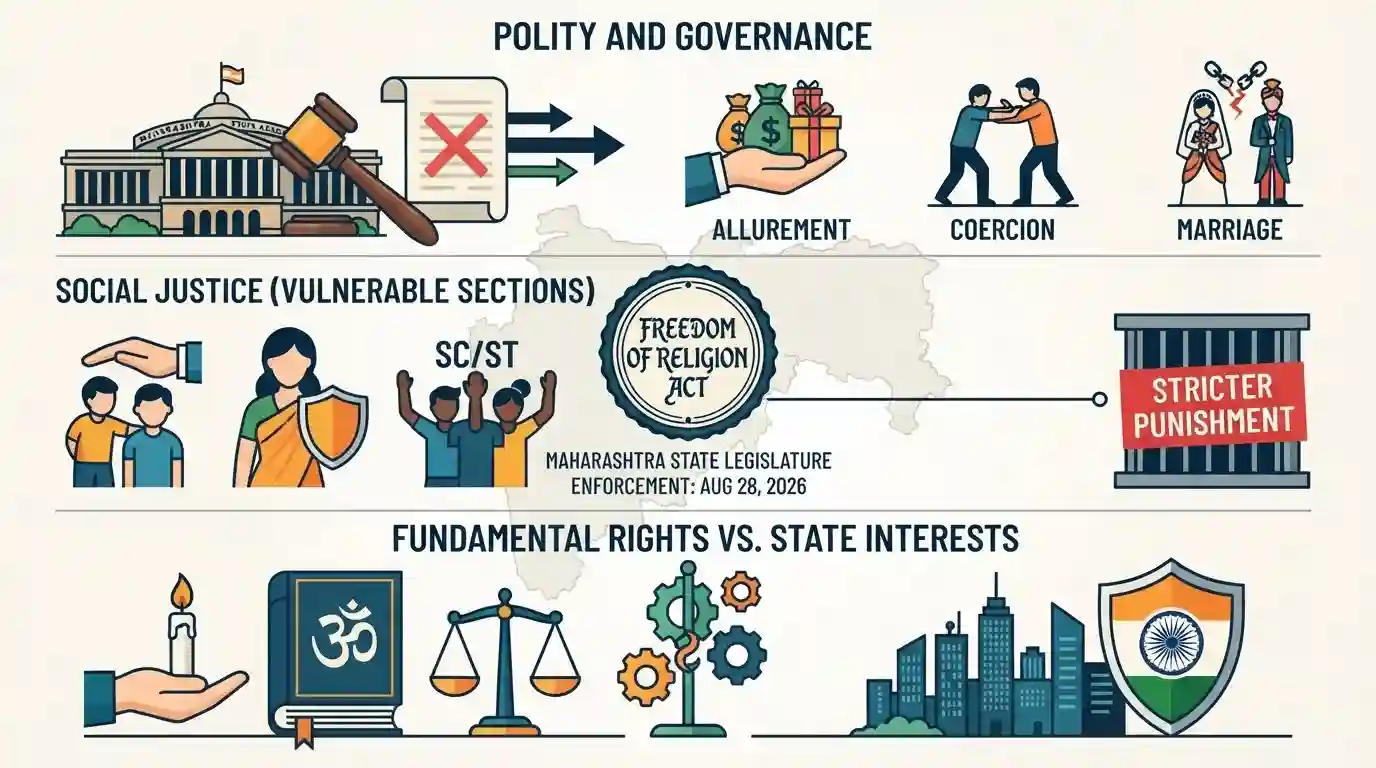
Maharashtra Freedom of Religion Act Enforcement Timeline
Source:economic-times ↗
Why It Matters
Anti-conversion laws represent a critical constitutional debate in India, testing the limits of religious freedom under Article 25 against the state's responsibility to protect vulnerable citizens from exploitation and maintain public order. Candidates must understand the legislative trend across states and its implications for secularism.
Summary
Maharashtra is set to enforce the Freedom of Religion Act starting August 28, 2026, aiming to curb forced or fraudulent religious conversions. The legislation explicitly bans conversions achieved through allurement, coercion, or on the pretext of marriage. The law imposes stricter punishments for conversions involving vulnerable groups, including minors, women, and members of SC/ST communities. By enacting this law, Maharashtra joins several other states in regulating religious conversions, navigating the complex intersection of the fundamental right to religious freedom (Article 25) and state interests in maintaining public order and morality.
Key Points
- The Maharashtra Freedom of Religion Act, 2026 comes into effect on August 28, prohibiting religious conversions via coercion, fraud, misrepresentation, or allurement.
- Allurement encompasses offers of gifts, money, better lifestyle, employment, and claims of divine healing.
- The act specifically criminalizes religious conversion on the pretext of marriage, often referred to in political discourse as 'love jihad'.
- Offenders face harsher penalties if the unlawful conversion involves minors, women, or persons belonging to Scheduled Castes (SC) or Scheduled Tribes (ST).
- Police are now mandated to register complaints regarding illegal conversions, aligning Maharashtra with states like UP, Gujarat, and MP that have similar laws.
Important Terms
Maharashtra Freedom of Religion Act, 2026

A state law prohibiting religious conversions executed through force, fraud, allurement, or pretext of marriage. It mandates stricter penalties for illegal conversions involving vulnerable demographics like minors, women, and SC/STs.
UPSC context
Crucial for MPSC GS Paper 2 (State Governance) when discussing legislative measures to balance public order with constitutional religious freedoms.
Article 25 of the Constitution of India
A fundamental right guaranteeing all persons the freedom of conscience and the right to freely profess, practice, and propagate religion, subject to public order, morality, and health.
UPSC context
Highly tested in MPSC GS Paper 2 (Polity). Focus is on the distinction between the constitutional right to propagate versus forced conversion.
Maharashtra State Legislature
The bicameral law-making body of the state, comprising the Legislative Assembly and Legislative Council, empowered to draft and pass state-level legislation addressing public order and social justice.
UPSC context
Important for MPSC GS Paper 2. Tests knowledge on the functioning of the state government, legislative powers, and law-making processes.
Prelims Trap
"Article 25 guarantees the fundamental right to convert others to one's own religion."
Article 25 guarantees the right to 'propagate', but the SC in Rev. Stainislaus (1977) ruled this does NOT include the fundamental right to convert another person.
Static Concepts Connected
What are the specific constitutional limitations placed on Article 25?
- Public Order: The state can restrict religious freedoms if a practice threatens societal peace or public order.
- Morality & Health: Religious practices that violate general public morality or endanger public health are not protected.
- Other Fundamental Rights: The right to religious freedom is subject to other provisions of Part III (Fundamental Rights).
Why do States, rather than the Centre, typically enact anti-conversion legislations?
- State List Entry: Courts uphold these laws under 'Public Order', which is Entry 1 of the State List in the Seventh Schedule.
- Absence of Central Law: Parliament has never passed a national anti-conversion law, leaving states to regulate under their constitutional mandate.
Cross-Topic Patterns
Anti-conversion & Vulnerable Sections
The Act's harsher penalties for converting SC/STs intersect with the social justice syllabus. It aligns with protective discrimination principles and parallels protections under the SC/ST (Prevention of Atrocities) Act.
Indian Secularism & State Intervention
State regulation of 'allurement' (including divine healing) tests the 'principled distance' model of Indian secularism, a frequent GS Paper 2 topic contrasting Indian and Western secular models.

Multi-statement Q expected mixing Article 25 exceptions (order, morality, health), the Stainislaus verdict, and Maharashtra Act provisions.
Linked PYQs · 2
Linked PYQs · 2
- 2024MPSC_PRELIMSGS1
The Indian Constitution establishes a secular state, meaning : (A) The state makes discrimination on the basis of religion in matters of employment. (B) The state avoids preferential treatment for any particular religion. (C) The state treats all religions equally. (D) Freedom of faith and worship is allowed to all the people. (E) Educational institutions, without exception, are free to impart religious instructions.
- 2019MPSC_PRELIMSGS1
In the case of a bill passed by the State Legislature, Governor can reserve it for the consideration of the President. a. The President may declare or withhold his assent to the bill. b. The President may return the bill for reconsideration to the State Legislature. c. State Legislature must reconsider the bill within three months and if passed again it is obligatory upon the President to give his assent. d. In case of reconsidered bill which is passed again by State Legislature, President shall declare his assent within a period of six months. Which of the statements given above are correct ? Answer Options :
