Maharashtra Freedom Of Religion Act Penalties And Scope
Source:economic-times ↗
Why It Matters
Understanding anti-conversion laws is crucial for analyzing the balance between individual fundamental rights (Article 25) and state powers to maintain public order and protect vulnerable communities.
Summary
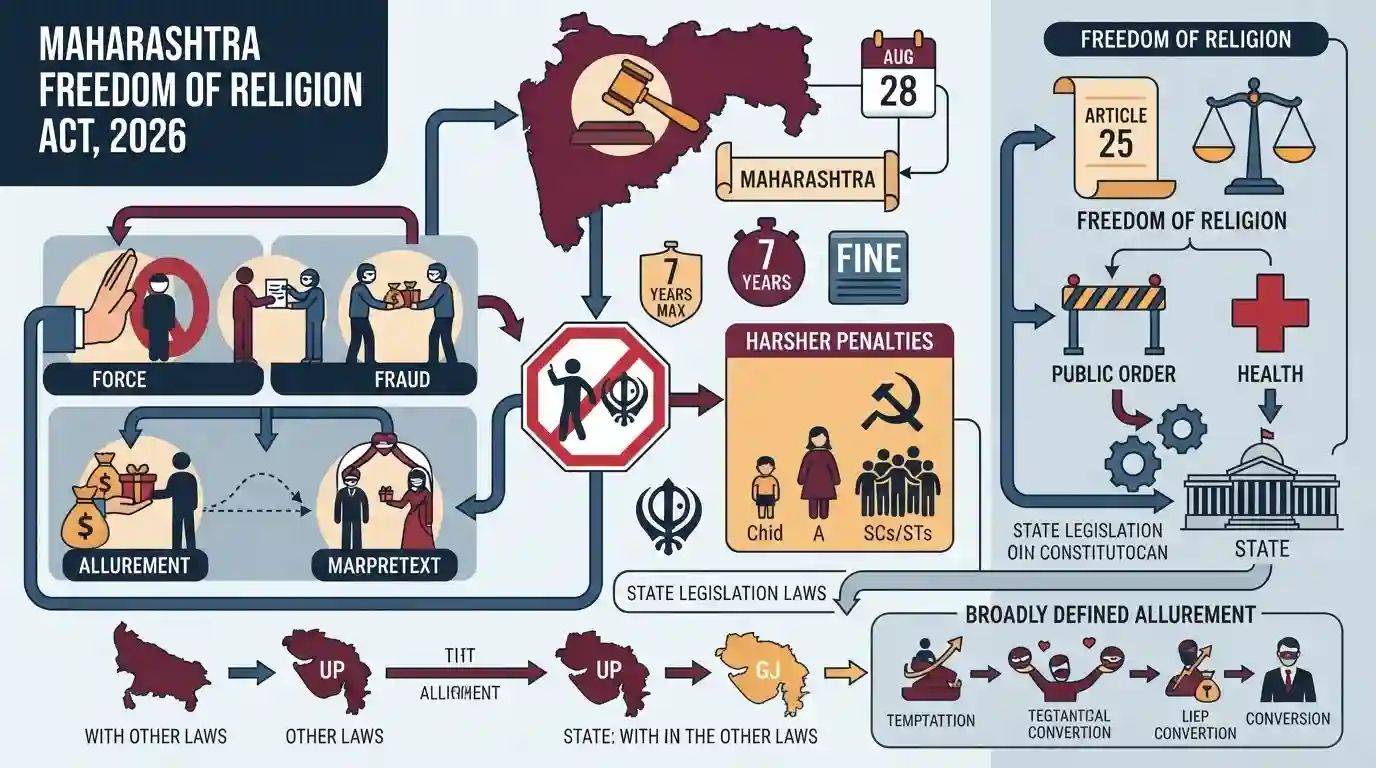
The Maharashtra Freedom of Religion Act, 2026, effective August 28, introduces stringent measures against religious conversions achieved through force, fraud, allurement, or on the pretext of marriage. The legislation aligns with similar laws in states like Uttar Pradesh and Gujarat. It stipulates rigorous imprisonment of up to seven years and substantial fines, with even harsher penalties for conversions involving minors, women, and marginalized communities (SCs/STs). The Act broadly defines 'allurement' and operates within the constitutional framework of Article 25, which guarantees freedom of religion while allowing state intervention for public order, morality, and health.
Key Points
- The Maharashtra Freedom of Religion Act, 2026, prohibits religious conversions through coercion, fraud, misrepresentation, undue influence, or allurement.
- Penalties include imprisonment up to seven years and a fine of Rs 1 lakh for unlawful conversions, notably those on the pretext of marriage.
- Conversions involving vulnerable groups (minors, women, SCs, STs) attract higher penalties, including a fine up to Rs 5 lakh.
- The Act defines 'allurement' comprehensively, including offers of money, employment, education, a better lifestyle, or divine healing.
- The law's provisions intersect with Article 25 of the Constitution (Right to Freedom of Religion), which is subject to public order, morality, and health.
Important Terms
Maharashtra Freedom of Religion Act, 2026

A state law criminalizing religious conversions achieved via force, fraud, allurement, or marriage pretext, prescribing up to seven years' imprisonment and substantial fines.
UPSC context
Important for GS-2 (State Legislation). Tests knowledge of anti-conversion laws, state interventions, and legal safeguards for marginalized communities.
Article 25 of the Constitution
A Fundamental Right guaranteeing freedom of conscience and the right to freely profess, practice, and propagate religion, subject to public order, morality, and health.
UPSC context
Crucial for GS-2 (Fundamental Rights). Questions often test the constitutional limitations on religious freedom and the state's regulatory powers.
Maharashtra State Legislature
The bicameral law-making body of Maharashtra, comprising the Legislative Assembly and Council, which exercises constitutional authority to pass state-level legislation regarding public order and justice.
UPSC context
Relevant for GS-2 (State Legislature). Focuses on state lawmaking processes, passage of bills, and the division of powers.
Prelims Trap
The fundamental right to propagate religion under Article 25 includes a fundamental right to convert another person.
The Supreme Court in Rev. Stainislaus (1977) ruled that 'propagate' means expounding tenets, not the right to convert another person.
Static Concepts Connected
What is the scope of Article 25 regarding religious conversion?
- Constitutional Scope: Article 25 guarantees freedom of conscience and the right to profess, practice, and propagate religion to all individuals.
- Reasonable Restrictions: This right is not absolute and is subject to public order, morality, health, and other Fundamental Rights.
- Stainislaus Ruling (1977): The Supreme Court ruled that the right to 'propagate' does not include the fundamental right to convert another person.
Cross-Topic Patterns
Secularism vs. State Police Power
Balances Indian secularism's principle of state neutrality with the state's police power to regulate individual conscience under the guise of maintaining public order.
Federal legislative divergence
Highlights how diverse state-level anti-conversion laws create asymmetric legal frameworks across India, impacting personal liberty and interstate marital disputes.

MPSC will likely pair the Maharashtra 2026 Act with Article 25 limits and the Rev. Stainislaus (1977) judgment in a multi-statement question.
Linked PYQs · 1
Linked PYQs · 1
- 2024MPSC_PRELIMSGS1
The Indian Constitution establishes a secular state, meaning : (A) The state makes discrimination on the basis of religion in matters of employment. (B) The state avoids preferential treatment for any particular religion. (C) The state treats all religions equally. (D) Freedom of faith and worship is allowed to all the people. (E) Educational institutions, without exception, are free to impart religious instructions.
