Maharashtra Freedom of Religion Act Implementation Deferred
Source:plutusias ↗
Why It Matters
State-level anti-conversion laws are a recurring theme in Indian polity, touching upon crucial constitutional issues including the limits of state legislative competence under the Seventh Schedule, and the protection of fundamental rights like religious freedom and personal autonomy.
Summary
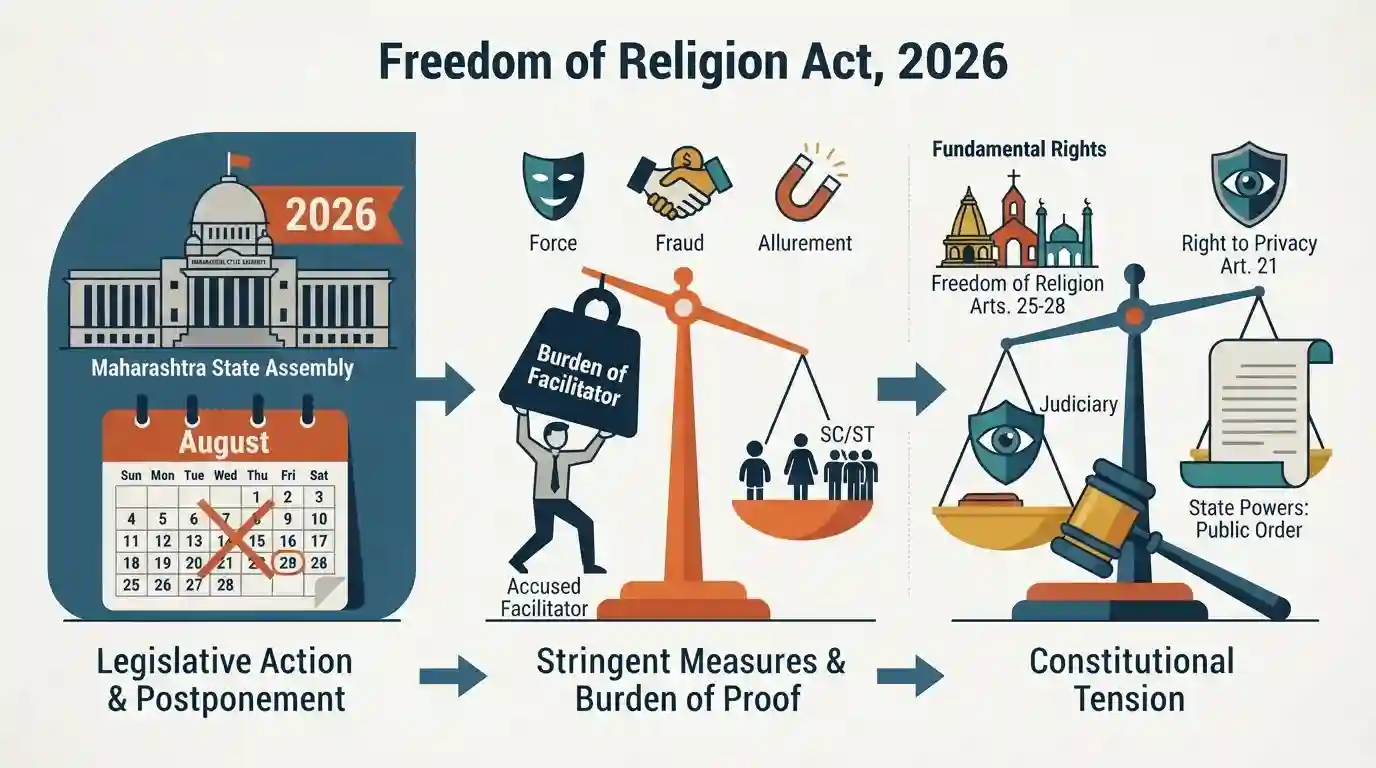
The enforcement of the Maharashtra Freedom of Religion Act, 2026, designed to curb religious conversions carried out through force, fraud, or allurement, has been postponed to August 28. The legislation introduces stringent measures, notably shifting the burden of proof to the accused facilitator and prescribing severe punishments for cases involving minors, women, and SC/ST individuals. Enacted under the purview of "Public Order" in the State List, the Act highlights the constitutional tension between state legislative powers and fundamental rights, particularly the Freedom of Religion (Articles 25-28) and the Right to Privacy established under Article 21.
Key Points
- The enforcement of the Maharashtra Freedom of Religion Act, 2026, which criminalizes forced or deceitful religious conversions, has been delayed to August 28.
- The legislation controversially shifts the burden of proof onto the person facilitating the conversion rather than the accuser.
- Stricter penalties are mandated if the conversion involves vulnerable demographics such as women, minors, and members of SC/ST communities.
- The Act is enacted under the State List's "Public Order" entry but faces constitutional friction against Article 25 (Freedom of Religion) and Article 21 (Right to Privacy).
Important Terms
Maharashtra Freedom of Religion Act, 2026

A state legislation aimed at prohibiting unlawful religious conversions carried out through force, fraud, coercion, or inducement, prescribing strict penalties and requiring prior administrative declaration.
UPSC context
MPSC Rajyaseva GS Paper II (Polity & Governance). Tests understanding of state-level social legislations and secularism issues.
Freedom of Religion (Articles 25-28)
A fundamental right under Part III of the Indian Constitution ensuring citizens can practice and propagate their faith, subject to public order, morality, and health.
UPSC context
MPSC Rajyaseva GS Paper II (Indian Constitution). Tests fundamental rights, state interference, and the Indian concept of secularism.
Right to Privacy (Article 21)
A fundamental right implicitly protected under Article 21, upheld in the Puttaswamy case (2017) as protecting individual choice and autonomy from unwarranted state intrusion.
UPSC context
MPSC Rajyaseva GS Paper II. Tests awareness of judicial interpretations expanding personal liberties and the right to make private choices.
Public Order
A key subject under List II (State List) of the Seventh Schedule, enabling state governments to legislate on public peace, safety, and law enforcement.
UPSC context
MPSC Rajyaseva GS Paper II (Federal Structure). Tests understanding of Center-State legislative distribution of powers and regional governance.
Burden of Proof
A legal standard under evidentiary law determining which party must prove a disputed fact; typically resting on the prosecution but occasionally shifted by special laws.
UPSC context
MPSC GS Paper II (Laws & Judiciary). Tests knowledge of criminal law principles and legislative modifications to proof standards.
Maharashtra State Legislature
The bicameral legislative organ of Maharashtra, consisting of the Governor, Legislative Assembly (Vidhan Sabha), and Legislative Council (Vidhan Parishad), responsible for framing state laws.
UPSC context
MPSC GS Paper II (State Government). Tests understanding of structure, powers, and procedures of state-level law-making bodies.
Prelims Trap
Being a State List subject, the Act became law solely with the Governor's assent under Article 200.
The Bill was specifically reserved under Article 200 and required Presidential Assent under Article 201, which was granted on July 31, 2026.
Static Concepts Connected
What does Article 25 guarantee, and does it include the right to convert?
- Right to Propagate: Article 25 guarantees the right to transmit or spread one's religion but does not grant a fundamental right to convert another person.
- Judicial Precedent: In the Rev. Stainislaus v. State of MP (1977) case, the Supreme Court upheld that "propagation" does not include forcible conversion.
- State Limitations: Freedom of religion is explicitly subject to public order, morality, health, and other fundamental rights.
What is the constitutional mechanism for presidential assent to state bills?
- Article 200 Reserve: The Governor can reserve any state bill for the President's consideration under Article 200.
- Article 201 Action: The President can give assent, withhold it, or direct the Governor to return the bill to the State Legislature.
Cross-Topic Patterns
State penal amendments vs. Central codes
Shifted burden of proof in state-level criminal acts creates procedural divergence from the Bharatiya Nagarik Suraksha Sanhita (BNSS), testing federal uniformity.
Privacy vs. administrative notices
Mandating a 60-day prior notice to the District Collector for conversion challenges the informational privacy standards set in the K.S. Puttaswamy judgment.

Expect questions on the 13th state milestone, the Stainislaus case precedent, and Article 201 presidential assent mechanics.
Linked PYQs · 4
Linked PYQs · 4
- 2023MPSC_PRELIMSGS1
Match the pairs correctly. | Column A | Column B | |---|---| | A. Part - I | i. Fundamental Rights | | B. Part - III | ii. Panchayat Raj | | C. Part - IX | iii. Citizenship | | D. Part - II | iv. The Union and its territory | Code: A B C D
- 2024MPSC_PRELIMSGS1
Which article empowers the High Courts to issue directions for the enforcement of Fundamental Rights ?
- 2021MPSC_PRELIMSGS1
Which of the following statement is correct with respect to 'Right against exploitation' ?
- 2023MPSC_PRELIMSGS1
Provisions of the Constitution relating to the administration of Scheduled Areas and Scheduled Tribes in Schedule - V
