Maharashtra Sugar Mill Crushing Capacity Evaluation Committee
Source:chinimandi ↗
Why It Matters
The sugarcane and cooperative sugar industry forms the backbone of Maharashtra's rural economy. MPSC Combined Prelims frequently tests aspects of agricultural economics, irrigation usage (such as sugarcane occupying over 70% of state irrigation), and state water-conservation initiatives like the Jalyukta Shivar programme. This committee's structural classification of sugar mills and integration of AI with water schemes is highly relevant.
Summary
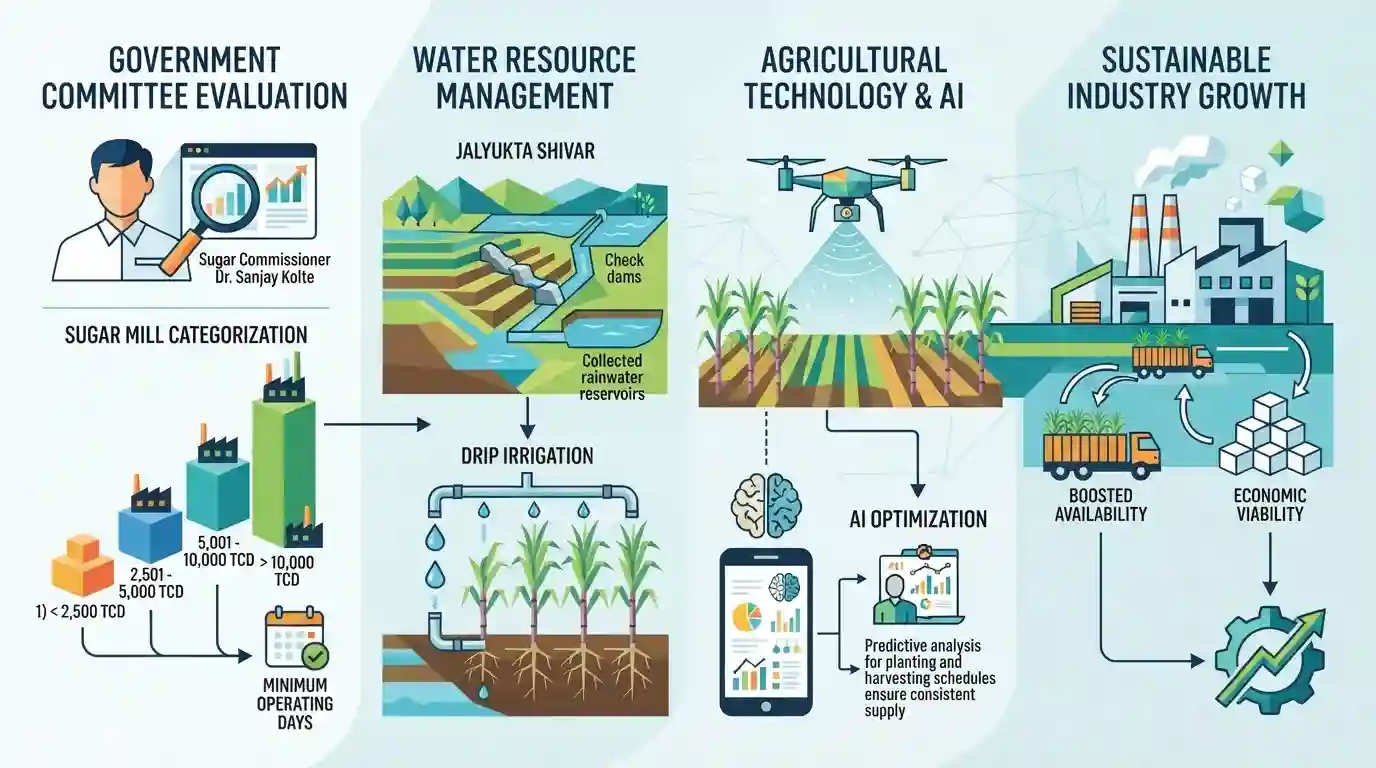
The Maharashtra government has established a special committee led by Sugar Commissioner Dr. Sanjay Kolte to evaluate the crushing capacity and financial viability of sugar mills. The committee will categorize factories into four groups (ranging from under 2,500 tonnes to over 10,000 tonnes daily capacity) and recommend the minimum operating days required for economic sustainability. Additionally, the panel will study water conservation programs like Jalyukta Shivar, drip irrigation, and the use of Artificial Intelligence in cultivation to boost sugarcane availability and optimize factory capacities.
Key Points
- The Maharashtra government has set up a special committee to assess the crushing capacity and financial viability of sugar factories in the state.
- The committee is headed by Sugar Commissioner Dr. Sanjay Kolte, with retired Solapur district official Dr. Sanjay Bhosale as a member.
- Sugar mills will be classified into four groups based on daily crushing capacity: up to 2,500 tonnes, 2,500–5,000 tonnes, 5,000–10,000 tonnes, and above 10,000 tonnes.
- The panel will determine the minimum number of operating days each capacity group needs to achieve economic viability.
- Factors influencing sugarcane availability will be examined, including total cane area, drip irrigation schemes, and the impact of the Jalyukta Shivar programme.
- The committee will also study the potential use of Artificial Intelligence (AI) technology in sugarcane cultivation to improve productivity.
- The core issue addressed is the mismatch where mills have expanded capacity but cane availability has not grown proportionally, leading to shorter crushing seasons.
Important Terms
Sugar Commissionerate of Maharashtra

The state regulatory and developmental authority under the Department of Cooperation, responsible for licensing sugar mills, auditing cooperatives, and ensuring Fair and Remunerative Price (FRP) payments to sugarcane farmers.
UPSC context
MPSC GS-IV (Cooperative Movement). Tests administrative bodies, regulatory powers, and agricultural marketing.
Jalyukta Shivar Abhiyan
A flagship water conservation scheme by the Maharashtra government aiming to make the state drought-free by harvesting rainwater, deepening streams, and recharging groundwater via community participation.
UPSC context
MPSC GS-I (Geography) & GS-IV (Agriculture). Tests state water conservation initiatives and rural schemes.
Cooperative Sugar Factories in Maharashtra
Farmer-owned agricultural cooperatives that form the economic backbone of rural Maharashtra, originating with the first cooperative sugar mill in Pravaranagar (1950) under Vithalrao Vikhe Patil.
UPSC context
MPSC GS-IV (Cooperative Movement). Tests historical evolution, economic impact, and challenges of agro-cooperatives.
Per Drop More Crop
A component of the Pradhan Mantri Krishi Sinchayee Yojana (PMKSY) aimed at improving water-use efficiency through micro-irrigation techniques like drip and sprinkler systems.
UPSC context
MPSC GS-IV (Agriculture & Irrigation). Tests government initiatives for upgrading agricultural systems and conserving water.
Prelims Trap
The Fair and Remunerative Price (FRP) of sugarcane is fixed and declared directly by the Maharashtra State Government.
FRP is determined by the Central Government's CCEA based on CACP recommendations; the State only enforces its payment via crushing licenses.
Static Concepts Connected
Explain the main sugarcane planting seasons in Maharashtra and their characteristics.
- Adsali (Adhe-Adsali): Planted in July-August, takes 15-18 months, yields highest sugar recovery but consumes maximum water.
- Suru (Eksali): Planted in January-February, takes 11-12 months, widely practiced across Western Maharashtra.
- Ratoon (Khodva): Regrown from harvested crop stubble, takes 11-12 months, and covers around 40% of the state's sugarcane area.
What regulations govern the cooperative sugar industry's crushing operations in Maharashtra?
- Sugarcane Control Order 1966: Issued under the Essential Commodities Act 1955, this Central order mandates operational and crushing licenses.
- Maharashtra Sugar Factories Order 1984: State-level regulation that manages the reservation of areas and controls cane supply to specific mills.
- FRP-Linked Licensing: Mills are legally prohibited from obtaining a crushing license unless they clear all outstanding FRP arrears to farmers.
Cross-Topic Patterns
Sugar Cooperatives + Ground Water Depletion
The dense network of sugar mills in Western Maharashtra drives political economy but severely depletes basaltic aquifers, forcing integration with water conservation schemes.
AI in Agriculture + Mill Viability
Integrating artificial intelligence for precision sugarcane yield estimation helps cooperative mills optimize crushing cycles and prevent premature seasonal shutdowns.

MPSC GS-4 likely to frame a question on Kolte Committee’s capacity classification alongside sugarcane planting types (Adsali/Suru).
Linked PYQs · 3
Linked PYQs · 3
- 2007MPSC_PRELIMSGS1
In Maharashtra, average sugar recovery from Sugarcane is ______ %.
- 2007MPSC_PRELIMSGS1
More than 70% irrigation capacity is utilised for which crops in Maharashtra ?
- 2022MPSC_PRELIMSGS1
Observe the statements regarding agriculture in Maharashtra : (a) Soil erosion is not a serious problem of agriculture. (b) Soil erosion takes place due to flooding in rivers, forest cutting and uncontrolled grazing. (c) Soils are saline due to over-irrigation. Answer Options :
