Maharashtra Formal Recognition of Women Farmers Without Land Titles
Source:india-mongabay ↗
Why It Matters
Crucial for understanding state-level policy changes addressing gender parity, agricultural welfare, and the inclusion of women in economic growth within Maharashtra.
Summary
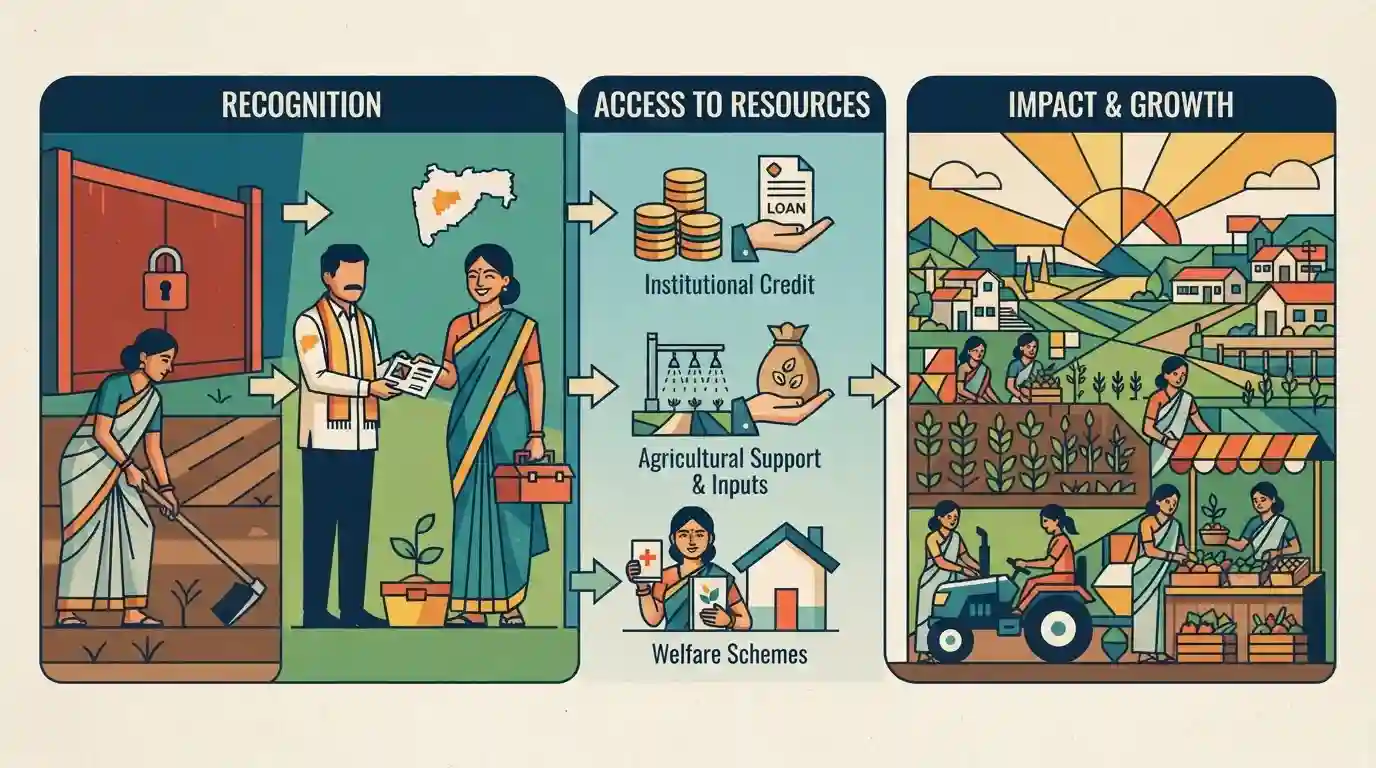
The article discusses Maharashtra's formal recognition of women farmers regardless of land ownership, a milestone policy shift addressing systemic gender inequalities in agriculture, allowing women access to institutional support, credit, and welfare schemes.
Key Points
- Maharashtra formally recognised women farmers regardless of land ownership, addressing a major barrier in agricultural welfare access.
- Traditionally, land titles were predominantly in men's names, excluding women farmers from institutional credit, subsidies, and extension services.
- This policy shift aims to promote gender equality in agriculture, improve economic empowerment, and tackle the feminisation of agriculture.
Important Terms
Maharashtra Women Farmers Empowerment Act, 2026

A pioneering legislative framework enacted by Maharashtra in 2026 granting formal state recognition to women engaged in farming and allied activities independent of land ownership titles.
UPSC context
MPSC Paper II (Governance, Social Welfare & Empowerment): Tests understanding of progressive state interventions bridging gender gaps in rural agriculture and welfare access.
Woman Farmer Certificate (WFC)
An official credential issued under Maharashtra's new law allowing rural women, tenant farmers, and agricultural laborers to access credit, subsidies, and welfare schemes without land titles.
UPSC context
MPSC Paper II (Government Policies & Schemes): Important for questions on administrative innovations facilitating financial inclusion and institutional support for women.
Maharashtra State Fund for Women Farmers
A dedicated institutional fund established under the Maharashtra legislation to finance capacity building, skill training, and targeted support programs for women farmers.
UPSC context
MPSC Paper III (Economy & Agriculture): Evaluates knowledge of dedicated financial mechanisms deployed to empower marginalized agricultural workers and boost rural productivity.
Prelims Trap
recognises women farmers regardless of land ownership
Aspirants often assume a policy recognizing women farmers automatically grants them legal land titles or ownership rights. The WFC is activity-based and does not alter underlying property deeds.
Static Concepts Connected
What are the key institutional mechanisms and challenges regarding women in Indian agriculture?
- Feminisation Trend:: Feminisation of agriculture denotes the increasing participation of women in farming as men migrate to urban non-farm sectors.
- Credit Barrier:: Lack of land titles prevents women from accessing institutional credit, Kisan Credit Cards (KCC), and formal bank loans.
- Policy Response:: Joint Pattas and state-level schemes attempt to bridge the ownership gap, though implementation remains uneven across states.
Cross-Topic Patterns
Women Farmers Policy & Gender Budgeting
MPSC frequently links gender policy interventions to Panchayati Raj institutional frameworks and state budgetary allocations under gender budgeting principles.
Activity-Based Entitlements vs Property Rights
The shift from property-based entitlement to activity-based recognition mirrors progressive reforms in labor welfare and forest rights legislation (FRA, 2006).

Maharashtra Women Farmer Empowerment Act 2026 criteria, WFC issuance, and 30% scheme reservations will feature in MPSC Prelims.
Linked PYQs · 3
Linked PYQs · 3
- 2018MPSC_PRELIMSGS1
Government of Maharashtra's Sumatibai Sukalikar Udyogini Mahila Sakshamikaran Yojana is related to
- 2022MPSC_PRELIMSGS1
Government of Maharashtra has adopted gender budgeting from the year ________.
- 2026MPSC_PRELIMSGS1
Women Technology Parks (WTPs) have been set up in which of the following states to promote gender equality and empower women through science and technology based solutions. (a) Gujarat (b) Tamilnadu (c) Sikkim (d) Maharashtra (e) Uttar Pradesh
