Food Safety: FDA Statewide Festive Adulteration Inspection Drive
Source:rediff ↗
Why It Matters
Food safety and the regulatory role of statutory bodies like the FDA and FSSAI are critical aspects of public health governance. MPSC frequently tests knowledge of regulatory acts, food security, and state mechanisms designed to protect citizens from adulteration and health risks.
Summary
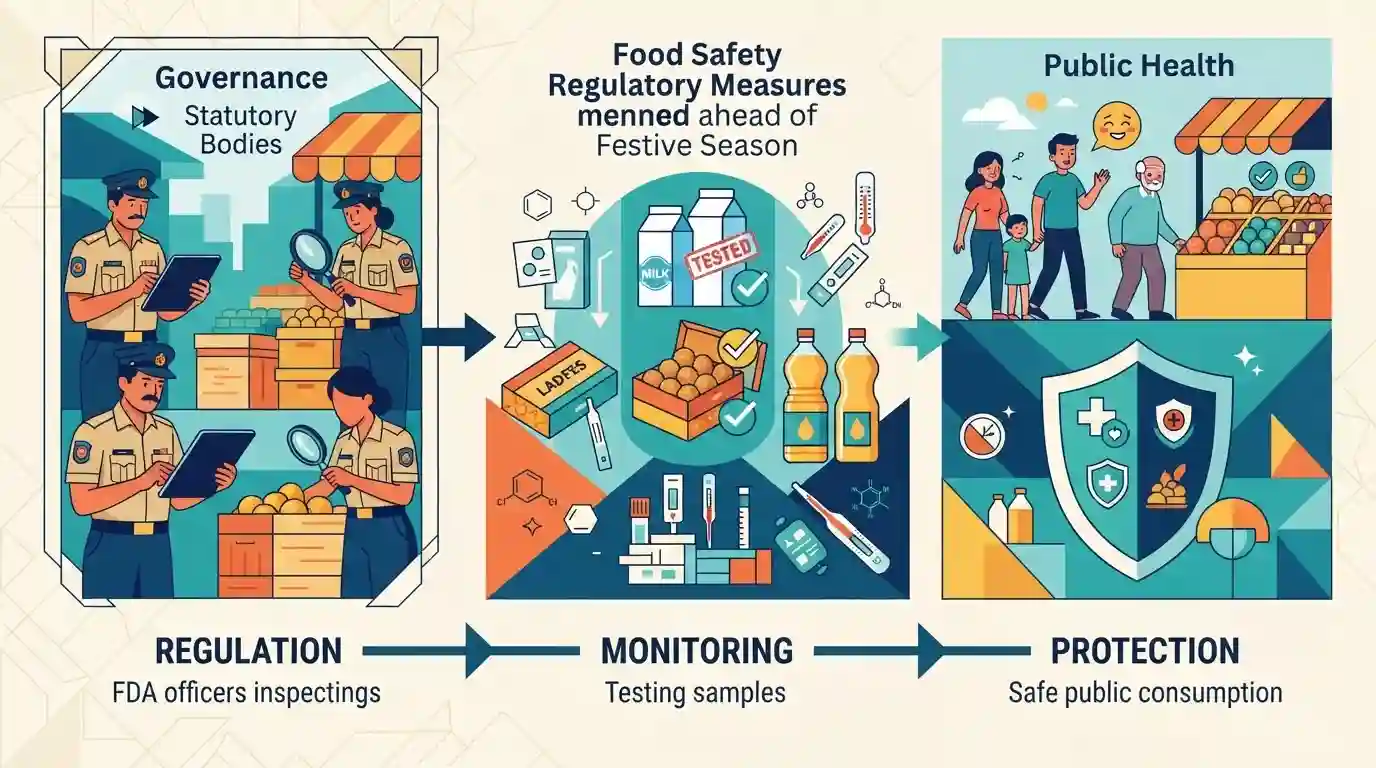
The Maharashtra Food and Drug Administration (FDA) is stepping up its regulatory measures and surveillance to curb food adulteration ahead of the festive season. By launching targeted inspection drives, the FDA aims to monitor the quality of highly consumed items such as milk, sweets, and edible oils. The proactive enforcement of the Food Safety and Standards Act is intended to protect consumers from health hazards associated with substandard food products and ensure public health safety.
Key Points
- The Maharashtra FDA has initiated a special state-wide drive to ensure food quality and prevent adulteration during the festive season.
- Intensified inspections are being carried out at sweet shops, manufacturing units, and eateries, with a special focus on high-demand items like mawa, milk, ghee, and edible oils.
- Strict penal action under the Food Safety and Standards Act is planned against vendors found selling substandard or adulterated food products.
- The initiative aims to safeguard public health and ensure compliance with hygiene standards across the food supply chain.
Important Terms
Food Safety and Standards Act, 2006

A central Indian law consolidating previous food-related regulations to establish science-based standards for food manufacture, storage, distribution, sale, and import, ensuring safe and wholesome food for consumers.
UPSC context
Crucial for MPSC GS-2 (Governance) and GS-3 (Public Health), testing knowledge of national regulatory frameworks ensuring food safety.
Maharashtra Food and Drug Administration (FDA)
The state-level regulatory authority in Maharashtra responsible for enforcing food safety and drug regulations, preventing adulteration, monitoring licenses, and ensuring overall public health protection.
UPSC context
Important for MPSC GS-2 (State Governance), highlighting state-level enforcement of public health standards and anti-adulteration drives.
Food Safety and Standards Authority of India (FSSAI)
A statutory body under the Ministry of Health and Family Welfare that creates science-based standards for food products and regulates their manufacture, storage, distribution, and import nationwide.
UPSC context
Vital for MPSC GS-2 (Statutory Bodies) and GS-3 (Health), assessing knowledge of national health regulations, compliance, and consumer protection.
Prelims Trap
The Food Safety and Standards Authority of India (FSSAI) is governed by the Ministry of Consumer Affairs.
FSSAI is an autonomous statutory body under the Ministry of Health and Family Welfare (MoHFW), not the Ministry of Consumer Affairs.
Static Concepts Connected
What is the institutional and statutory framework under the FSS Act, 2006?
- Legislative Consolidation: It consolidated and replaced 8 legacy central laws, most notably the Prevention of Food Adulteration Act, 1954.
- FSSAI Setup: Established as an autonomous body under MoHFW, comprising a Chairperson and 22 members (at least one-third must be women).
- State-Level Enforcement: Administrative and enforcement powers rest with the State Commissioner of Food Safety, who designates local Food Safety Officers (FSOs).
Cross-Topic Patterns
State Capacity & Regulatory Deficits
Maharashtra's severe FDA personnel shortfall (350 FSOs for 1.8 lakh businesses vs. 1:1000 standard) highlights chronic state capacity deficits in enforcing statutory public health regulations.
Informal Economy vs. Public Health Interventions
The statewide ban on loose edible oil exemplifies the regulatory push to formalize retail markets to curb adulteration, which disproportionately impacts the informal vendor economy.

Multi-statement questions on FSSAI often trick candidates on its nodal ministry (MoHFW, not Consumer Affairs) and its 33% women quota.
Linked PYQs · 3
Linked PYQs · 3
- 2026MPSC_PRELIMSGS1
Which of the following statement/s is/are correct regarding National Food Security Act - 2013 ? (a) Women empowerment is a feature of the National Food Security Act - 2013. (b) State Food Commission is monitoring, reviewing and implementing authority of this Act - 2013. Answer options :
- 2024MPSC_PRELIMSGS1
Food security includes following stages : (a) Adequate availability of food grains to all. (b) Adequate availability of food grains and pulses to all. (c) Adequate availability of food grains, pulses, milk and vegetables to all. (d) Adequate availability of food grains, pulses, milk products, vegetables, fruits, meat and fish etc. Answer options :
- 2025MPSC_PRELIMSGS1
Identify the correct statement/s from the following regarding Food Security Bill, 2013. A. The Bill provides food safety benefits to the 50% of the urban population and 75% of the rural population. B. Beneficiaries will be provided rice at Rs. 3/-kg, coarse grains at Re. 1/-kg and wheat at Rs. 2/-kg per month.
