Maharashtra FDA Action on Quick Commerce Dark Stores
Source:mid-day ↗
Why It Matters
With the rapid rise of quick-commerce and gig economy delivery models, monitoring 'dark stores' for food safety standard adherence is a major public health concern and governance challenge.
Summary
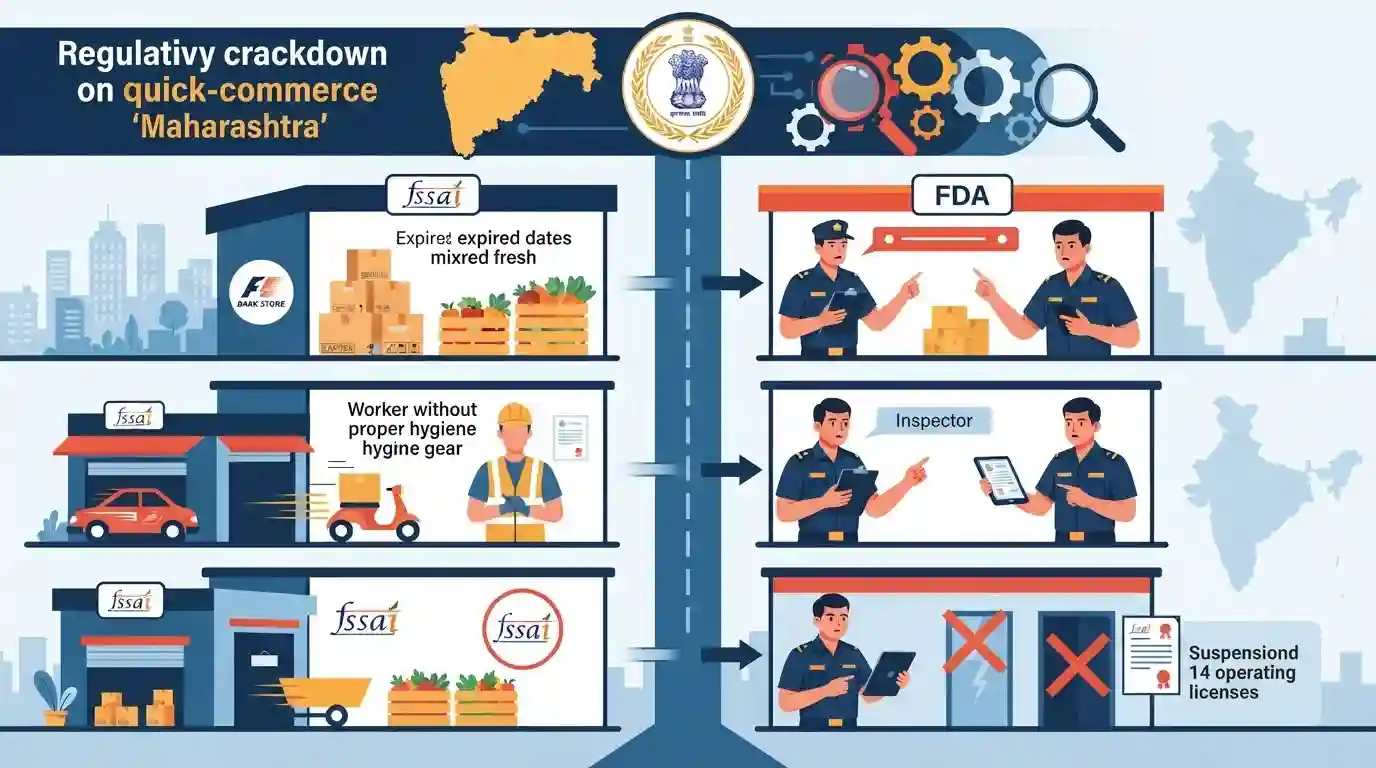
The Maharashtra Food and Drug Administration (FDA) has intensified regulatory scrutiny on quick-commerce platforms like Blinkit, Zepto, and Instamart. During a statewide crackdown under the 'Safe Food, Safe Maharashtra' campaign, the FDA inspected 86 'dark stores' (local fulfillment centers). Authorities found major food safety and hygiene violations, leading to the suspension of 14 operating licenses. Violations included operating without valid FSSAI licenses, storing expired goods alongside fresh items, and failing to maintain proper staff medical records.
Key Points
- The Maharashtra FDA conducted statewide inspections of 86 e-commerce dark stores belonging to platforms like Blinkit, Zepto, and Instamart.
- Action was taken as part of the 'Safe Food, Safe Maharashtra' campaign, spearheaded by FDA Commissioner Tukaram Mundhe.
- The FDA suspended 14 licenses after identifying widespread health and hygiene violations at these quick-commerce fulfillment centers.
- Violations included operating without required FSSAI licenses, improper storage of expired products, and lacking medical records for staff.
Important Terms
Food Safety and Standards Act, 2006

A comprehensive Indian law that consolidates multiple food-related legislations to establish science-based standards, regulate food manufacture, storage, and distribution, and safeguard public health across India.
UPSC context
GS-2: Statutory Laws & Regulatory Bodies. Tests governance, health policies, and the regulatory framework of consumer protection.
Food Safety and Standards Authority of India (FSSAI)
An autonomous statutory body under the Ministry of Health and Family Welfare that sets science-based standards for food and regulates its manufacture, storage, and sale.
UPSC context
GS-2: Statutory Bodies. Tests executive and regulatory enforcement of food safety laws and consumer safety standards in India.
Maharashtra Food and Drug Administration (FDA)
The state-level regulatory body in Maharashtra responsible for enforcing safety standards, issuing licenses, and conducting hygiene audits for food, drug, and cosmetic establishments.
UPSC context
MPSC GS-2: State Administration. Tests state regulatory mechanisms, enforcement of federal laws, and local public health administration.
Safe Food, Safe Maharashtra campaign
An intensive statewide enforcement and hygiene compliance initiative launched by the Maharashtra FDA to inspect food business operators, curb adulteration, and protect public health.
UPSC context
MPSC GS-2/GS-3: State-specific schemes & governance. Tests regional food safety initiatives and consumer welfare measures.
Blinkit
An Indian quick-commerce and instant delivery platform, operating as a Food Business Operator that manages regional fulfillment micro-warehouses (dark stores) under FSSAI guidelines.
UPSC context
MPSC GS-3: Economy & Technology. Tests knowledge of e-commerce business models, supply-chain compliance, and new-age consumer service regulations.
Zepto
A rapid quick-commerce delivery platform in India that stores and distributes groceries from local dark stores, requiring strict food safety and hygiene registration.
UPSC context
MPSC GS-3: Economy. Tests operational compliance, consumer rights, and supply chain regulation in the quick-commerce sector.
Prelims Trap
E-commerce 'dark stores' do not require FSSAI licenses because they only act as intermediaries and do not manufacture food.
Under the FSS Act, 2006, e-commerce entities and fulfillment centers are classified as Food Business Operators (FBOs) and must mandatorily acquire FSSAI licenses.
Static Concepts Connected
How is food safety regulation structured under the FSS Act, 2006?
- Apex body: FSSAI is a statutory body under the Ministry of Health and Family Welfare, setting national standards.
- State execution: State Food Safety Commissioners handle enforcement and license issuance through state Food and Drug Administrations (FDA).
- E-commerce mandate: E-commerce platforms must obtain a Central License from FSSAI, while localized dark stores need state-level licenses/registrations based on turnover.
What features define the Consumer Protection (E-Commerce) Rules, 2020?
- Parent Act: Promulgated under the Consumer Protection Act, 2019, by the Ministry of Consumer Affairs, Food and Public Distribution.
- Broad scope: Applies to inventory and marketplace e-commerce models, including quick-commerce delivery apps.
- Key compliance: Mandates clear display of country of origin, product expiry dates, and a 48-hour grievance acknowledgment system.
Cross-Topic Patterns
Quick-commerce growth vs Urban Zoning Laws
Proliferation of dark stores in residential zones challenges municipal corporations' urban planning bylaws and commercial trade licensing under the Maharashtra Municipal Corporations Act.
Gig economy health and labor standards
FDA's medical check mandates for food handlers directly intersect with the social security of gig workers, currently being institutionalized via Maharashtra's proposed Gig Workers Bill.

MPSC GS-2 may target state FDA enforcement powers over digital intermediaries and the statutory boundaries of the FSS Act 2006.
Linked PYQs · 3
Linked PYQs · 3
- 2026MPSC_PRELIMSGS1
Which of the following statement/s is/are correct regarding National Food Security Act - 2013 ? (a) Women empowerment is a feature of the National Food Security Act - 2013. (b) State Food Commission is monitoring, reviewing and implementing authority of this Act - 2013. Answer options :
- 2024MPSC_PRELIMSGS1
Food security includes following stages : (a) Adequate availability of food grains to all. (b) Adequate availability of food grains and pulses to all. (c) Adequate availability of food grains, pulses, milk and vegetables to all. (d) Adequate availability of food grains, pulses, milk products, vegetables, fruits, meat and fish etc. Answer options :
- 2025MPSC_PRELIMSGS1
Identify the correct statement/s from the following regarding Food Security Bill, 2013. A. The Bill provides food safety benefits to the 50% of the urban population and 75% of the rural population. B. Beneficiaries will be provided rice at Rs. 3/-kg, coarse grains at Re. 1/-kg and wheat at Rs. 2/-kg per month.
