Maharashtra International Trade And Mumbai Antwerp Port Partnership
Source:mumbaiviral ↗
Why It Matters
This development highlights Maharashtra's proactive trade diplomacy and integration into global value chains, which is highly relevant for MPSC aspirants tracking state-level economic policies, international trade pacts, and regional industrial development.
Summary
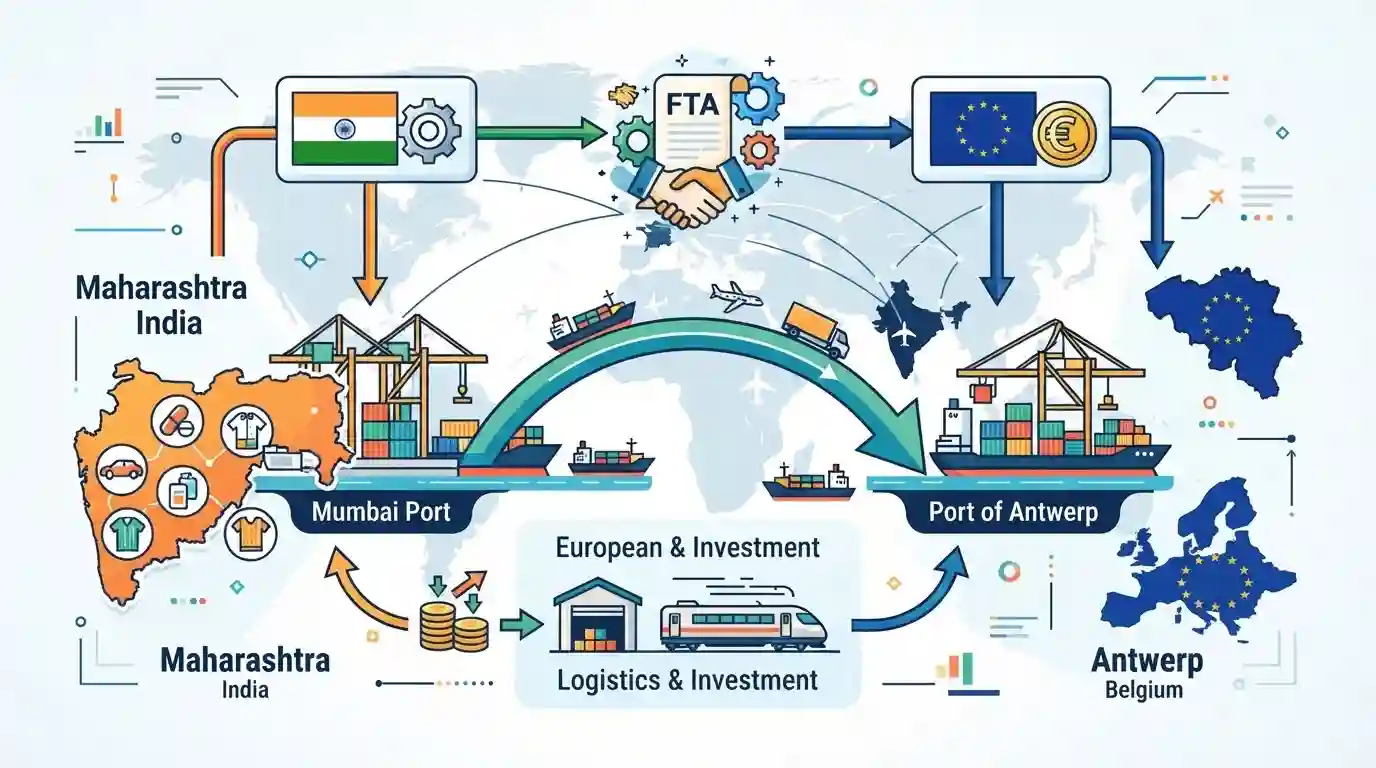
Maharashtra is actively strategizing to capitalize on the prospective India-European Union Free Trade Agreement (FTA) through a strategic pact between Mumbai and Antwerp, focusing on bolstering maritime trade, enhancing logistics, and drawing European investments into the state's industrial ecosystem.
Key Points
- Maharashtra is positioning itself to maximize economic and trade gains from the proposed India-European Union Free Trade Agreement (FTA).
- A strategic collaboration pact between Mumbai and Antwerp has been formed to boost maritime trade, logistics, and port connectivity.
- The partnership aims to enhance European investments, improve supply chain efficiencies, and expand export opportunities for Maharashtra's industrial sectors.
Important Terms
India-EU Free Trade Agreement

A landmark bilateral trade pact between India and the European Union aimed at slashing tariffs, liberalizing services, and boosting investment across a vast free-trade zone.
UPSC context
Important for MPSC Economy and International Relations; tests bilateral trade dynamics, tariff structures, and export opportunities for Maharashtra.
Mumbai-Antwerp Pact
A proposed strategic economic and maritime partnership between Mumbai and Antwerp to expand collaboration in ports, logistics, clean technology, and industrial investments.
UPSC context
Crucial for MPSC Maharashtra Economy and Trade; tests regional urban-economic partnerships and port-led development strategies.
Port of Antwerp
A major European port in Belgium functioning as a prime logistics gateway for Indian exports entering the European market.
UPSC context
Relevant for MPSC Geography and Logistics topics; evaluates international trade routes and maritime infrastructure connectivity.
European Union
A political and economic union of European member states operating as a single internal market and a major global trade bloc.
UPSC context
Essential for MPSC International Relations; tests global economic groupings, trade pacts, and multilateral diplomatic engagements.
Static Concepts Connected
What are the key institutional mechanisms and administrative authorities governing major ports in India?
- Governing Act: Major ports in India are governed by the Major Port Authorities Act, 2021, which replaced the old Major Port Trusts Act, 1963.
- Autonomy & Board: Provides greater autonomy, operational flexibility, and professional board-managed governance to major port authorities like JNPA.
Cross-Topic Patterns
Port Modernization + International FTAs
Port-led industrialization strategies under Sagarmala are increasingly tied to international bilateral pacts and prospective FTAs to secure direct foreign investment.

Mumbai-Antwerp pact + India-EU FTA likely to feature in MPSC questions on Maharashtra's export-import ecosystem and port infrastructure.
Linked PYQs · 3
Linked PYQs · 3
- 2026MPSC_PRELIMSGS1
Observe the following statements. (a) As per the State Mineral Policy 1999, iron, sulphur, gold, copper and lead mineral production was opened to the private sector. (b) Konkan region has the highest mineral availability after Nagpur region. (c) Maharashtra State Mining Corporation was established in 1973.
- 2022MPSC_PRELIMSGS1
Given the importance of supply side factors in determination of inflation in India, following long-term policies are likely to help. (a) Changing production patterns (b) Calibrated import policy (c) Focus on transportation (d) Storage infrastructure for perishable commodities
- 2026MPSC_PRELIMSGS1
According to the Economic Survey of India 2025-26 : (a) An increase in immigration control across countries favoured by Indian emigrants may reduce the growth in remittances. (b) Global trade is being increasingly influenced by Geopolitical alignments and economic statecraft. (c) Trade policy at the global level is driven by protectionist and retaliatory tariffs. (d) Geoeconomic factors are now critical determinants in shaping key bilateral trade patterns. Which of the above statement is /are correct ?
