Maharashtra Crop Damage Assessment for Relief Compensation
Source:freepressjournal ↗
Why It Matters
Understanding disaster assessment processes, agricultural vulnerability, and relief mechanisms like SDRF/NDRF in Maharashtra is essential for MPSC aspirants regarding state economy and rural administration.
Summary
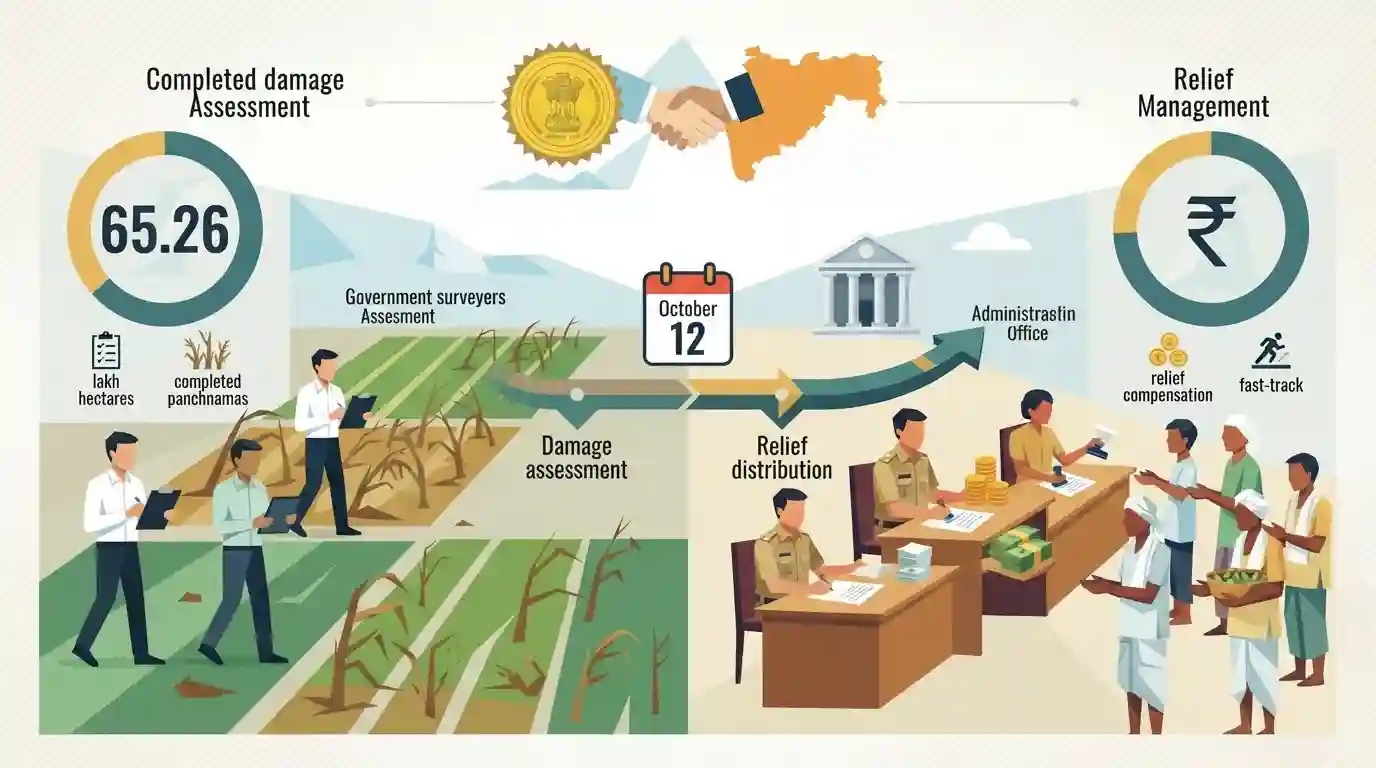
The Maharashtra government has completed crop damage assessments (panchnamas) across 65.26 lakh hectares, with the entire exercise targeted for completion by October 12 to fast-track relief compensation for affected agriculturists.
Key Points
- Crop damage assessment (panchnamas) has been completed on 65.26 lakh hectares in Maharashtra due to adverse weather or drought conditions.
- The administrative process of completing all panchnamas was scheduled to finish by October 12 to facilitate timely agricultural relief compensation to affected farmers.
- Such assessments form the baseline for disbursing financial aid under the State and National Disaster Response Funds (SDRF/NDRF) in Maharashtra.
Important Terms
State Disaster Response Fund (SDRF)

The primary fund available with state governments for immediate relief to victims of notified natural calamities like droughts, floods, and cyclones, constituted under the Disaster Management Act, 2005.
UPSC context
MPSC Paper II & III (Polity & Disaster Management): Tests statutory framework, funding pattern, and utilization norms during agricultural crises.
National Disaster Response Fund (NDRF)
A central statutory fund under the Disaster Management Act, 2005, providing supplementary financial assistance to states when severe natural disasters exceed SDRF capacities.
UPSC context
MPSC Paper III (Economy / Disaster Management): Evaluates centre-state fiscal coordination and disaster relief disbursement mechanisms.
State Government of Maharashtra
The executive governing authority of Maharashtra responsible for state administration, policy execution, disaster response, and agricultural relief distribution.
UPSC context
MPSC Paper I & II (Maharashtra Governance & Polity): Tests state administrative machinery, executive decisions, and crisis management.
Prelims Trap
panchnamas completed across all cultivated land uniformly funded by the Central government under NDRF
Aspirants often confuse NDRF (fully funded by the Centre) with SDRF (funded with a 75:25 or 90:10 Centre-State sharing pattern), and panchnama targets change annually based on actual monsoon failures.
Static Concepts Connected
What are the core financing mechanisms and sharing patterns of SDRF and NDRF in India?
- Funding Ratio: SDRF funding ratio is 90:10 for North-Eastern/Himalayan states and 75:25 for general states between Centre and States.
- NDRF Nature: NDRF is funded entirely by the Central Government and supplements SDRF when a calamity is of severe nature.
- Legal Basis: Disaster management is statutory under the Disaster Management Act, 2005, which establishes the National Executive Committee.
Cross-Topic Patterns
Disaster Relief & Fiscal Federalism
Drought relief mechanisms connect disaster management funds (SDRF/NDRF) with fiscal federalism and cooperative governance under the Disaster Management Act, 2005.
Agrarian Distress & Rural Livelihoods
Agrarian distress triggers multi-agency interventions such as crop loan restructuring, E-Panchayats, and rural employment generation via MGNREGS.

Expect a statement-based question combining SDRF/NDRF funding ratios, drought declaration criteria, and immediate relief measures.
Linked PYQs · 2
Linked PYQs · 2
- 2020MPSC_PRELIMSGS1
What happened in Maharashtra due to fragmentation of agricultural land ? (a) Farmer is not able to produce food grains, sufficient for his family. (b) There are obstacle to supply water to agricultural land. (c) The use of modern agricultural tools is uneconomical. (d) To pay individual attention on agriculture is uneconomical. Answer Options :
- 2022MPSC_PRELIMSGS1
Observe the statements regarding agriculture in Maharashtra : (a) Soil erosion is not a serious problem of agriculture. (b) Soil erosion takes place due to flooding in rivers, forest cutting and uncontrolled grazing. (c) Soils are saline due to over-irrigation. Answer Options :
