Drought Relief and Crop Compensation Measures in Maharashtra
Source:krishibazaar ↗
Why It Matters
Important for MPSC Combined Prelims candidates tracking state-specific agricultural policies, drought relief packages, crop compensation frameworks, and rural welfare governance in Maharashtra.
Summary
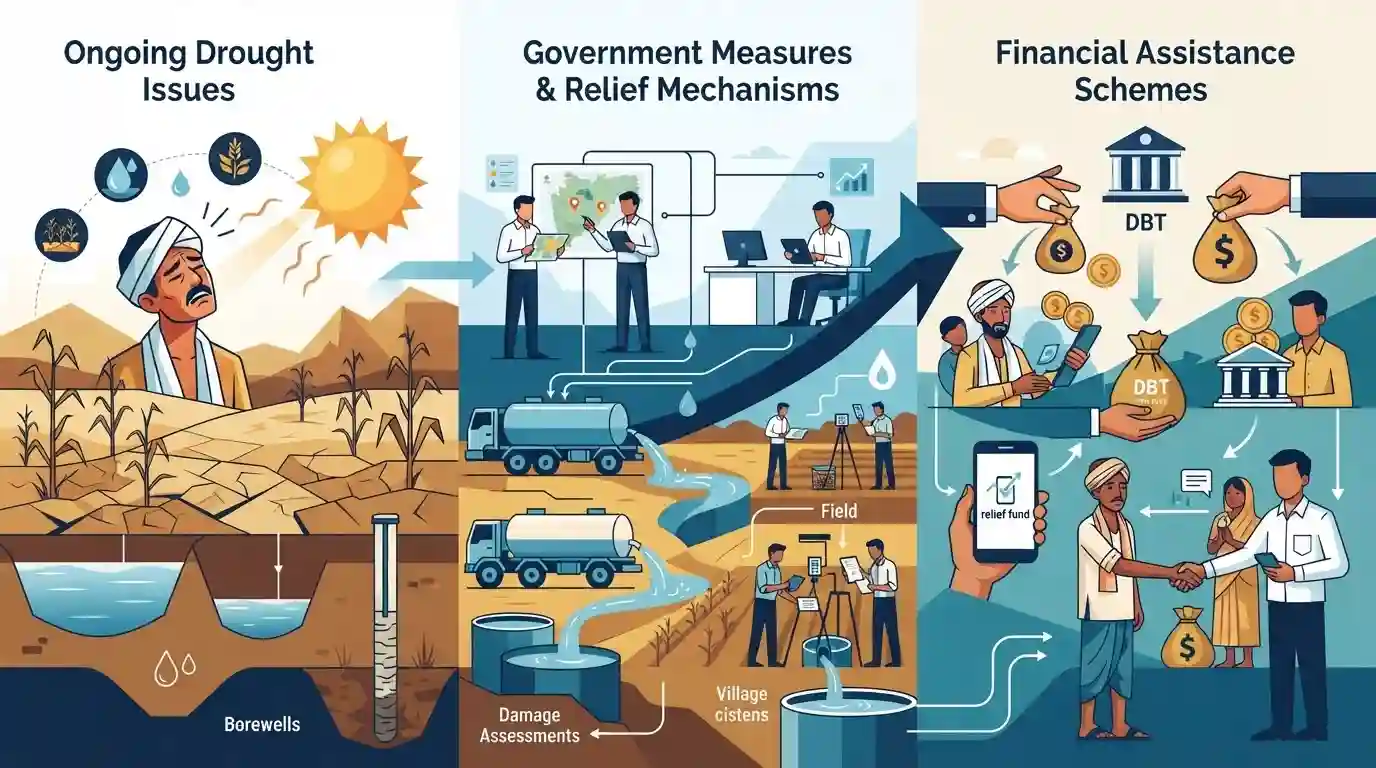
The article highlights the ongoing issues regarding drought conditions and farmer relief crop compensation in Maharashtra, detailing government measures, financial assistance schemes, and relief mechanisms designed to support distressed agrarian communities.
Key Points
- Maharashtra faces recurring agricultural challenges and drought conditions, requiring prompt relief packages and crop compensation mechanisms for affected farmers.
- Government interventions involve state disaster relief funds, crop insurance claims processing, and financial aid distribution to mitigate agrarian distress.
- Effective implementation of drought mitigation and compensation policies is critical for rural livelihood security in Maharashtra.
Important Terms
Pradhan Mantri Fasal Bima Yojana (PMFBY)

A central-state sponsored crop insurance scheme providing financial protection to farmers against natural calamities, unseasonal rainfall, and pest attacks, requiring nominal premium shares.
UPSC context
MPSC Paper II & III (Agriculture, Government Schemes): Tests knowledge of agricultural risk mitigation and crop insurance implementation in Maharashtra.
State Disaster Response Fund (SDRF)
The primary financial reserve allocated to states under the Disaster Management Act, 2005, to provide immediate relief and assistance during natural disasters like droughts.
UPSC context
MPSC Paper I & III (Disaster Management): Tests funding mechanisms and state-level administrative responses during agrarian crises and droughts.
Prelims Trap
Maharashtra's Re 1 crop insurance scheme applies uniformly across all seasons without changes to state subsidy policies.
Aspirants often confuse state-level ex-gratia relief with the mandatory actuarial premium rates under PMFBY, assuming all state crop schemes are fully free.
Static Concepts Connected
What are the key institutional funding mechanisms under the State Disaster Response Fund (SDRF) for agricultural drought relief in India?
- Funding Ratio: Centre-State Ratio: SDRF allocation is funded by the Central Government and State Government in a 75:25 ratio for general states and 90:10 for North-Eastern and Himalayan states.
- Relief Norms: Item & Norms: Expenditure on relief items like input subsidy for crop loss exceeding 33% is strictly governed by Ministry of Home Affairs guidelines.
- Management Body: Approval Body: State Executive Committee (SEC) headed by the Chief Secretary manages and releases SDRF funds at the state level.
Cross-Topic Patterns
Maharashtra Drought & National Disaster Relief Funds
Drought declarations in Maharashtra trigger immediate SDRF/NDRF fund allocation guidelines under the Disaster Management Act, 2005, connecting state agrarian distress directly to national fiscal federalism.
Welfare Populism vs. PMFBY Crop Insurance
The rollback of the 'Re 1' crop insurance scheme and reversion to PMFBY highlights administrative challenges in balancing populist welfare schemes with fiscal prudence.

Expect statement-based questions on Maharashtra drought criteria, SDRF/NDRF sharing norms, and PMFBY implementation changes.
Linked PYQs · 2
Linked PYQs · 2
- 2026MPSC_PRELIMSGS1
Consider the following statements regarding the Public Distribution System (PDS) in Maharashtra. (a) By December 2025, there were 270.48 lakh ration card holders in the state. (b) As of 31 October 2025, 51,636 Fair price shops were functioning in the state. (c) By October 2025, about 1.55 crore families received food grains through Aadhaar - based biometric authentication. Which of the statements given above is/are correct ?
- 2024MPSC_PRELIMSGS1
Identify the correct statements regarding the Chief Minister Solar Agricultural Channel Scheme. (a) This Scheme was started in June 2017, when Devendra Fadanvis was Chief Minister. (b) The main purpose of this Scheme is to provide supply of electricity to farmers through the agricultural feeder. (c) The government has decided to pay ₹ 50,000 per acre as rent to the farmers under this Scheme. (d) Solar panels are set up on government land up to ten kilometres from the 33 kV substation.
