Student Welfare: Proposed Maharashtra Law Regulates Coaching Centers
Source:deccan-chronicle ↗
Why It Matters
The unchecked expansion of the private coaching industry has led to intense academic pressure, resulting in a rise in student suicides, safety hazards, and financial exploitation of parents. This legislation represents a vital state-level governance intervention to protect children's mental health, enforce standard safety norms, and ensure ethical educational practices.
Summary
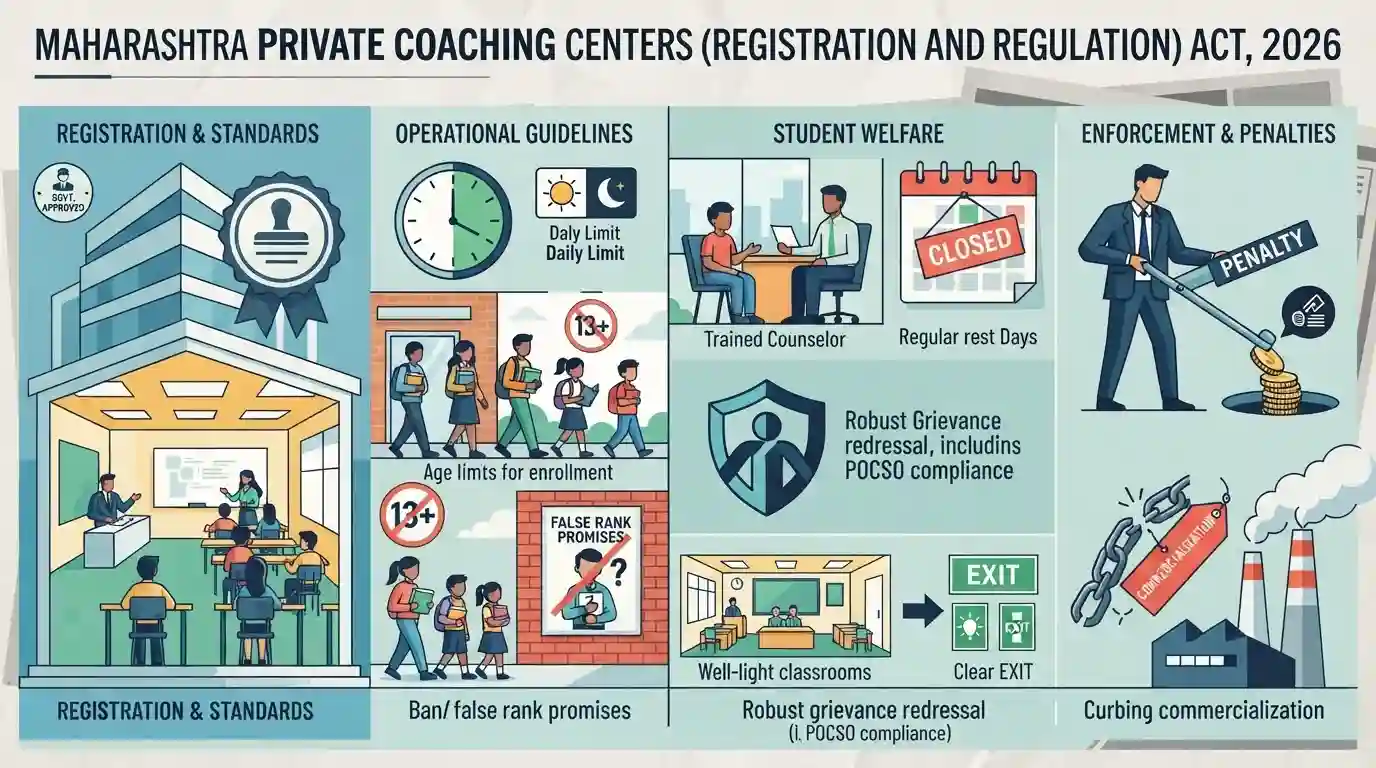
The Maharashtra government has proposed the 'Maharashtra Private Coaching Centers (Registration and Regulation) Act, 2026', a comprehensive draft law to regulate the private tutoring industry. The legislation introduces strict operational guidelines, including a 5-hour daily limit on classes, a ban on enrolling children under 13, and prohibitions against false promises of high ranks. Emphasizing student safety and mental well-being, the draft mandates trained counselors, regular rest days, robust grievance redressal mechanisms (including for POCSO violations), and stringent infrastructure requirements. Violators face steep financial penalties, aiming to curb the commercialization and hazardous practices within the coaching sector.
Key Points
- Maharashtra's draft law mandates the registration of all private coaching centers and limits daily class hours to a maximum of 5 hours.
- The legislation prohibits the enrollment of students below 13 years of age and bans misleading advertisements guaranteeing ranks or marks.
- Stringent infrastructure and safety norms are introduced, including mandatory CCTV, fire safety, and a minimum space of 1 sq. meter per student.
- The policy prioritizes mental health by requiring trained counselors, mandating weekly days off, and prohibiting exams on the day immediately following a holiday.
- Strict penalties ranging from Rs 1 lakh to Rs 50 lakh can be imposed for violations, with a specific focus on grievance redressal for POCSO and sexual harassment cases.
Important Terms
Maharashtra Private Coaching Centers (Registration and Regulation) Act, 2026

A proposed state law mandating the registration of private coaching classes, limiting teaching to five hours daily, barring the enrollment of students under 13, and establishing strict infrastructure and counseling norms.
UPSC context
Essential for GS Paper 2 (Governance) and GS Paper 3 (HRD), highlighting state interventions in unregulated education sectors.
Protection of Children from Sexual Offences (POCSO) Act, 2012
A comprehensive Indian law enacted to protect children under 18 from sexual assault, harassment, and pornography, providing child-friendly legal procedures and special courts for speedy trials.
UPSC context
Highly relevant for GS Paper 3 (Human Rights) and GS Paper 2 (Social Justice), testing legal frameworks for vulnerable groups.
Dummy School Model
An illicit arrangement where students enroll in regular schools merely to fulfill attendance criteria on paper, while actually dedicating their time entirely to private coaching centers for competitive exams.
UPSC context
Important for GS Paper 3 (Education/HRD) regarding regulatory challenges and systemic malpractices within the formal education system.
Prelims Trap
"The Maharashtra draft law prohibits the enrollment of students below 16 years of age."
Aspirants often confuse Maharashtra's draft age limit (13) with the Union Education Ministry's 2024 coaching guidelines (16). The exam will likely swap these numbers.
Static Concepts Connected
How is 'Education' distributed under the Seventh Schedule of the Indian Constitution?
- Original status: Originally placed in the State List (Entry 11) of the Seventh Schedule.
- 42nd Amendment: Moved to the Concurrent List (Entry 25) by the 42nd Constitutional Amendment Act, 1976.
- Concurrent jurisdiction: Both Centre and States can legislate, but Central law prevails in a conflict (Article 254) unless the State law receives Presidential assent.
What are the foundational principles of the POCSO Act, 2012?
- Child definition: The Act explicitly defines a child as any person below the age of 18 years.
- Gender neutral: Unlike many traditional laws, POCSO is entirely gender-neutral, protecting all children regardless of sex.
- Special Courts: Mandates the creation of designated Special Courts in each district for child-friendly and speedy trials.
Cross-Topic Patterns
Coaching regulations + Concurrent List friction
The variance between the Union Ministry's 2024 guidelines (minimum age 16) and Maharashtra's draft (age 13) perfectly illustrates legislative dynamics and potential friction under the Concurrent List.
Dummy Schools + RTE Act mandates
The strict ban on 'dummy schools' connects directly to the Right to Education (RTE) Act's mandates for compulsory physical attendance, holistic development, and continuous comprehensive evaluation.

Expect a multi-statement question contrasting Maharashtra's draft provisions (age 13, 5-hour limit) against Union Ministry 2024 guidelines.
Linked PYQs · 2
Linked PYQs · 2
- 2025MPSC_PRELIMSGS1
The 'Protection of Children from Sexual Offences' (POCSO) Act was enacted in India in which year ?
- 2024MPSC_PRELIMSGS1
Match the following pairs : | List-I | List-II | |---|---| | (a) Dr. Nitin Karmalkar Committee | (i) For implementation of National Education Policy - 2020 in Maharashtra | | (b) Nitin Karir Committee | (ii) To enquire the incident which happened during the distribution of Maharashtra Bhushan Award | | (c) Sunil Pawar Committee | (iii) To study why the rates of onion collapse. | | (d) Dr. K. Kasturirangan Committee | (iv) To make the syllabus for pre-primary to degree according to National Education Policy - 2020 | Code: (a) (b) (c) (d)
