Maharashtra Departmental Schemes and Welfare Policy Updates
Source:impriindia ↗
Why It Matters
Crucial for MPSC aspirants tracking state-specific administrative updates, departmental schemes, and welfare policies implemented by the Government of Maharashtra.
Summary
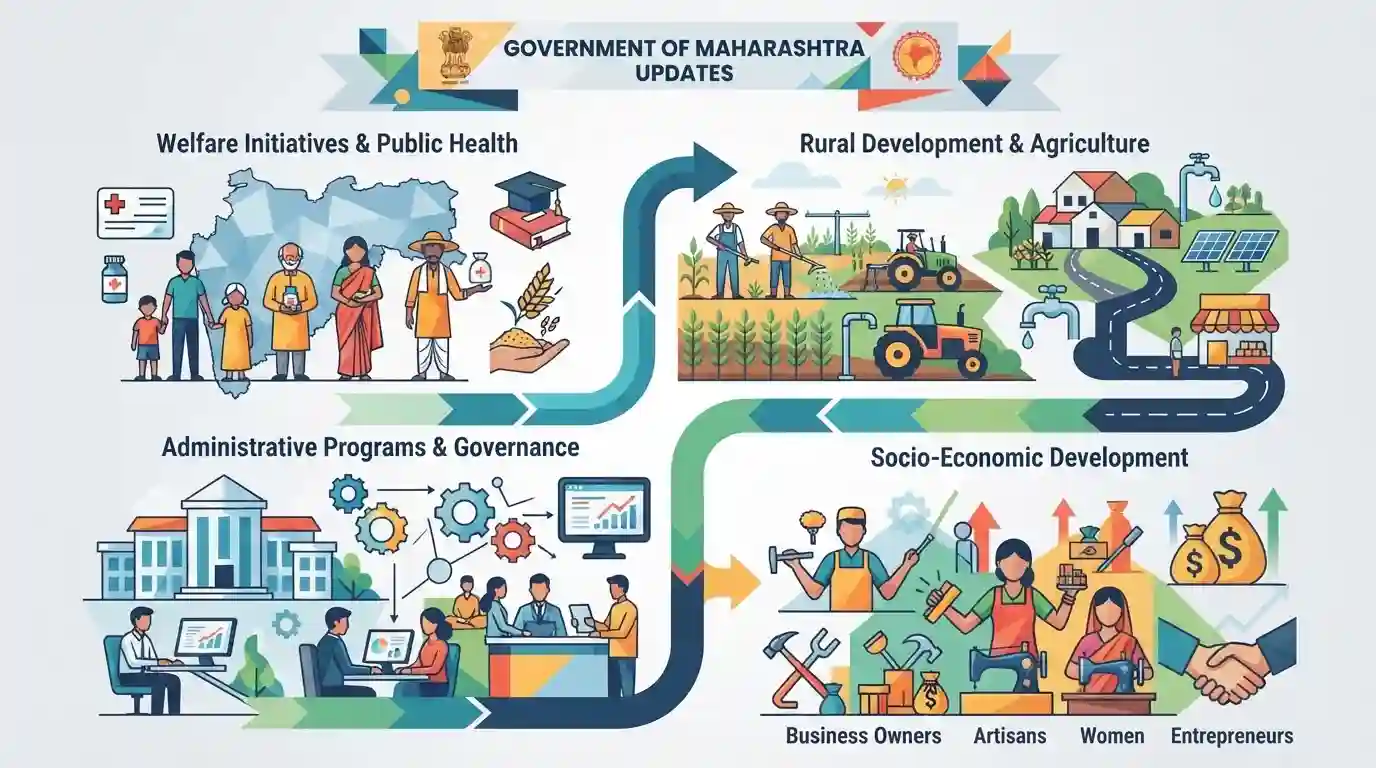
An update on Maharashtra department schemes highlighting government welfare initiatives, rural development policies, and administrative programs relevant to public administration and socio-economic development in the state.
Key Points
- The article outlines recent updates regarding various policy schemes and administrative initiatives managed by departments in Maharashtra.
- Focuses on welfare measures, financial allocations, and governance frameworks relevant to Maharashtra state development.
- Highlights administrative decisions and sector-specific policy updates impacting public service delivery across Maharashtra departments.
Important Terms
Government of Maharashtra

The executive apex body governing Maharashtra, responsible for formulating state-level socio-economic development policies, administrative programs, welfare scheme execution, and budget allocations.
UPSC context
Crucial for MPSC Paper II (Polity & Governance) and Paper III (Economy & Maharashtra Administration), testing administrative structure and state welfare implementation.
IMPRI Impact and Policy Research Institute
An independent research and policy think tank that tracks public policy, social initiatives, and budgetary outlays, providing data on Maharashtra state welfare schemes.
UPSC context
Important for MPSC current affairs and socio-economic policy evaluation, testing analytical skills regarding state budgets and department schemes.
Static Concepts Connected
What are the key structural features and administrative tiers of the Maharashtra Mantralaya governance framework?
- Department Expansion: Mantralaya reorganization increased administrative departments from 33 to 45 without adding new posts to improve accountability.
- Decision Tiers: GPR 2.0 caps bureaucratic decision-making at a maximum of three administrative tiers to accelerate public service delivery.
- MahaDBT 2.0: Direct Benefit Transfers are streamlined through the revamped MahaDBT 2.0 portal for transparent welfare distribution.
Cross-Topic Patterns
State E-Governance & National Digital Frameworks
Maha AI platform utilizes NIC technical support, mirroring national digital governance frameworks like Digital India and UMANG for localized state service delivery.
Multilateral Financing & State Infrastructure
AIIB financing for rural roads links state infrastructure development with multilateral development bank funding strategies and foreign debt management.

Mpscs frequently test specific administrative structural reforms, tier caps under GPR, and welfare scheme financial allocations like PM-Kisan top-ups.
Linked PYQs · 3
Linked PYQs · 3
- 2022MPSC_PRELIMSGS1
Government of Maharashtra has adopted gender budgeting from the year ________.
- 2026MPSC_PRELIMSGS1
Match the pairs. | Poverty Eradication Programs in India | Year of launch | |---|---| | (a) Integrated Rural Development Programme (IRDP) | (i) 2001 | | (b) Rural Landless Employment Guarantee Programme (RLEGP) | (ii) 1989 | | (c) Jawahar Rojgar Yojana | (iii) 1983 | | (d) Sampoorna Grameen Rojgar Yojana | (iv) 1978 | Code: (a) (b) (c) (d)
- 2024MPSC_PRELIMSGS1
Through which of the following factors the fisheries development program is implemented effectively ? (a) The Fishery Survey of India. (b) National fisheries development board. (c) Development of fishing harbours. (d) Meat Marketing. Answer options :
