Pandharpur Development Plan and Stakeholder Consultation Process
Source:mid-day ↗
Why It Matters
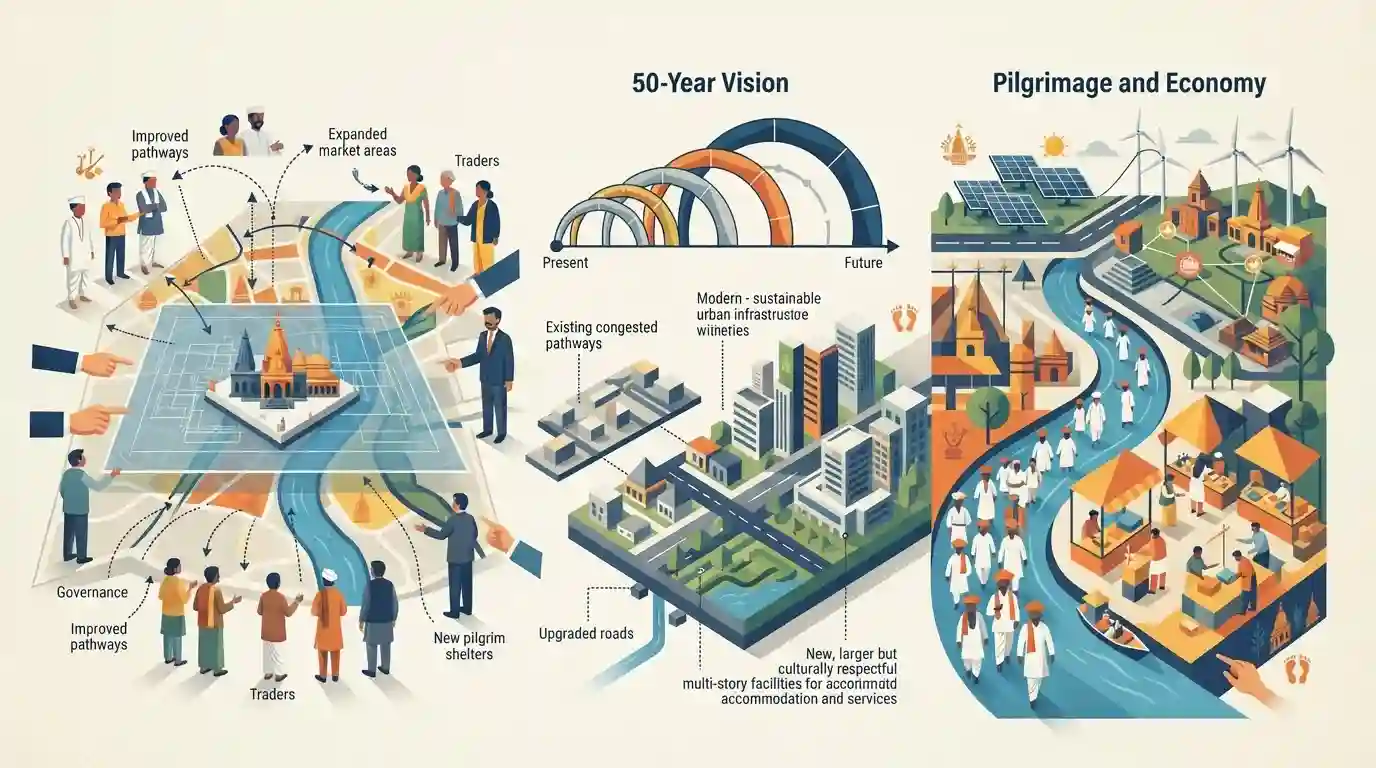
Illustrates the intersection of cultural heritage conservation and urban infrastructure planning. It highlights the importance of participatory governance and stakeholder consultation (similar to the objectives of schemes like HRIDAY and PRASAD) when developing sensitive and high-footfall religious centers.
Summary
Maharashtra Chief Minister Devendra Fadnavis has stated that the comprehensive development plan for the temple town of Pandharpur will be finalized only after taking all stakeholders—including warkaris, devotees, local residents, and traders—into confidence. Addressing concerns during a meeting in Solapur, he emphasized that the plan is designed with a 50-year vision to enhance facilities for the growing annual influx of pilgrims while simultaneously boosting the local economy through sustainable urban and tourism infrastructure development.
Key Points
- Maharashtra CM Devendra Fadnavis assured that the Pandharpur development plan will be finalized only after consulting all stakeholders, including warkaris, locals, and traders.
- The development plan aims to create a 50-year vision for the temple town, focusing on improving facilities for the increasing number of devotees.
- A key objective of the plan is to boost the local economy through improved pilgrimage tourism infrastructure.
- A meeting regarding this plan was recently held in Solapur to gather inputs from various groups.
Important Terms
Warkari Sampradaya

A prominent Bhakti tradition in Maharashtra centered on the worship of Lord Vitthal at Pandharpur. Warkaris undertake an annual pilgrimage (Wari) singing abhangs, representing an egalitarian, deeply rooted cultural and spiritual heritage.
UPSC context
Vital for MPSC GS-1 (History of Maharashtra, Bhakti Movement) as it forms the core of the state's socio-cultural history.
Pandharpur Development Plan
A multi-crore infrastructure initiative by the Maharashtra government designed with a 50-year vision. It aims to modernize Pandharpur's amenities for pilgrims while boosting the local economy and preserving its spiritual heritage.
UPSC context
Important for MPSC GS-3 (Infrastructure & Economic Development) and GS-1 (Tourism in Maharashtra) as a model of heritage conservation.
Participatory Governance
A civic framework that includes citizens and local stakeholders—such as residents, traders, and devotees—in the policy-making and urban planning process to ensure transparent, accountable, and inclusive development.
UPSC context
Crucial for MPSC GS-2 (Polity & Public Administration) regarding local governance, the 74th Amendment, and citizen-inclusive urban planning.
Prelims Trap
"Sant Tukaram's Palkhi originates from Alandi while Sant Dnyaneshwar's originates from Dehu."
This is a classic swap trap. Sant Dnyaneshwar's Palkhi starts from Alandi, whereas Sant Tukaram's Palkhi originates from Dehu.
Static Concepts Connected
What are the foundational elements of the Warkari Sampradaya?
- Primary Deity: Centers on the worship of Lord Vithoba (Vitthal) of Pandharpur, recognized as a manifestation of Krishna.
- Key Saints: Founded in the 13th century by Saint Dnyaneshwar; later popularized by poet-saints like Namdev, Eknath, Tukaram, and Chokhamela.
- Literature & Practice: Rooted in Abhangas (devotional poetry) and the Dnyaneshwari, promoting egalitarianism and the annual Wari pilgrimage.
What is the geographical significance of the Bhima River around Pandharpur?
- River Origin: It originates at Bhimashankar (Pune) and is a major tributary of the Krishna River.
- Chandrabhaga: In Pandharpur, it is locally called "Chandrabhaga" due to its crescent-shaped, half-moon turn near the temple town.
- Ujani Dam: The Ujani Dam (Bhima Irrigation Project) in Solapur is built across it, serving as a critical water source for the region.
Cross-Topic Patterns
Religious Tourism & Urban Planning
The massive ₹4,150 crore Pandharpur layout mirrors the PRASHAD scheme approach, integrating Maharashtra's cultural heritage with sustainable, 50-year urban economic planning.
Stakeholder consensus in Town Planning
Involving Warkaris and local traders emphasizes participatory governance in mega-infrastructure, a recurring theme in MPSC Mains GS-2 regarding democratic decentralization and citizen engagement.

Expect a multi-statement MPSC question mapping Bhakti saints to their Palkhi origins (Alandi/Dehu) alongside Chandrabhaga river geography.
Linked PYQs · 1
Linked PYQs · 1
- 2021MPSC_PRELIMSGS1
Government of India's ministry of Housing and urban affairs is implementing which scheme for urban planning and heritage conservation ?
