State Executive: CM Empowered To Override Ministerial Decisions
Source:uni-india ↗
Why It Matters
This development sheds light on the practical application of Article 166 of the Indian Constitution, detailing how the Governor allocates government business and structures the functional relationship between the Chief Minister and the Cabinet.
Summary
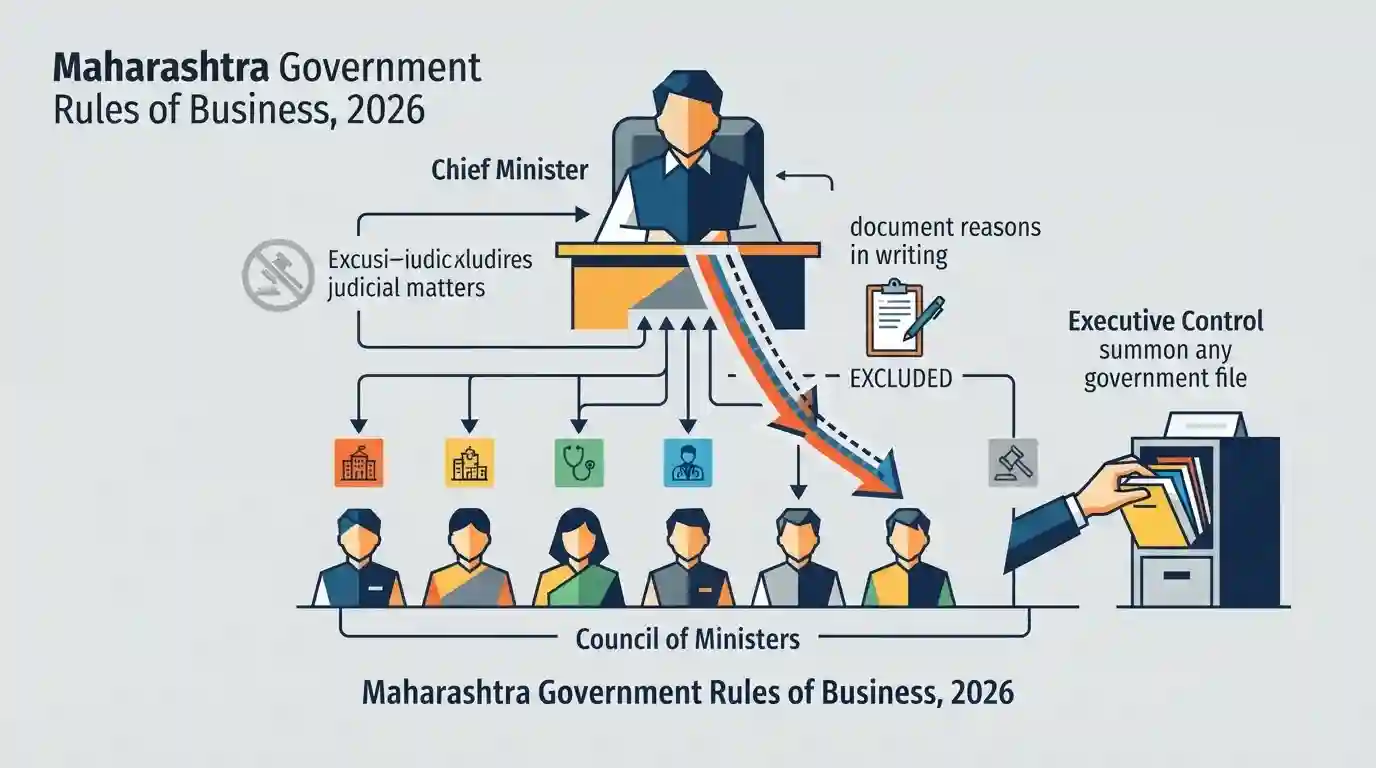
The Maharashtra government has notified the 'Maharashtra Government Rules of Business, 2026', formally granting Chief Minister Devendra Fadnavis the authority to override decisions made by any cabinet minister. Exercisable in the larger public interest, this power requires the Chief Minister to document the reasons in writing and explicitly excludes quasi-judicial matters. Furthermore, the CM has been authorized to summon any government file or record, enhancing executive control over state governance.
Key Points
- The newly notified Maharashtra Government Rules of Business, 2026 empower Chief Minister Devendra Fadnavis to override decisions made by any cabinet minister.
- The overriding power can be exercised in the larger public interest and requires the CM to record the reasons in writing.
- The new rules explicitly exclude quasi-judicial matters from the Chief Minister's overriding authority.
- The CM is now authorized to call for any file, document, or record from any minister or state secretary.
Important Terms
Maharashtra Government Rules of Business, 2026

A 2026 regulatory framework granting the Maharashtra Chief Minister explicit authority to override any cabinet minister's decision—except in quasi-judicial matters—in the public interest, provided reasons are recorded in writing.
UPSC context
MPSC/UPSC GS Paper 2 (State Executive). Tests the regulatory powers of the Chief Minister and procedural mechanisms of state governance.
Article 166 (Rules of Business)
A constitutional provision empowering the State Governor to frame rules for the convenient transaction of government business and the allocation of portfolios among ministers on the Chief Minister's advice.
UPSC context
MPSC GS-2 (Constitution). Essential for understanding the constitutional basis of executive functioning, portfolio allocation, and state-level administrative procedures.
Quasi-judicial matters
Administrative or executive proceedings resembling a court of law, where officials evaluate evidence and issue rulings affecting individual rights. Under Maharashtra's 2026 rules, the CM cannot override these specific ministerial decisions.
UPSC context
MPSC GS-2 (Governance & Polity). Tests the distinction between purely executive actions and quasi-judicial functions, emphasizing legal limitations on politicians.
State Cabinet (Council of Ministers)
The apex state executive body headed by the Chief Minister. While ministers head specific departments, Maharashtra's newly updated Rules of Business alter internal dynamics by legally centralizing override powers with the CM.
UPSC context
MPSC GS-2 (State Legislature & Executive). Tests the principles of collective responsibility (Article 164), portfolio allocation, and the Chief Minister's structural supremacy.
Prelims Trap
"The Rules of Business of the State Government are enacted by the State Legislature."
Under Article 166(3) of the Constitution, the Governor (not the legislature or CM) makes the rules for the convenient transaction of the State's executive business.
Static Concepts Connected
How does the Constitution govern the conduct of State Government business?
- Article 166(1): All executive actions of the state government must be formally expressed to be taken in the name of the Governor.
- Article 166(3): The Governor makes rules for the more convenient transaction of government business and for the allocation of said business among the Ministers.
- Article 167: The Chief Minister is constitutionally duty-bound to communicate all administrative decisions of the Council of Ministers to the Governor.
Why are quasi-judicial matters excluded from the CM's overriding powers?
- Adjudicatory Nature: These are administrative actions that require adjudicating rights or disputes (e.g., revenue appeals, licensing tribunals) based on facts and law.
- Required Independence: They must be decided strictly on merit by the designated statutory authority without dictation or interference from higher political executives.
Cross-Topic Patterns
Collective Responsibility vs CM's Primacy
Granting the CM an overriding veto shifts the balance of Article 164(2) (the Cabinet's collective responsibility) heavily toward a centralized Chief Ministerial system of governance.
Art 167 Duties & Administrative Control
The CM’s formalized power to summon any departmental file practically strengthens their ability to fulfill constitutional obligations under Article 167, ensuring the Governor is kept fully informed.

Expect a multi-statement polity question testing Art 166(3) rule-making powers mixed with quasi-judicial exceptions to executive control.
Linked PYQs · 1
Linked PYQs · 1
- 2023MPSC_PRELIMSGS1
Which of the following statement is not included in Article 164 ?
