Maharashtra Chief Minister Override Powers Under Business Rules
Source:uni-india ↗
Why It Matters
This development is a prime example of the application of Article 166 (Rules of Business of the State Government) and highlights the dynamic relationship and power hierarchy between the Chief Minister and the Council of Ministers, especially relevant for state polity questions.
Summary
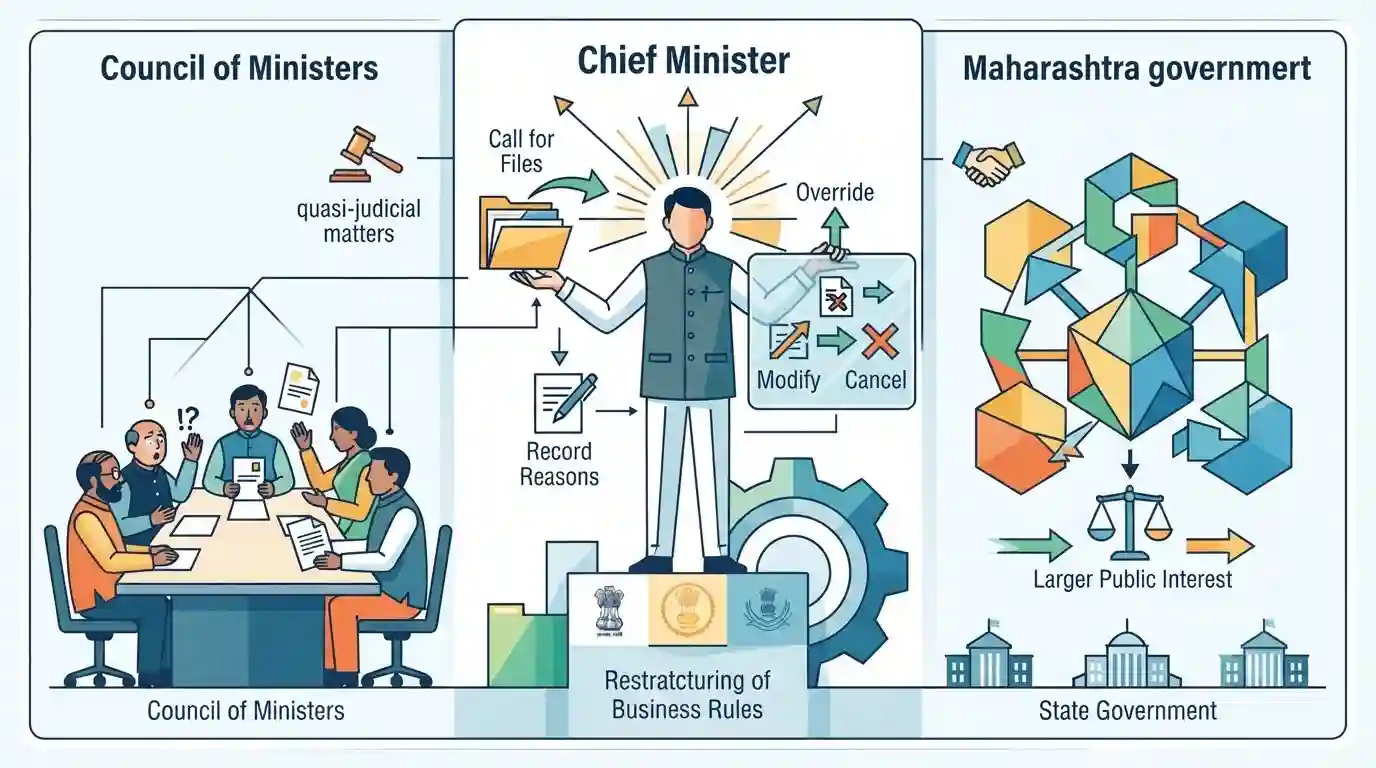
The Maharashtra state government has promulgated the 'Maharashtra Government Rules of Business, 2026', granting Chief Minister Devendra Fadnavis the power to override, modify, or cancel decisions made by any cabinet minister. Excluding quasi-judicial matters, the CM can intervene in the larger public interest but must record reasons in writing and can call for any relevant files. This restructuring of business rules asserts the CM's primacy over the Council of Ministers, holding particular significance within the Mahayuti coalition government's administration.
Key Points
- The Maharashtra government has introduced the 'Maharashtra Government Rules of Business, 2026', significantly enhancing the Chief Minister's executive powers.
- CM Devendra Fadnavis now holds the authority to override, alter, or cancel any decision taken by a cabinet minister in the larger public interest.
- When exercising this override power, the Chief Minister is required to record the reasons in writing.
- The new rules exclude quasi-judicial matters from the Chief Minister's override authority.
- This move centralizes executive authority within the context of the Mahayuti coalition government framework.
Important Terms
Maharashtra Government Rules of Business, 2026

Notified administrative framework under Article 166 authorizing the Maharashtra CM to review, modify, or override cabinet ministers' decisions in public interest, with written justification, excluding quasi-judicial cases.
UPSC context
MPSC Paper II (Polity). Tests state executive powers, administrative rules, and CM supremacy.
Article 166 of the Constitution of India
Constitutional provision regulating state government business conduct, empowering the Governor to make rules for convenient transaction of business and allocation of portfolios among ministers.
UPSC context
MPSC Paper II (Polity). Crucial for state executive machinery and administrative rules of business.
Mahayuti
The ruling political coalition in Maharashtra, currently comprising the Bharatiya Janata Party (BJP), Shiv Sena, and the Nationalist Congress Party (NCP).
UPSC context
MPSC Paper II (Polity). Tests coalition politics and regional alliance dynamics.
Chief Secretary
The highest-ranking civil servant in a state government, serving as the chief advisor to the Chief Minister and head of the state's administrative machinery.
UPSC context
MPSC Paper II (State Administration). Tests bureaucracy, civil service roles, and cabinet operations.
Prelims Trap
The Rules of Business are framed by the Chief Minister and empower them to override all ministerial decisions, including quasi-judicial ones.
Under Article 166(3), the Rules of Business are formally made and promulgated by the Governor, not the Chief Minister, and they strictly exclude quasi-judicial matters.
Static Concepts Connected
What are the key constitutional provisions under Article 166?
- Executive Action Name: All executive actions of a State government are formally taken in the name of the Governor.
- Rules of Business: The Governor makes rules for the more convenient transaction of government business and allocates portfolios among ministers.
- Legal Immunity: An order/instrument executed in the Governor's name cannot be challenged on the ground that it was not made by the Governor.
How does Article 164 define the Council of Ministers' relationship with the Assembly?
- Collective Responsibility: The Council of Ministers is collectively responsible to the Legislative Assembly of the State, meaning they sink or swim together.
- CM's Primacy: The Chief Minister is appointed by the Governor, and other Ministers are appointed on the advice of the Chief Minister.
- Pleasure of Governor: Ministers hold office during the pleasure of the Governor, though this is practically guided by the Chief Minister's majority.
Cross-Topic Patterns
Coalition dynamics vs. Rules of Business
Examines how formal constitutional tools under Article 166 are utilized to streamline decision-making and manage friction in multi-party state coalitions.
Quasi-judicial immunity from CM control
Highlights the administrative law principle that quasi-judicial decisions of ministers must remain independent of executive/political override to prevent violation of natural justice.

MPSC may test the constitutional source (Art 166) of Rules of Business alongside the exemptions (quasi-judicial) of the CM's override power.
Linked PYQs · 2
Linked PYQs · 2
- 2023MPSC_PRELIMSGS1
Which of the following statement is not included in Article 164 ?
- 2013MPSC_PRELIMSGS1
The Chief Minister of a state can be removed if : (a) a resolution is passed by 2/3rd members of the Legislative Council or the Rajya Sabha. (b) in the opinion of the Governor, there is a breakdown of the constitutional machinery in the state. (c) a no - confidence motion is passed by the Legislative Assembly. (d) a no - confidence motion is passed by both the houses of State Legislature. Codes :
