Maharashtra CM Overriding Powers Under Rules of Business
Source:indianmandarins ↗
Why It Matters
Understanding the operational dynamics, constitutional position, and administrative powers of a Chief Minister relative to cabinet ministers is crucial for mastering Indian state polity and executive governance.
Summary
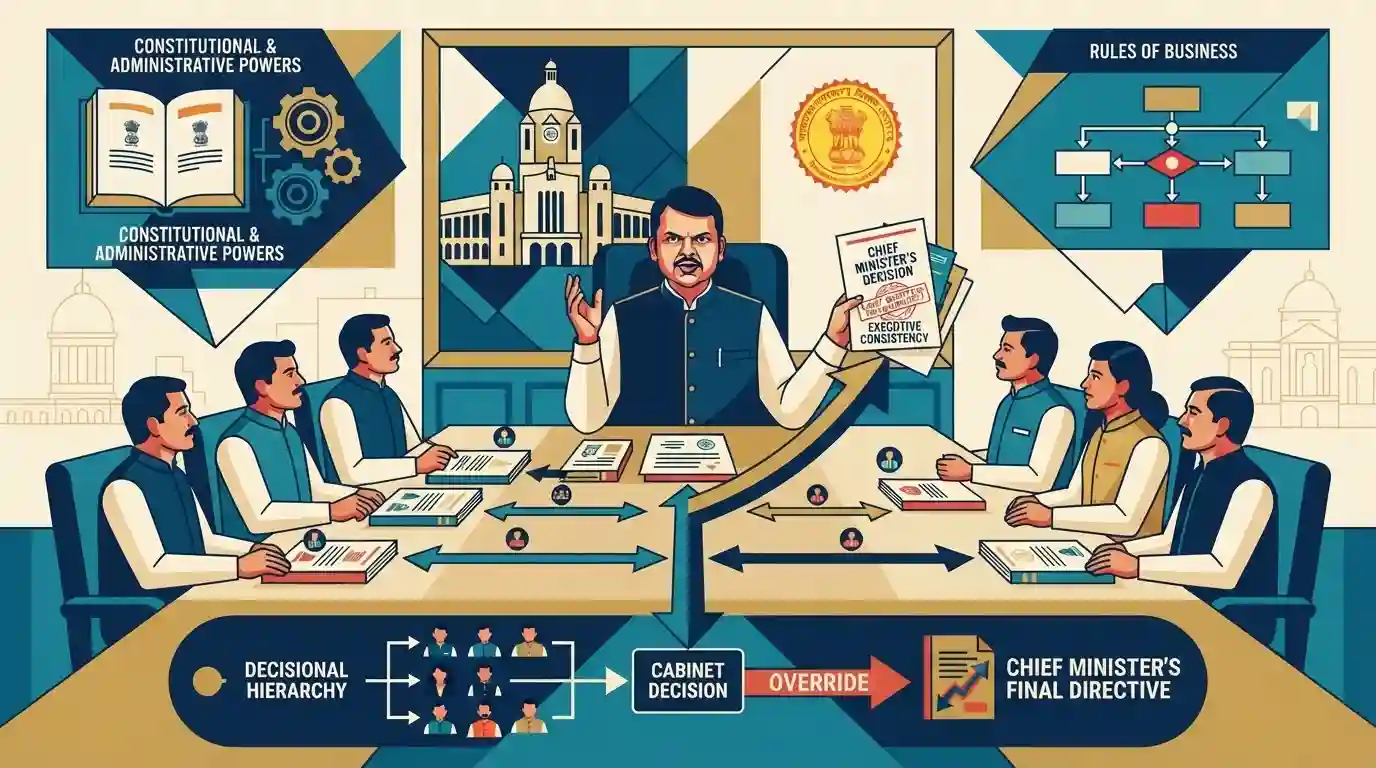
The article outlines the constitutional and administrative powers of the Chief Minister of Maharashtra, emphasizing their authority to override decisions made by individual cabinet ministers under established rules of business to maintain executive consistency.
Key Points
- The Chief Minister of Maharashtra possesses the administrative and executive authority under the rules of business to override decisions made by individual cabinet ministers.
- The Chief Minister acts as the head of the state government council of ministers, coordinating and directing policy execution across departments.
- While collective responsibility exists, the CM retains overriding powers to ensure administrative coherence and governmental policy alignment.
Important Terms
Maharashtra Government Rules of Business, 2026

The statutory framework framed under Articles 166(2) and (3) of the Constitution that regulates administrative work allocation and executive decision-making processes within the state government.
UPSC context
MPSC Paper II (Polity & Governance) - Tests knowledge of executive procedures, constitutional provisions under Article 166, and state administrative machinery.
Chief Minister of Maharashtra
The constitutional head of the state government whose executive authority includes allocating portfolios, directing cabinet functioning, and exercising override powers under the rules of business.
UPSC context
MPSC Paper II (Polity & Governance) - Evaluates understanding of the Chief Minister's powers, cabinet leadership, and political dynamics in state governance.
Articles 166(2) and 166(3)
The constitutional provisions governing the conduct of business of the state government, requiring executive actions to be expressed in the name of the Governor and making rules for the convenient transaction of government business.
UPSC context
MPSC Paper II (Polity & Governance) - Essential for questions testing constitutional provisions related to state executive powers and secretarial operations.
Prelims Trap
Individual cabinet ministers have final and absolute authority over their departmental decisions under collective responsibility.
Collective responsibility implies cabinet ministers share equal and final authority within their departments, but the CM holds specific statutory overriding powers under the Rules of Business.
Static Concepts Connected
What are the constitutional provisions governing the conduct of business of a State Government in India?
- Executive Actions: Article 166(1) requires all executive actions of the State Government to be expressed in the name of the Governor.
- Rules of Business: Article 166(2) empowers the Governor to make rules for the more convenient transaction of government business and the allocation among ministers.
- Allocation of Business: Article 166(3) directs the Governor to make rules for the allocation of business to ministers and the smooth functioning of the council of ministers.
Cross-Topic Patterns
Rules of Business and Governor's Constitutional Role
Article 166 rules of business are framed by the Governor, connecting executive rulemaking power with the discretionary administrative oversight exercised by the Chief Minister.
Judicial Intervention in Executive Rulemaking
The Bombay High Court ruling highlights how judicial interpretation of subordinate legislation forces amendments to state executive rules, bridging the judiciary and state administration.

Expect a multi-statement question combining Article 166, Rules of Business framing, and the CM's overriding powers in state cabinets.
Linked PYQs · 3
Linked PYQs · 3
- 2019MPSC_PRELIMSGS1
Which one of the following statements about the Governor of Maharashtra is true ?
- 2023MPSC_PRELIMSGS1
Which of the following statement is not included in Article 164 ?
- 2013MPSC_PRELIMSGS1
The Chief Minister of a state can be removed if : (a) a resolution is passed by 2/3rd members of the Legislative Council or the Rajya Sabha. (b) in the opinion of the Governor, there is a breakdown of the constitutional machinery in the state. (c) a no - confidence motion is passed by the Legislative Assembly. (d) a no - confidence motion is passed by both the houses of State Legislature. Codes :
