Climate Finance: Maharashtra Launches Green Investment Pipeline
Source:theprint ↗
Why It Matters
It highlights a novel sub-national strategy for tackling climate finance shortfalls, providing a blueprint for integrating private and philanthropic funds into state-level green initiatives like electric mobility and rural solarisation.
Summary
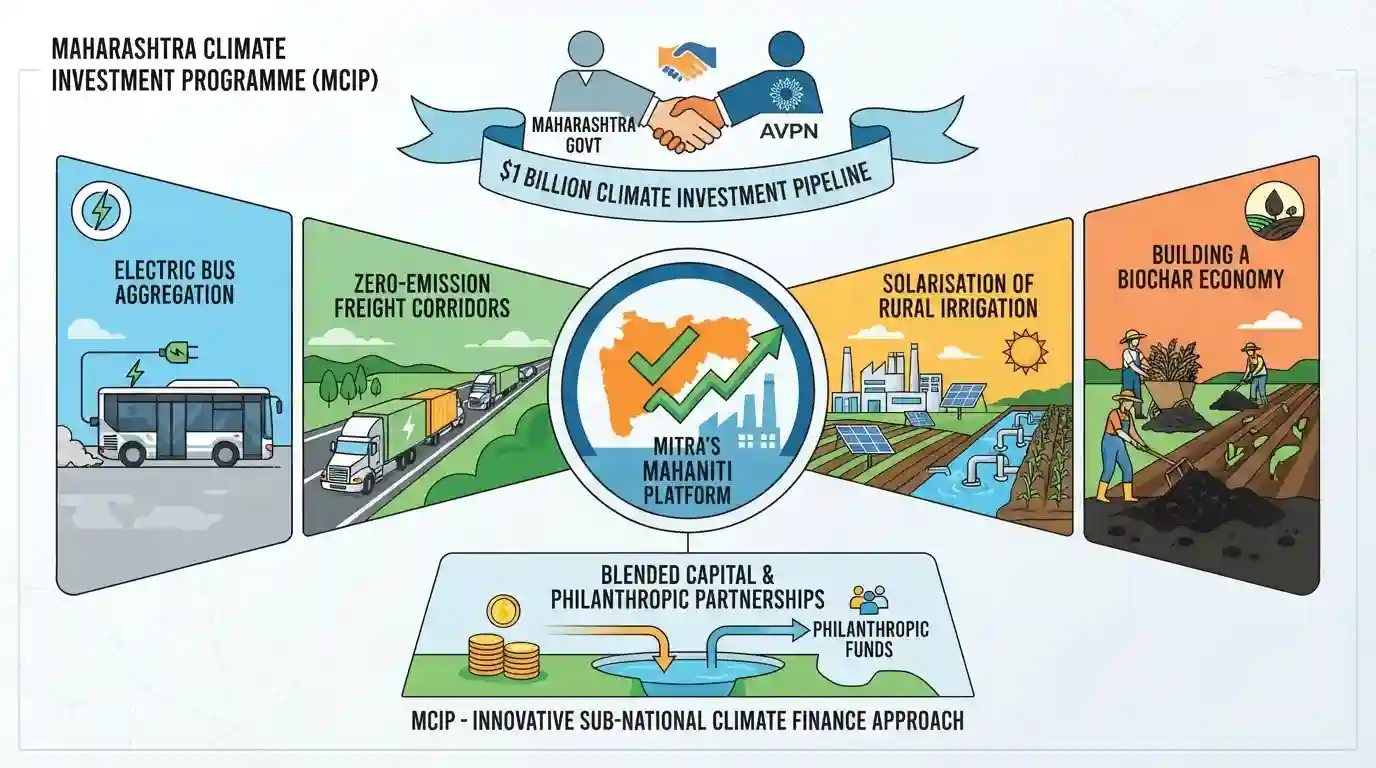
The Maharashtra government, in partnership with the Asian Venture Philanthropy Network (AVPN), has launched a $1 billion climate investment pipeline to attract private capital for climate resilience and decarbonization. Hosted on MITRA's Mahaniti platform, the pipeline covers five priority areas: electric bus aggregation, zero-emission freight corridors, industrial decarbonisation for MSMEs, solarisation of rural irrigation, and building a biochar economy. This initiative falls under the Maharashtra Climate Investment Programme (MCIP) and represents an innovative sub-national approach to mobilizing climate finance through blended capital and philanthropic partnerships.
Key Points
- Maharashtra has launched a $1 billion climate investment pipeline to channel private capital into climate transition projects.
- The initiative operates under the Maharashtra Climate Investment Programme (MCIP) and is hosted on 'Mahaniti', a portal by MITRA.
- In partnership with the Asian Venture Philanthropy Network (AVPN), the platform connects global investors and philanthropic capital directly to climate projects.
- The five priority areas include electric bus aggregation, zero-emission freight corridors, MSME industrial decarbonisation, rural irrigation solarisation, and the biochar economy.
- The framework serves as a pioneering sub-national model in India for employing blended finance to achieve net-zero emission targets.
Important Terms
Maharashtra Climate Investment Programme (MCIP)

A state-led initiative to mobilize private and philanthropic capital for climate action. Under this program, Maharashtra recently launched a $1 billion investment pipeline for projects like electric mobility, rural solarisation, and industrial decarbonisation.
UPSC context
Important for MPSC GS-3 (Environment) to highlight sub-national climate finance strategies and Maharashtra's leadership in energy transition.
MITRA (Maharashtra Institution for Transformation)
A state-level think tank set up by the Maharashtra government in 2022 on the lines of NITI Aayog. It focuses on comprehensive data analysis and evidence-based policymaking to drive economic growth.
UPSC context
Highly relevant for MPSC GS-2 (Governance) as the institutional driver behind Maharashtra’s ambition to become a $1 trillion economy.
Mahaniti platform
A digital portal hosted by MITRA that consolidates investment-ready climate and energy transition projects. It gives private investors direct visibility and access to fund Maharashtra's decarbonisation and resilience initiatives.
UPSC context
Tests knowledge of digital governance and climate finance in MPSC GS-3, showing how the state bridges the gap between projects and investors.
Asian Venture Philanthropy Network (AVPN)
A Singapore-based social investment network that partners with governments to increase impactful capital flows. It co-launched Maharashtra's $1 billion climate pipeline to deploy blended capital beyond traditional grants and aid.
UPSC context
Relevant for MPSC GS-3 (Investment Models/Environment) as an example of international public-private partnerships driving local climate resilience.
Prelims Trap
"MahaNITI is a climate finance portal launched by NITI Aayog for sub-national funding."
MahaNITI is actually a state-level portal developed by MITRA (Maharashtra Institution for Transformation) to channel private and philanthropic capital specifically into Maharashtra's projects.
Static Concepts Connected
What is MITRA and what is its administrative structure?
- Establishment: Established in November 2022 on the lines of NITI Aayog to serve as the primary policy think-tank for the Maharashtra government.
- Leadership: It is officially chaired by the Chief Minister of Maharashtra, with the Deputy Chief Minister serving as the Co-Chairperson.
- Mandate: Provides strategic inputs, fosters Public-Private Partnerships, and hosts development platforms like the 'MahaNITI' portal.
What is a 'Biochar Economy' in the context of climate mitigation?
- Pyrolysis Process: Produced by pyrolysis (heating biomass like crop residue in the absence of oxygen), which locks carbon into a highly stable solid form.
- Dual Benefit: Acts as a long-term carbon sink (aiding decarbonisation) while simultaneously improving soil fertility and water retention when applied to agricultural lands.
Cross-Topic Patterns
Sub-national Paradiplomacy in Finance
Maharashtra negotiating directly with global entities like AVPN illustrates paradiplomacy, where states bypass traditional central devolution mechanisms to secure global philanthropic and private climate funding.
JNPA Green Freight + Logistics Policy
Deploying EV freight trucks at JNPA ties into the National Logistics Policy, addressing the heavily polluting port-hinterland transport corridors while advancing the state's net-zero transition.

Expect a multi-statement question on MITRA (CM as Chair) combined with the 5 specific targets (like Biochar & MSMEs) of the MCIP.
Linked PYQs · 4
Linked PYQs · 4
- 2026MPSC_PRELIMSGS1
Arrange the following major greenhouse gases in descending order according to the percentage of their contribution to global warming.
- 2025MPSC_PRELIMSGS1
Which of the following options does not involve use of carbon in any form for energy production ? A. Wood B. Biogas C. Geothermal source D. Coal
- 2025MPSC_PRELIMSGS1
Which of the following is an example of a renewable energy resource ?
- 2018MPSC_PRELIMSGS1
Which of the following factors is/are concerned in the calculation of Green National Income (GNI) ? a. National Income b. Depletion of Natural Resources c. Environmental Degradation Answer Options :
