Maharashtra Public Private Partnership Policy for Infrastructure
Source:propnewstime ↗
Why It Matters
Understanding state-level policy frameworks like PPP policies is critical for MPSC aspirants tracking economic growth, public finance, and infrastructure bottlenecks in Maharashtra.
Summary
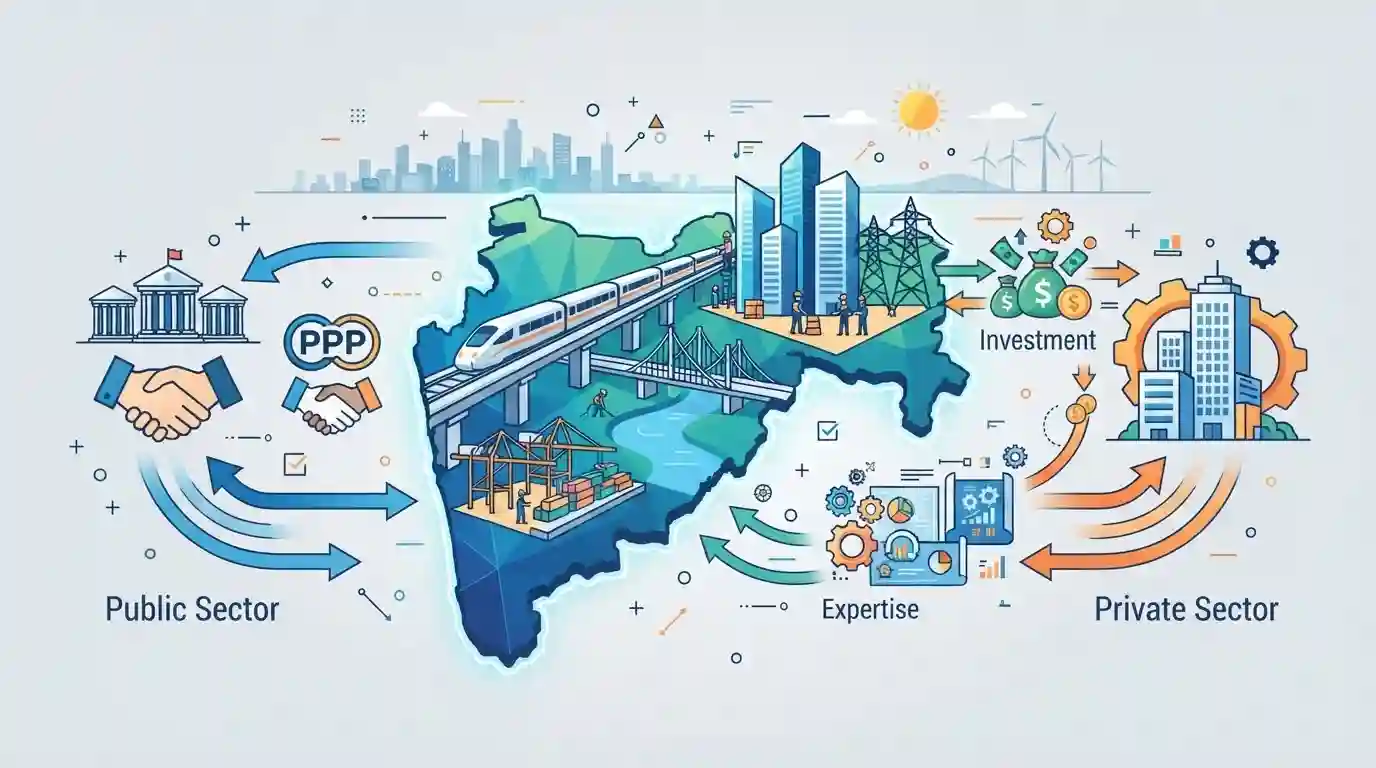
The Maharashtra government has cleared a new strategic Public-Private Partnership (PPP) policy aimed at accelerating the execution of infrastructure projects within the state by leveraging private sector investments and expertise.
Key Points
- Maharashtra government has cleared a strategic Public-Private Partnership (PPP) policy to accelerate infrastructure execution across the state.
- The policy aims to bring private investments, enhance efficiency, and overcome capital constraints in public infrastructure projects.
- It provides a streamlined framework for project identification, risk allocation, and transparent execution.
Important Terms
Strategic PPP Policy

A state policy framework designed to accelerate infrastructure execution by leveraging private sector investments, risk allocation, contract standardization, and dedicated institutional PPP units.
UPSC context
MPSC Economy & Infrastructure: Tests knowledge of alternative financing models and public-private partnerships in state development.
Maharashtra Institution for Transformation (MITRA)
A state-level policy think tank established on the lines of NITI Aayog to guide strategic planning, regional development, and private-sector collaborations for economic growth.
UPSC context
MPSC Polity & Governance: Tests knowledge of institutional bodies, state planning agencies, and advisory structures in Maharashtra.
Prelims Trap
All infrastructure projects under the new PPP policy require mandatory clearance from the Chief Minister-headed cabinet sub-committee.
Aspirants often assume all PPP projects in the state need direct Chief Minister clearance, whereas the policy delegates projects below ₹25 crore to a Chief Secretary-led committee.
Static Concepts Connected
What are the major Public-Private Partnership (PPP) models utilized in Indian infrastructure development?
- BOOT Model: Private partner builds, owns, operates facility for a period, then transfers ownership to government.
- DBFOM Model: Private partner designs, builds, finances, operates, and maintains facility; ownership remains with private entity or is leased.
- O&M Model: Government builds asset, hands over operation and maintenance to private entity for a specific duration.
- ROT Model: Private entity rehabilitates existing facility, operates it, and transfers it back after concession period.
Cross-Topic Patterns
State PPP Policies & Federal Fiscal Support
Maharashtra's ₹200 crore pooled feasibility gap fund echoes the Centre's VGF scheme under DEA, connecting state-level fiscal federalism with infrastructure deficit financing.
Viksit Maharashtra 2047 & State Economy
Achieving the $1 trillion economy target via private capital relies heavily on state-level ease of doing business and transparent risk-sharing mechanisms.

Maharashtra's new PPP thresholds (₹25 cr cabinet sub-committee rule) and MITRA cell integration are ripe for a multi-statement MPSC question.
Linked PYQs · 2
Linked PYQs · 2
- 2026MPSC_PRELIMSGS1
Match the pairs. | Poverty Eradication Programs in India | Year of launch | |---|---| | (a) Integrated Rural Development Programme (IRDP) | (i) 2001 | | (b) Rural Landless Employment Guarantee Programme (RLEGP) | (ii) 1989 | | (c) Jawahar Rojgar Yojana | (iii) 1983 | | (d) Sampoorna Grameen Rojgar Yojana | (iv) 1978 | Code: (a) (b) (c) (d)
- 2022MPSC_PRELIMSGS1
Given the importance of supply side factors in determination of inflation in India, following long-term policies are likely to help. (a) Changing production patterns (b) Calibrated import policy (c) Focus on transportation (d) Storage infrastructure for perishable commodities
