Maharashtra Introduces Three-Tier Cancer Treatment Policy
Source:Indian Express ↗
Why It Matters
The policy represents a vital state-level model for public healthcare decentralization and non-communicable disease management. It provides a concrete case study for GS Paper 2 answers regarding grassroots health infrastructure, state intervention to contain healthcare marketisation, and addressing the rising NCD burden.
Summary
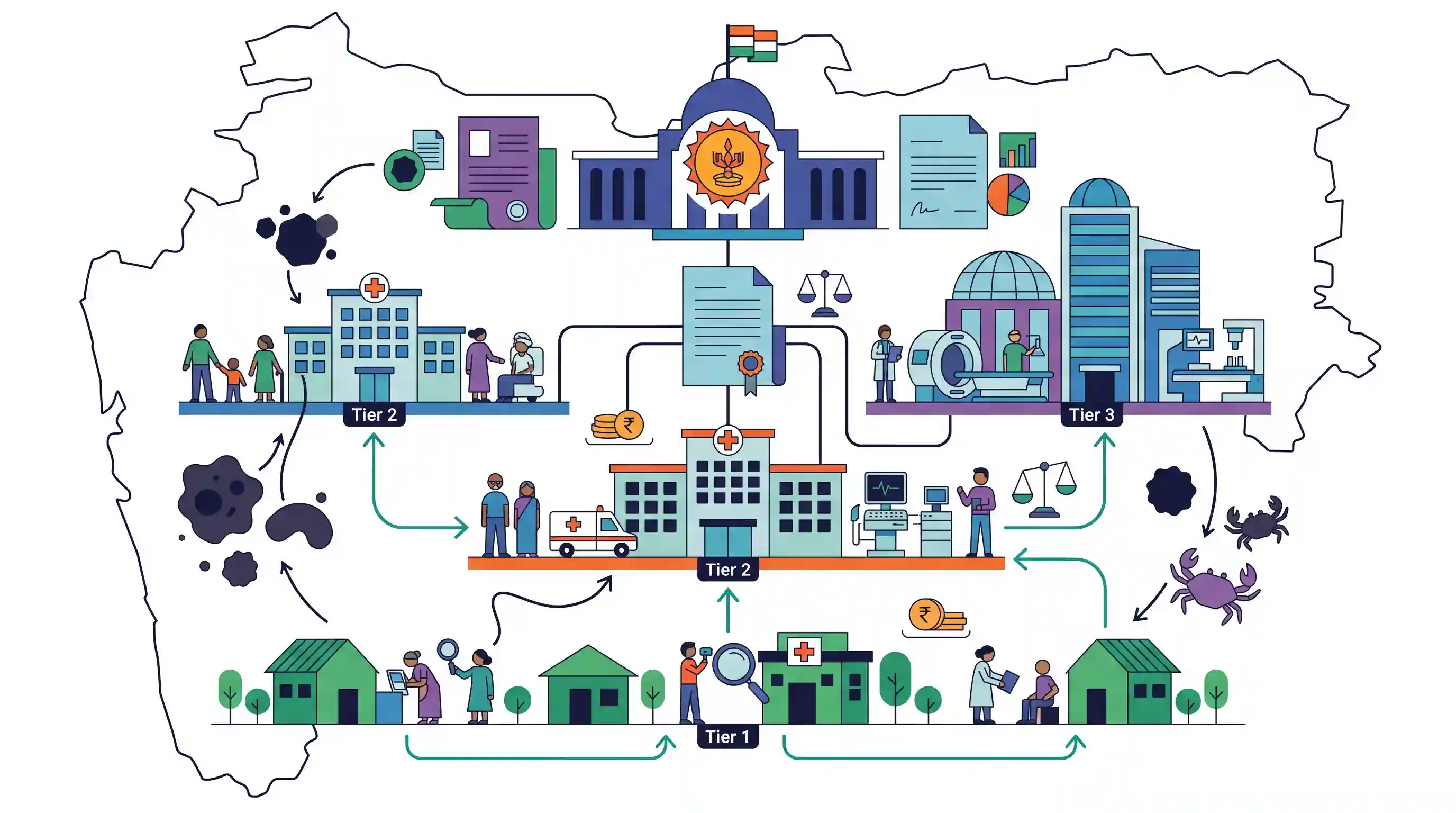
Maharashtra has framed a dedicated Cancer Cure Policy featuring a three-tier healthcare structure. The framework is designed to decentralize cancer treatment, ensuring early screening and accessible care from the grassroots level up to specialized tertiary centers. This strategic move addresses the growing burden of non-communicable diseases (NCDs) while attempting to make healthcare more inclusive and affordable for the state's population.
Key Points
- The Maharashtra government has introduced a comprehensive Cancer Cure Policy to address the rising burden of the disease.
- The policy establishes a three-tier healthcare structure to streamline the screening, diagnosis, and treatment of cancer.
- By decentralizing cancer care, the framework aims to improve accessibility for patients at the grassroots level and reduce the load on apex hospitals.
- The initiative is a significant step in managing non-communicable diseases (NCDs) and minimizing out-of-pocket healthcare expenditure for citizens.
Important Terms
Maharashtra Cancer Cure Policy

Maharashtra's decentralized health framework (2025) for cancer treatment, utilizing an L-1 (apex), L-2 (regional), and L-3 (district) tier system to improve accessibility, screening, and affordable care across the state.
UPSC context
GS Paper II: Government Policies & Health; GS Paper III: NCD management. Tests understanding of decentralized healthcare delivery and state-level policy innovation.
MAHACARE Foundation
The 'Maharashtra Cancer Care, Research and Education Foundation,' a dedicated entity established to provide funding, manpower, and management for the state's cancer care network through clinical trials and government schemes.
UPSC context
GS Paper II: Statutory/Non-statutory bodies and Governance. Relevant for questions on institutional mechanisms for specialized public health services.
Three-tier Healthcare Structure
An integrated healthcare delivery model consisting of Primary (grassroots/PHCs), Secondary (District Hospitals), and Tertiary (Specialized/Teaching Hospitals) levels, designed for efficient referral and universal health coverage.
UPSC context
GS Paper II: Health Infrastructure. A fundamental concept for Indian administration and social justice topics related to the National Health Mission.
Mahatma Phule Jan Arogya Yojana (MPJAY)
Maharashtra’s flagship universal health insurance scheme that provides end-to-end cashless treatment for identified specialty services; 20% of its cancer-related fees will fund the MAHACARE Foundation.
UPSC context
GS Paper II: Welfare Schemes for vulnerable sections. Important for understanding state-led insurance models and their financial integration with health policies.
Non-Communicable Diseases (NCDs)
Chronic conditions like cancer, diabetes, and cardiovascular diseases that are not infectious. They represent a growing global and national health burden requiring long-term care and preventive policy interventions.
UPSC context
GS Paper III: Issues relating to Health and Science. Essential for discussing India's epidemiological transition and public health challenges.
Tata Memorial Hospital (TMH)
The designated Level-1 (apex) institution in Maharashtra’s cancer policy, serving as a premier national specialist center for cancer research, treatment, and education.
UPSC context
GS Paper II: Important Institutions. Relevant for its role in national oncology standards and as a model for public-sector super-specialty care.
Prelims Trap
"MAHACARE is a Centrally Sponsored Scheme to combat non-communicable diseases."
Public Health and Hospitals are State subjects (Entry 6). MAHACARE is an exclusive state-level foundation in Maharashtra, not a central scheme under the National Health Mission.
Static Concepts Connected
How is healthcare governance divided under the 7th Schedule?
- State List: Public health, sanitation, hospitals, and dispensaries fall exclusively under Entry 6 of the State List, giving states primary responsibility for NCD infrastructure.
- Concurrent List: The Concurrent List covers the prevention of inter-state spread of infectious diseases and medical education, but direct treatment infrastructure remains largely state-driven.
What are the key pillars of the National Programme for NCDs (NP-NCD)?
- Core Objective: It aims to prevent and control major NCDs, including cancer, diabetes, and cardiovascular diseases, by integrating interventions with the National Health Mission (NHM).
- Screening Strategy: Mandates population-based early screening for common cancers (oral, breast, and cervical) at the grassroots level through Ayushman Arogya Mandirs (formerly HWCs).
Cross-Topic Patterns
Innovative Health Financing via Insurance Pooling
Maharashtra's policy of pooling 20% of state health insurance (MPJAY) reimbursements to fund the MAHACARE foundation exemplifies a shift from pure budgetary outlays to self-sustaining financial cycles.
NITI Aayog's PPP Push for NCDs
The policy's reliance on PPPs for tier-3 hospital equipment and manpower directly reflects NITI Aayog's broader guidelines for roping private players into district-level tertiary care for oncology and cardiology.

State-led NCD frameworks (like Maharashtra's) and innovative health-financing via insurance pooling are prime targets for GS-2 Mains 2026.
Linked PYQs · 2
Linked PYQs · 2
- 2024MainsGS2
In a crucial domain like the public healthcare system the Indian State should play a vital role to contain the adverse impact of marketisation of the system. Suggest some measures through which the State can enhance the reach of public healthcare at the grassroots level.
- 2020MainsGS2
In order to enhance the prospects of social development, sound and adequate health care policies are needed particularly in the fields of geriatric and maternal health care. Discuss.
