Maharashtra decentralized hub-and-spoke cancer care policy framework
Source:Indian Express ↗
Why It Matters
Healthcare is a critical component of social justice and governance. This state-level policy provides an excellent case study for UPSC Mains answers on how states can address the rising NCD burden, shift from curative to preventive care, and implement decentralized models to counteract the marketisation of public health.
Summary
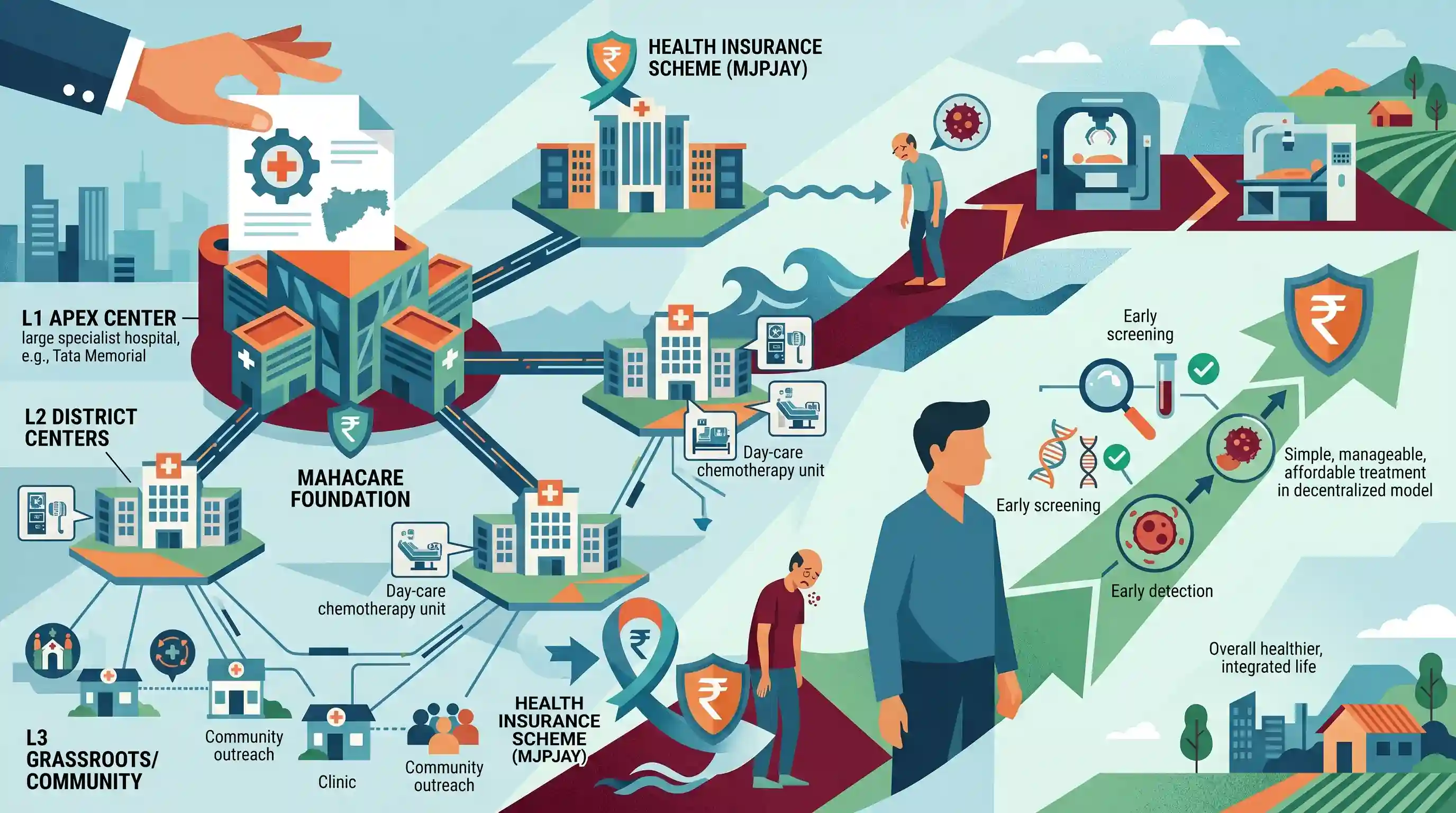
Maharashtra has implemented a new Cancer Care Policy aimed at combating the increasing prevalence of cancer through a decentralized, hub-and-spoke healthcare model. By strengthening district-level infrastructure and integrating services with the state's health insurance scheme (MJPJAY), the policy seeks to make cancer care accessible and affordable. Crucially, it shifts the focus of public health from merely curative treatments to preventive screening and early detection at the grassroots level.
Key Points
- Maharashtra has introduced a comprehensive Cancer Care Policy to address the rising burden of Non-Communicable Diseases (NCDs) and improve survival rates through early detection.
- The policy adopts a 'hub-and-spoke' model to decentralize cancer treatment, shifting the load from major urban tertiary centers to district and regional hospitals.
- It emphasizes a transition from purely curative care to preventive and promotive care by bolstering grassroots screening for prevalent cancers (oral, breast, and cervical).
- Integration with state insurance schemes like MJPJAY ensures that expensive diagnostics and treatments become affordable, countering the adverse impacts of healthcare marketisation.
Important Terms
Mahatma Jyotirao Phule Jan Arogya Yojana (MJPJAY)

Maharashtra's flagship health insurance scheme providing cashless treatment (up to ₹1.5–5 lakh/year) for secondary and tertiary care. It was recently expanded to cover all families in the state.
UPSC context
GS-II: Social Justice/Healthcare; tests knowledge of state-led universal health coverage and insurance-based delivery models.
Maharashtra Cancer Care Policy
A 2024 framework creating a three-tier (L1, L2, L3) decentralized network to improve cancer screening, early detection, and affordable treatment across Maharashtra's districts.
UPSC context
GS-II: Governance/Interventions; relevant for questions on health-sector reforms and tackling region-specific disease burdens.
MAHACARE Foundation
A government-led entity established to coordinate cancer treatment, manage staffing/infrastructure for 18 hospitals, and raise funds through clinical trials and CSR for cancer care.
UPSC context
GS-II: Institutional frameworks; example of a specialized body managing public health infrastructure and financing.
Hub-and-Spoke Model
A hierarchical healthcare structure where a central "hub" (specialized hospital) provides advanced care, while "spokes" (district/local centers) handle routine screening, diagnostics, and triage.
UPSC context
GS-II/III: Healthcare Infrastructure; a key strategy for efficient resource distribution and scaling specialized services.
Non-Communicable Diseases (NCDs)
Chronic, non-infectious conditions like cancer, diabetes, and cardiovascular diseases. They account for over 60% of deaths in India and require long-term management.
UPSC context
GS-II: Issues relating to health; tests understanding of the shifting epidemiological burden from infectious to chronic diseases.
Prelims Trap
Communicable and maternal diseases still account for the absolute majority of mortality in India.
NCDs (cancer, cardiovascular diseases) now account for ~63-65% of all deaths in India, marking an epidemiological transition. Aspirants wrongly assume communicable diseases still dominate.
Static Concepts Connected
What is the epidemiological transition in India's public health landscape?
- The Shift: The disease burden has fundamentally shifted from infectious, maternal, and nutritional diseases to Non-Communicable Diseases (NCDs) like cancer and diabetes.
- Mortality Burden: NCDs are now responsible for approximately 65% of all deaths in India, a massive increase from 37.9% in 1990.
- Triple Burden: India currently faces a 'triple burden' of disease: unfinished communicable diseases, rising NCDs, and emerging infectious outbreaks.
How does the 'Hub-and-Spoke' model function in healthcare infrastructure?
- Decentralized Network: It connects advanced tertiary hospitals (the hubs) with peripheral district or primary health centers (the spokes) to decentralize care.
- Resource Optimization: Routine screening, early detection, and basic care occur at spokes, while complex procedures are escalated to hubs, preventing tertiary overcrowding.
- Application: This architecture is increasingly utilized in tele-medicine (eSanjeevani) and regional networks to improve rural access to specialized medicine.
Cross-Topic Patterns
Health Federalism + Insurance synergies
States frequently integrate regional health schemes (like Maharashtra's MJPJAY) with Ayushman Bharat to expand beneficiary pools, mitigate out-of-pocket expenditure, and counter aggressive healthcare marketisation.
NCD burden + Demographic Dividend limits
The rising prevalence of cancer and CVDs threatens India's demographic dividend by shifting household savings into catastrophic health expenditures, limiting workforce productivity and economic growth.

Expect a GS2 Mains question on utilizing the 'Hub-and-Spoke' model to decentralize specialized healthcare and tackle rural NCD burdens.
Linked PYQs · 3
Linked PYQs · 3
- 2024MainsGS2
In a crucial domain like the public healthcare system the Indian State should play a vital role to contain the adverse impact of marketisation of the system. Suggest some measures through which the State can enhance the reach of public healthcare at the grassroots level.
- 2023PrelimsGS1
Consider the following statements: Statement-I: India's public sector health care system largely focuses on curative care with limited preventive, promotive and rehabilitative care. Statement-II: Under India's decentralized approach to health care delivery, the States are primarily responsible for organizing health services. Which one of the following is correct in respect of the above statements?
- 2021MainsGS2
“Besides being a moral imperative of a Welfare State, primary health structure is a necessary precondition for sustainable development.” Analyze.
