CAG Performance Audit of MGNREGS Implementation Gaps in Maharashtra
Source:Indian Express ↗
Why It Matters
Demonstrates the practical challenges and governance deficits in India's flagship rural employment scheme, providing crucial case-study material for Mains answers on the efficacy of poverty alleviation programs and the vital role of the CAG in ensuring propriety in public expenditure.
Summary
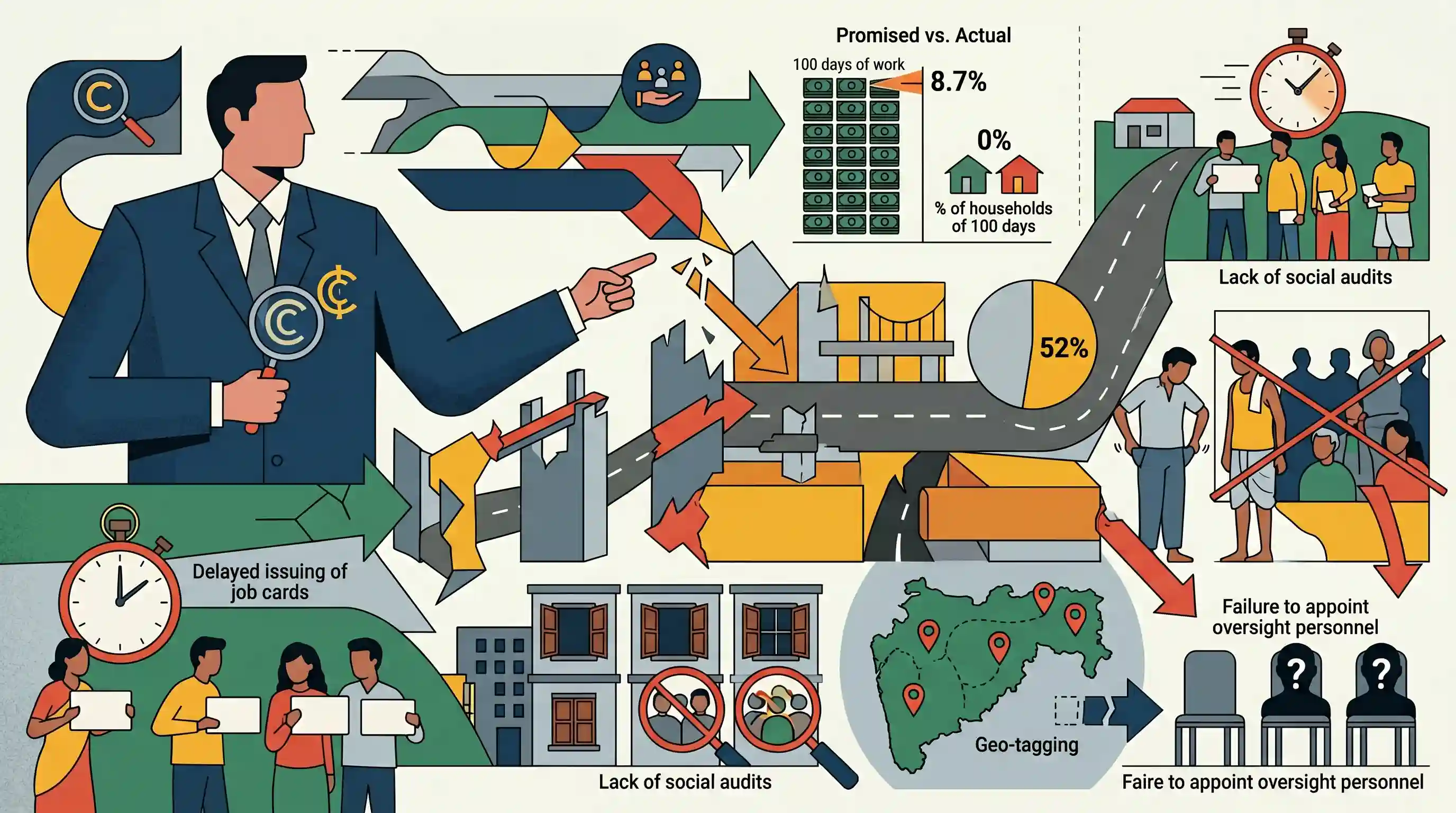
The Comptroller and Auditor General (CAG) of India has highlighted significant implementation gaps in the Mahatma Gandhi National Rural Employment Guarantee Scheme (MGNREGS) in Maharashtra between 2019-20 and 2023-24. The audit reveals that only 52% of undertaken works were completed, and critical provisions such as the payment of unemployment allowance and compensation for delayed wages were largely ignored. Furthermore, only 8.7% of households secured the promised 100 days of work. Systemic failures, including delayed job card issuance, lack of mandated social audits, absence of proper geo-tagging, and failure to appoint essential oversight personnel, underscore severe accountability and transparency deficits in the scheme's execution.
Key Points
- Merely 52% of the 38.8 lakh MGNREGS works were completed in Maharashtra over five years, with over 7.1 lakh projects yet to commence.
- Despite legal mandates to provide work within 15 days, unemployment allowances were largely ignored, with only Rs 2,268 paid against an outstanding Rs 34.85 lakh.
- A staggering Rs 35.32 crore in wages for unskilled workers remained unpaid as of March 2024, and compensation claims for delays were routinely rejected.
- Only 8.7% of rural households that availed work managed to complete the promised 100 days of wage employment per year.
- Severe accountability deficits were flagged, including inadequate Social Audits, non-appointment of State Quality Monitors, and lacking geo-tagging of assets.
Important Terms
Mahatma Gandhi National Rural Employment Guarantee Scheme (MGNREGS)

A flagship demand-driven program providing a legal guarantee of 100 days of unskilled manual work per rural household annually to enhance livelihood security.
UPSC context
GS Paper II: Welfare Schemes; tests understanding of rights-based social security and poverty alleviation frameworks.
Comptroller and Auditor General (CAG) of India
A constitutional authority under Article 148 responsible for auditing the accounts of the Union and States, acting as the 'Guardian of the Public Purse'.
UPSC context
GS Paper II: Constitutional Bodies; crucial for topics on accountability, transparency, and executive oversight.
Social Audit
A participatory monitoring process mandated by Section 17 of MGNREGA where the community verifies official records against ground realities to ensure transparency.
UPSC context
GS Paper II: Governance; tests knowledge of democratic decentralization and community-led accountability mechanisms.
Gram Panchayat
The lowest tier of the Panchayati Raj system, responsible for local planning, issuing job cards, and executing at least 50% of MGNREGS works.
UPSC context
GS Paper II: Panchayati Raj Institutions; highlights the role of local bodies in scheme implementation.
Unemployment Allowance
Statutory compensation mandated by MGNREGA, payable to job seekers if work is not provided within 15 days of their demand.
UPSC context
GS Paper II: Social Justice; emphasizes the legal entitlements and penalty provisions for state failure in service delivery.
Geo-tagging
The process of assigning geographical coordinates to assets created under schemes to ensure real-time monitoring, prevent duplication, and improve transparency.
UPSC context
GS Paper III: E-governance; tests understanding of how technology aids in monitoring public expenditure and asset creation.
Prelims Trap
"Unemployment allowance under MGNREGA is paid entirely by the Central Government."
While the Centre funds 100% of unskilled wages, Section 7 of MGNREGA places the statutory burden to pay unemployment allowances squarely on the State Government.
Static Concepts Connected
What are the statutory provisions for Social Audit under MGNREGA?
- Statutory Mandate: Section 17 of the Act legally mandates the Gram Sabha to conduct regular social audits of all executed works.
- Independent Facilitation: State governments are required to establish independent Social Audit Units (SAUs) to facilitate the Gram Sabha in conducting these audits.
- Verification Scope: It acts as a tool for public vigilance by verifying official muster rolls and financial records against physical ground realities.
How does a CAG Performance Audit differ from a Financial Audit?
- Financial Audit: Focuses on the accuracy, completeness, and legal compliance of government accounts and financial statements.
- Performance Audit: Evaluates whether welfare programs (like MGNREGS) achieve their intended socio-economic objectives with economy, efficiency, and effectiveness.
Cross-Topic Patterns
Geo-MGNREGA and spatial asset tracking
The CAG's finding on missing geo-tagging connects to 'Geo-MGNREGA', a joint initiative with ISRO's Bhuvan portal to map rural assets using space technology and prevent phantom asset creation.
PRIs and decentralized planning gaps
Gram Panchayats are the principal implementing agencies for MGNREGS. Unstarted works and missing social audits directly reflect systemic capacity deficits in grassroots Panchayati Raj Institutions (73rd Amendment).

Expect a multi-statement Prelims question on MGNREGA statutory rights, specifically testing who funds wages vs unemployment allowances.
Linked PYQs · 3
Linked PYQs · 3
- 2018MainsGS2
“The Comptroller and Auditor General (CAG) has a very vital role to play.” Explain how this is reflected in the method and terms of his appointment as well as the range of powers he can exercise.
- 2024MainsGS2
“The duty of the Comptroller and Auditor General is not merely to ensure the legality of expenditure but also its propriety.” Comment.
- 2017MainsGS2
Poverty alleviation programmes in India remain mere showpieces until and unless they are backed up by political will." Discuss with reference to the performance of the major poverty alleviation programmes in India.
