Maharashtra Approves Global Capability Center Policy for Jobs
Source:Indian Express ↗
Why It Matters
Provides a practical example for Mains answers regarding how states are structuring industrial policies to attract high-value foreign investments (FDI in tech/services) and tackle urban congestion by promoting Tier 2 and Tier 3 city development.
Summary
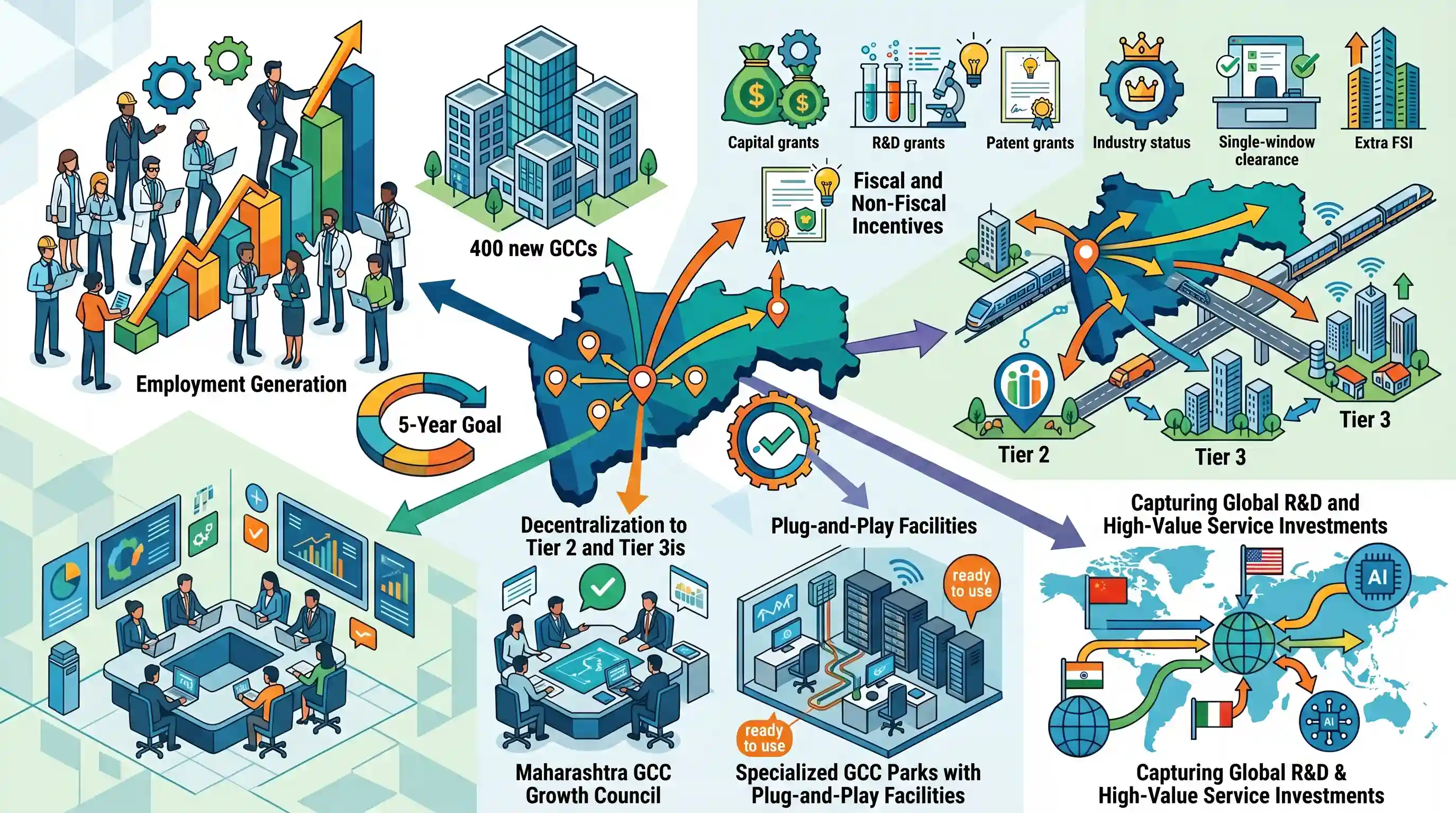
The Maharashtra government has approved a dedicated Global Capability Center (GCC) policy with the ambitious goal of generating 4 lakh high-skilled jobs and establishing 400 new GCCs over the next five years. By offering a mix of fiscal subsidies (capital, R&D, and patent grants) and non-fiscal benefits (industry status, single-window clearance, and extra FSI), the policy seeks to decentralize IT and tech-driven growth away from traditional hubs towards Tier 2 and Tier 3 cities. Additionally, the formation of the Maharashtra GCC Growth Council and the development of specialized GCC parks with plug-and-play facilities highlight the state's strategic intent to capture a larger share of global R&D and high-value service investments.
Key Points
- Maharashtra Cabinet approved a new Global Capability Center (GCC) policy aiming to create 4 lakh high-skilled jobs and establish 400 new GCCs.
- The policy shifts focus towards Tier 2 and Tier 3 cities like Nashik, Nagpur, and Chhatrapati Sambhajinagar for balanced regional growth.
- It will remain valid for five years (FY 2029-30) and establishes a Maharashtra GCC Growth Council to advise on implementation.
- Dedicated GCC parks with walk-to-work designs, plug-and-play infrastructure, and cluster development models are proposed.
- Fiscal incentives include a one-time capital subsidy of Rs 10 to 50 crore based on investment scale, along with reimbursement for patent filing, green certification, and R&D grants.
- Non-fiscal incentives provide industry status, additional floor space index (FSI), and single-window clearance mechanisms.
Important Terms
Global Capability Center (GCC)

Captive centers established by MNCs to handle specialized, high-value functions like R&D, IT, and finance, evolving from cost-saving back-offices into strategic innovation hubs.
UPSC context
GS-3 (Economy); vital for service exports, FDI, and India’s transition to a knowledge economy.
Maharashtra GCC Policy 2025
A five-year state framework aiming to attract 400 new GCCs and create 4 lakh jobs by 2030 through fiscal subsidies and infrastructure support.
UPSC context
GS-2 (Govt Policies); tests state-level initiatives for industrial and technological growth.
Maharashtra GCC Growth Council
A specialized advisory body and think-tank established to monitor policy implementation, drive international outreach, and align workforce skills with global industry requirements.
UPSC context
GS-2 (Governance); represents institutional mechanisms for public-private collaboration and policy responsiveness.
Industry Status
Regulatory recognition granting GCCs access to manufacturing benefits, including industrial power tariffs, 24x7 operations, and flexible employment norms to enhance competitiveness.
UPSC context
GS-3 (Industrial Policy); critical for understanding Ease of Doing Business (EoDB) and sector-neutral incentives.
Tier 2 and Tier 3 Cities
Smaller urban centers targeted for expansion to reduce metro congestion and promote inclusive regional growth by utilizing untapped local talent pools.
UPSC context
GS-1 (Urbanization) and GS-3 (Regional Development); tests strategies for balanced economic expansion.
Single-Window Clearance (MAITRI)
A unified digital platform (MAITRI) that provides all necessary regulatory approvals and permits in one place to simplify the investment process.
UPSC context
GS-3 (Economy); essential for 'Ease of Doing Business' and reducing administrative hurdles for investors.
Prelims Trap
"Global Capability Centers are external third-party service providers handling low-value outsourced backend operations."
GCCs are NOT third-party BPOs. They are captive, fully-owned offshore units of MNCs executing core, high-value strategic functions like R&D and analytics.
Static Concepts Connected
What are Global Capability Centers (GCCs) and how do they differ from BPOs?
- Captive ownership: GCCs are fully-owned offshore subsidiaries of MNCs, unlike BPOs which are external, third-party service providers.
- Value chain shift: They focus on strategic operations like core R&D, analytics, and engineering, moving beyond low-cost labor arbitrage.
- Nature of FDI: GCCs primarily attract greenfield FDI, bringing long-term capital, high-skilled job creation, and deep technology transfer to the host economy.
How does industrial decentralization address urban challenges?
- Counter-magnet development: Promoting industrial hubs in Tier-2/3 cities limits excessive rural-to-metro migration, easing severe pressure on housing, water, and transit in saturated Tier-1 cities.
- Agglomeration economies: Cluster-based models like dedicated 'GCC Parks' provide shared 'plug-and-play' infrastructure, replicating metro-level operational efficiencies in smaller urban centers.
Cross-Topic Patterns
GCCs + High-Skill Demographic Dividend
Transitioning from basic BPOs to strategic GCCs is crucial for absorbing India's massive pool of engineering graduates into high-income, formal sector roles, maximizing the demographic dividend.
Sub-national FDI + Competitive Federalism
States like Maharashtra offering tailored fiscal subsidies and 'industry status' highlights competitive federalism in attracting high-value foreign direct investment (FDI) away from traditional tech hubs like Bengaluru.
Spatial decentralization + Urban decay
Pushing IT growth to Tier 2/3 cities aligns with GS-1 urban planning goals to mitigate congestion, urban flooding, and infrastructure collapse in saturated metros.

Expect a Mains GS-3 question on how the GCC boom shifts India's service sector from low-cost BPOs to global innovation & R&D hubs.
Linked PYQs · 4
Linked PYQs · 4
- 2022MainsGS1
How is the growth of Tier 2 cities related to the rise of a new middle class with an emphasis on the culture of consumption ?
- 2017MainsGS1
"The growth of cities as I.T. hubs has opened up new avenues of employment, but has also created new problems." Substantiate this statement with examples.
- 2023MainsGS3
Faster economic growth requires increased share of the manufacturing sector in GDP, particularly of MSMEs. Comment on the present policies of the Government in this regard.
- 2016MainsGS3
Justify the need for FDI for the development of the Indian economy. Why there is gap between MOUs signed and actual FDIs? Suggest remedial steps to be taken for increasing actual FDIs in India.
