Maharashtra Renewable Energy Policy Land Concessions And Rules
Source:theprint ↗
Why It Matters
It reflects the Maharashtra government's integrated approach to addressing governance bottlenecks, stimulating renewable energy investments through fiscal incentives, and modernizing agriculture administration via digital infrastructure like AgriStack. The linkage of land compensation interest to the RBI lending rate is a critical policy shift for agrarian land acquisition.
Summary
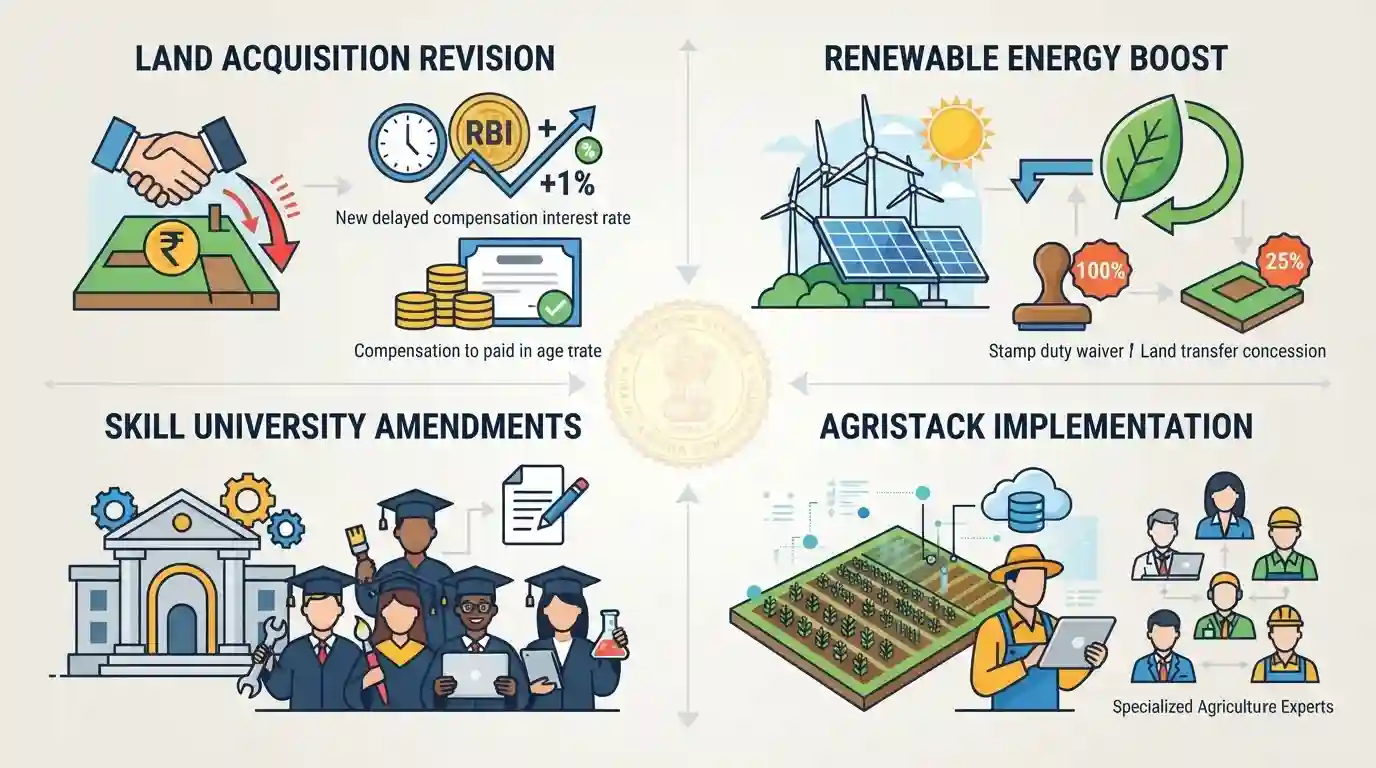
The Maharashtra Cabinet has approved a series of policy decisions including a revision to the land acquisition compensation rules, where the interest rate on delayed payments will now be 1% above the RBI commercial lending rate. In a major boost to green energy, a 100% stamp duty waiver and 25% concession on land transfer fees were introduced for renewable energy projects. The Cabinet also cleared amendments to the Maharashtra Private Skill Universities Act, 2024, and created specialized posts for implementing the AgriStack project.
Key Points
- Interest on delayed compensation under the 2013 Land Acquisition Act will now be pegged at 1% higher than the RBI's commercial lending rate.
- The state announced a complete stamp duty waiver for internal land transfers among group companies/SPVs for renewable energy projects.
- A 25% concession in land transfer fees has been approved for purchasing private or MIDC land for renewable energy projects.
- The Cabinet approved the creation of specialized posts in the agriculture department to support the AgriStack project.
- Amendments were approved for the Maharashtra Private Skill Universities Act, 2024, and senior colleges were allowed to establish social work as an independent faculty.
Important Terms
Right to Fair Compensation and Transparency in Land Acquisition, Rehabilitation and Resettlement Act, 2013

A 2013 national law regulating land acquisition to ensure fair compensation, consent, and rehabilitation for affected landowners. Maharashtra recently amended its rules under Section 72 to rationalize interest rates on delayed compensation.
UPSC context
GS Paper 2 (Governance) & GS Paper 3 (Land Reforms). Tests statutory frameworks balancing infrastructure and land rights.
AgriStack
A farmer-centric Digital Public Infrastructure (DPI) developed by the Indian government. It provides a unique digital identity linked to digitized land records and crop data, enabling seamless access to agricultural credit and welfare schemes.
UPSC context
GS Paper 3 (Agriculture/E-technology). Tests knowledge of digital public infrastructure and tech-driven interventions for farmer welfare.
Maharashtra Renewable Energy and Energy Storage Policy
An upcoming state framework (2025-36) accelerating green energy investments. It offers strategic financial incentives, including a 100% stamp duty waiver and 25% land transfer fee concessions for Special Purpose Vehicles executing renewable energy projects.
UPSC context
GS Paper 3 (Infrastructure/Energy). Evaluates state-level policy measures designed to meet India's renewable energy and net-zero climate goals.
Maharashtra Private Skill Universities Act, 2024
A state legislative framework regulating self-financed private skill universities. It ensures institutions maintain uniform academic standards while focusing on practical training, apprenticeships, and sector-specific courses to address demand for industry-relevant skills.
UPSC context
GS Paper 2 (Education). Relevant for analyzing state regulatory mechanisms addressing India's skill development and youth employability challenges.
Commercial Lending Rate (RBI)
The prevailing benchmark interest rate, influenced by the Reserve Bank of India, at which commercial banks lend to customers. Maharashtra will now pay 1% above this rate for delayed disbursements of land acquisition compensation.
UPSC context
GS Paper 3 (Economy). Connects monetary policy transmission mechanisms with real-world statutory governance and financial compensation frameworks.
Prelims Trap
The Union Government has exclusive jurisdiction to determine stamp duty rates for all commercial transactions and land transfers.
Rates of stamp duty for land transfers fall under the State List. The Union List only covers specific financial instruments like bills of exchange.
Static Concepts Connected
What are the core components of the AgriStack architecture?
- Unique Farmer ID: An Aadhaar-linked digital identity provided to farmers to seamlessly target subsidies, insurance, and credit.
- Federated Architecture: Acts as a Digital Public Infrastructure (DPI) integrating state land records, crop data, and registries.
How does the LARR Act 2013 determine land compensation?
- Rural Multiplier: Mandates compensation up to 4 times the market value for land acquired in rural areas.
- Urban Multiplier: Mandates compensation up to 2 times the market value for land acquired in urban areas.
- Consent Requirement: Requires prior consent of 80% of affected families for private projects and 70% for PPPs.
Cross-Topic Patterns
AgriStack + Digital Public Infrastructure
The expansion of DPI from finance (UPI) to agriculture (AgriStack) highlights the systemic formalization of the rural economy, directly linking GS-3 agriculture with GS-3 technology.
Competitive Federalism + Climate Action
States using stamp duty waivers and land concessions to attract renewable energy SPVs demonstrates sub-national competitive federalism driving India's Net Zero transition.

AgriStack's DPI architecture and state-level land record integration will likely form a multi-statement Prelims question in 2026.
Linked PYQs · 2
Linked PYQs · 2
- 2010MPSC_PRELIMSGS1
How does the Reserve Bank of India control the credit money ?
- 2024MPSC_PRELIMSGS1
Match the following pairs : | List-I | List-II | |---|---| | (a) Dr. Nitin Karmalkar Committee | (i) For implementation of National Education Policy - 2020 in Maharashtra | | (b) Nitin Karir Committee | (ii) To enquire the incident which happened during the distribution of Maharashtra Bhushan Award | | (c) Sunil Pawar Committee | (iii) To study why the rates of onion collapse. | | (d) Dr. K. Kasturirangan Committee | (iv) To make the syllabus for pre-primary to degree according to National Education Policy - 2020 | Code: (a) (b) (c) (d)
