Maharashtra Agriculture Department Restructuring And Post Sanctions
Source:freepressjournal ↗
Why It Matters
For MPSC candidates, understanding structural reforms within key state departments like Agriculture is crucial. This development highlights the state's strategic shift towards digital governance (AgriStack) and climate-adaptive farming, which are recurrent themes in GS3 (Agriculture and Economy) and GS2 (Governance).
Summary
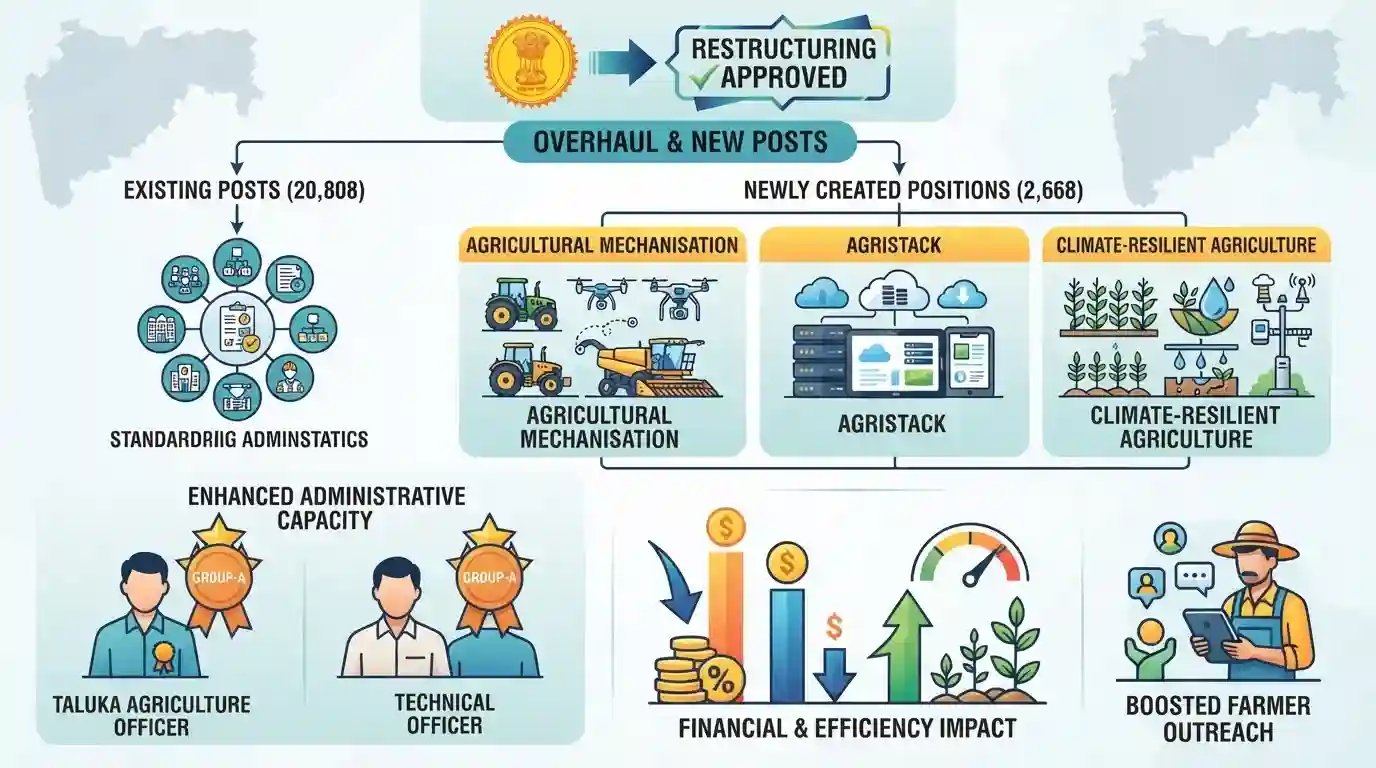
The Maharashtra Cabinet has approved a major restructuring of the state's Agriculture Department for the first time in 17 years. The overhaul includes the sanctioning of 23,476 regular posts, out of which 2,668 are newly created positions. A key feature of the restructuring is the establishment of new, specialized directorates focusing on Agricultural Mechanisation, AgriStack, and Climate-Resilient Agriculture to align the department with modern farming needs, digital integration, and climate adaptation. Additionally, Taluka Agriculture Officers and specific technical officers have been elevated to Group-A status, significantly enhancing their administrative capacity. The reorganization is projected to save the state exchequer ₹92.60 crore annually while boosting the efficiency of agricultural services and farmer outreach.
Key Points
- The Maharashtra Cabinet approved a revised structure for the Agriculture Department after 17 years, sanctioning 23,476 regular posts.
- Three new specialized directorates will be established: Agricultural Mechanisation, AgriStack, and Climate-Resilient Agriculture.
- The restructuring aims to modernize farming practices, integrate digital technology into agriculture, and address climate change challenges.
- Taluka Agriculture Officers and technical officers have been upgraded to Group-A status with an S-19 pay scale.
- The administrative revamp is expected to save the state government ₹92.60 crore annually while improving service delivery to farmers.
Important Terms
AgriStack

India's digital public infrastructure for agriculture that creates unique Farmer IDs, linking digitized land records and crop data to streamline credit, subsidies, and advisory services.
UPSC context
Essential for GS Paper 3 (E-technology for farmers), testing knowledge of e-governance and data-driven agricultural administration.
Climate-Resilient Agriculture
An integrated farming approach combining stress-tolerant seeds, precision water management, and sustainable practices to absorb and recover from climate-induced shocks while sustaining crop productivity.
UPSC context
Crucial for GS Paper 3 (Agriculture/Environment), focusing on food security, climate adaptation, and sustainable farming methods.
Agricultural Mechanisation
The integration of modern machinery and engineering technologies into farming operations to optimize inputs, reduce manual labor dependency, and significantly enhance overall agricultural productivity.
UPSC context
Relevant to GS Paper 3 (Agriculture), addressing farm efficiency, technological interventions, and strategies to modernize Indian agriculture.
Agriculture Department (Maharashtra)
The state's nodal agency for agricultural governance, recently overhauled to establish specialized directorates for mechanization, digital integration (AgriStack), and climate adaptation, boosting administrative capacity.
UPSC context
Highlights GS Paper 2 (State Governance) and GS Paper 3, illustrating institutional structural reforms for modern farming needs.
Prelims Trap
"AgriStack is an exclusive state-level digital ecosystem designed and launched by the Government of Maharashtra."
AgriStack is a Central government framework (Digital Public Infrastructure for agriculture), not a state invention. Maharashtra is merely creating a dedicated administrative directorate to implement it.
Static Concepts Connected
What constitutes the 'AgriStack' digital ecosystem for agriculture?
- DPI Foundation: It is a federated Digital Public Infrastructure (DPI) architecture designed to provide end-to-end digital services to farmers.
- Core Registries: It is built on three foundational pillars: Farmers' Database, Geo-referenced village maps, and crop sown registries.
- Unified Farmer ID: It aims to provide a unique digital ID for every farmer, linking land records, financial services, and government subsidies seamlessly.
What are the core strategies of Climate-Resilient Agriculture (CRA)?
- Stress-Tolerant Varieties: Promoting drought, flood, and heat-resistant crop seed varieties to secure yields against extreme weather fluctuations.
- Resource Conservation: Implementing zero-tillage, mulching, and micro-irrigation to preserve soil moisture, improve soil carbon, and enhance water-use efficiency.
- Risk Mitigation: Integrating weather-based crop insurance (like PMFBY) to financially protect farmers against unavoidable climate shocks.
Cross-Topic Patterns
DPI + Agrarian Land Fragmentation
Digital Public Infrastructure like AgriStack allows precise targeting of credit and subsidies, helping states bypass the physical and economic hurdles caused by continuous agricultural land fragmentation.
Institutionalizing Climate Adaptation
Upgrading climate-resilient agriculture from temporary schemes to permanent state directorates reflects a governance shift, recognizing climate change as a structural, long-term agrarian reality rather than a passing crisis.

Expect a 2026 GS3 question on how adopting AgriStack (DPI) and dedicated climate-resilient frameworks resolve structural farm bottlenecks.
Linked PYQs · 3
Linked PYQs · 3
- 2020MPSC_PRELIMSGS1
What happened in Maharashtra due to fragmentation of agricultural land ? (a) Farmer is not able to produce food grains, sufficient for his family. (b) There are obstacle to supply water to agricultural land. (c) The use of modern agricultural tools is uneconomical. (d) To pay individual attention on agriculture is uneconomical. Answer Options :
- 2024MPSC_PRELIMSGS1
Identify the correct statements regarding the Chief Minister Solar Agricultural Channel Scheme. (a) This Scheme was started in June 2017, when Devendra Fadanvis was Chief Minister. (b) The main purpose of this Scheme is to provide supply of electricity to farmers through the agricultural feeder. (c) The government has decided to pay ₹ 50,000 per acre as rent to the farmers under this Scheme. (d) Solar panels are set up on government land up to ten kilometres from the 33 kV substation.
- 2024MPSC_PRELIMSGS1
Consider the following statements regarding global warming : (a) Anaerobic Methane is emitted with rice cultivation. (b) When nitrogen - based fertilizers are used, nitrous oxide is released into the soil. Which of the above statement/statements is/are correct ?
